The word “queen” carries deep cultural meaning symbolizing leadership, royalty, power, and respect. Whether you’re learning a new language, traveling, or simply curious, understanding how to say queen in different languages can help you connect with cultures across the globe.
In this guide, you’ll discover 70 translations of “queen” in all languages, along with pronunciation tips and real-life example sentences. This makes it easy to learn, remember, and use these words naturally.
Queen in Different Languages
| Language | Pronunciation | Example |
| English | Kween | The queen rules wisely. (A female monarch governs wisely.) |
| Spanish | Reina (Ray-na) | La reina es amable. (The queen is kind.) |
| French | Reine (Ren) | La reine parle au peuple. (The queen speaks to the people.) |
| German | Königin (Kuh-ni-gin) | Die Königin lebt im Schloss. (The queen lives in the castle.) |
| Italian | Regina (Reh-jee-na) | La regina è potente. (The queen is powerful.) |
| Portuguese | Rainha (Hai-nya) | A rainha visita a cidade. (The queen visits the city.) |
| Dutch | Koningin (Ko-ning-in) | De koningin is geliefd. (The queen is loved.) |
| Russian | Koroleva (Ko-ro-lye-va) | Koroleva pravit stranoy. (The queen rules the country.) |
| Chinese (Mandarin) | Nǚwáng | Nǚwáng hěn cōngmíng. (The queen is intelligent.) |
| Japanese | Joō | Joō wa yasashii. (The queen is kind.) |
| Korean | Yeowang | Yeowang-eun gangryeokhada. (The queen is strong.) |
| Arabic | Malika | Al-malika adila. (The queen is just.) |
| Hindi | Rani | Rani sundar hai. (The queen is beautiful.) |
| Urdu | Malika | Malika hukumat karti hai. (The queen governs.) |
| Bengali | Rani | Rani rajjo kore. (The queen rules.) |
| Punjabi | Rani | Rani mazboot hai. (The queen is strong.) |
| Turkish | Kraliçe | Kraliçe sarayda yaşıyor. (The queen lives in the palace.) |
| Greek | Vasilissa | I vasilissa einai dynati. (The queen is powerful.) |
| Polish | Królowa | Królowa rządzi krajem. (The queen rules the country.) |
| Swedish | Drottning | Drottningen är snäll. (The queen is kind.) |
| Danish | Dronning | Dronningen besøger byen. (The queen visits the city.) |
| Norwegian | Dronning | Dronningen er respektert. (The queen is respected.) |
| Finnish | Kuningatar | Kuningatar puhuu kansalle. (The queen speaks to the people.) |
| Czech | Královna | Královna je silná. (The queen is strong.) |
| Slovak | Kráľovná | Kráľovná vládne. (The queen rules.) |
| Hungarian | Királynő | A királynő szép. (The queen is beautiful.) |
| Romanian | Regină | Regina conduce țara. (The queen leads the country.) |
| Bulgarian | Králitsa | Králitsata e dobra. (The queen is kind.) |
| Serbian | Kraljica | Kraljica vlada. (The queen rules.) |
| Croatian | Kraljica | Kraljica je moćna. (The queen is powerful.) |
| Ukrainian | Koroleva | Koroleva mudra. (The queen is wise.) |
| Thai | Rachini | Rachini suay. (The queen is beautiful.) |
| Vietnamese | Nữ hoàng | Nữ hoàng mạnh mẽ. (The queen is strong.) |
| Indonesian | Ratu | Ratu bijaksana. (The queen is wise.) |
| Malay | Ratu | Ratu dihormati. (The queen is respected.) |
| Filipino | Reyna | Ang reyna ay mabait. (The queen is kind.) |
| Swahili | Malkia | Malkia anaongoza. (The queen leads.) |
| Zulu | Indlovukazi | Indlovukazi inamandla. (The queen is powerful.) |
| Afrikaans | Koningin | Die koningin regeer. (The queen rules.) |
| Hebrew | Malkah | Ha-malkah tovah. (The queen is good.) |
| Persian | Malakeh | Malakeh zibast. (The queen is beautiful.) |
| Pashto | Malika | Malika qawi da. (The queen is strong.) |
| Nepali | Rani | Rani ramri cha. (The queen is beautiful.) |
| Sinhala | Rajini | Rajini shaktimath. (The queen is powerful.) |
| Tamil | Rani | Rani azhagu. (The queen is beautiful.) |
| Telugu | Rani | Rani balamaina. (The queen is strong.) |
| Kannada | Rani | Rani sundara. (The queen is beautiful.) |
| Marathi | Rani | Rani shaktishali aahe. (The queen is powerful.) |
| Gujarati | Rani | Rani sundar chhe. (The queen is beautiful.) |
| Khmer | Sdech srey | Sdech srey la-or. (The queen is beautiful.) |
| Lao | Nangsao | Nangsao suay. (The queen is beautiful.) |
| Burmese | Minma | Minma hla de. (The queen is beautiful.) |
| Mongolian | Khatan | Khatan khuchtei. (The queen is strong.) |
| Icelandic | Drottning | Drottningin er sterk. (The queen is strong.) |
| Irish | Banríon | Tá an bhanríon álainn. (The queen is beautiful.) |
| Welsh | Brenhines | Mae’r frenhines yn gryf. (The queen is strong.) |
| Scottish Gaelic | Banrigh | Tha a’ bhanrigh cumhachdach. (The queen is powerful.) |
| Estonian | Kuninganna | Kuninganna on tark. (The queen is wise.) |
| Latvian | Karaliene | Karaliene ir skaista. (The queen is beautiful.) |
| Lithuanian | Karalienė | Karalienė stipri. (The queen is strong.) |
| Albanian | Mbretëreshë | Mbretëresha sundon. (The queen rules.) |
| Macedonian | Kralica | Kralicata e silna. (The queen is strong.) |
| Georgian | Dedopali | Dedopali dzlieri. (The queen is strong.) |
| Armenian | Taguhi | Taguhin gexecik e. (The queen is beautiful.) |
| Azerbaijani | Kraliça | Kraliça güclüdür. (The queen is strong.) |
| Kazakh | Patsha ayel | Patsha ayel kúshti. (The queen is strong.) |
| Uzbek | Malika | Malika kuchli. (The queen is strong.) |
| Turkmen | Patysha ayal | Patysha ayal güýçli. (The queen is strong.) |
| Tajik | Malika | Malika qavi ast. (The queen is strong.) |
How to Say Queen in Different Languages
Learning how to say queen in different languages is useful for travelers, students, and language enthusiasts. Many languages derive their word for queen from ancient roots tied to royalty and leadership. For example, “Rani” is widely used across South Asia, while “Reina” and “Regina” share Latin origins.
Queen Translations Around the World
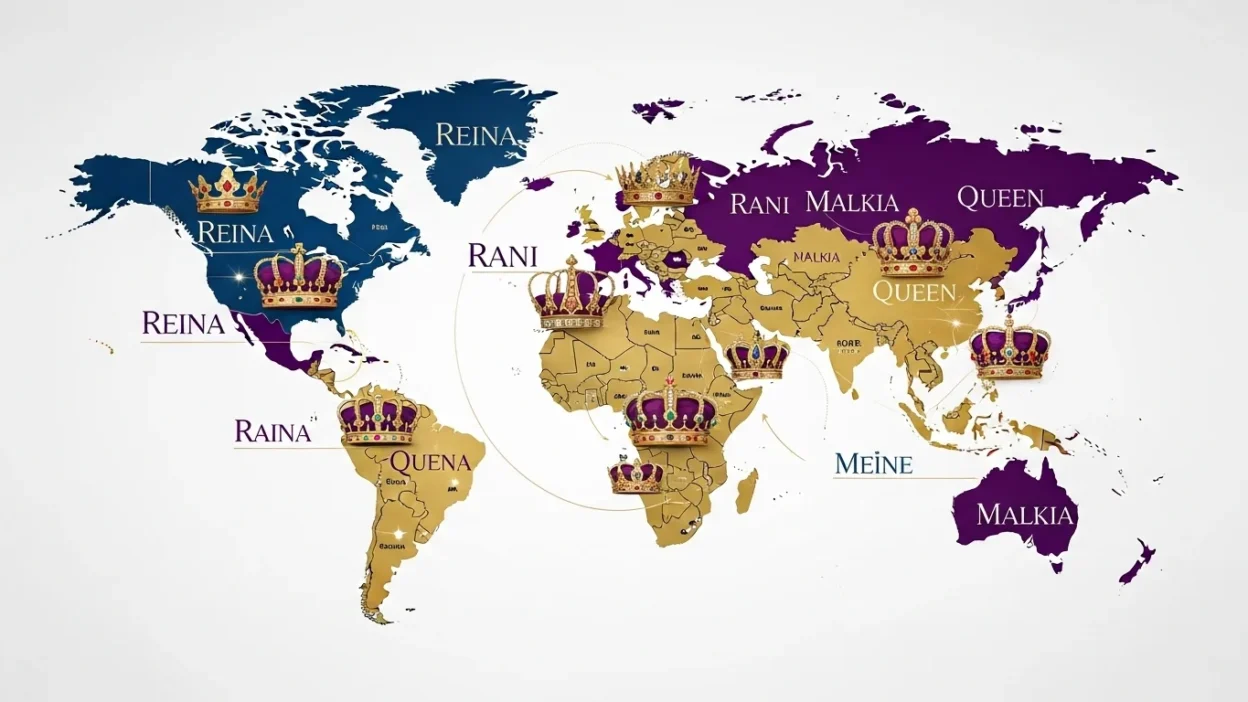
The term queen around the world reflects both linguistic diversity and cultural importance. In some cultures, the queen symbolizes power and governance, while in others, it may also represent elegance, beauty, or respect.
Across Europe, variations like Reine, Regina, and Königin are common. In Asia and Africa, simpler yet meaningful forms like Rani, Malkia, and Malika dominate.
Why Learn Queen in All Languages?
Understanding queen in all languages helps you:
- Improve vocabulary across multiple languages
- Connect better while traveling
- Appreciate global cultures
- Enhance translation and communication skills
It’s also useful for writers, students, and anyone interested in linguistics or world cultures.
Conclusion
The word queen holds universal significance, yet its expression varies beautifully across languages. From Reina in Spanish to Malkia in Swahili, these translations show how cultures interpret royalty and power. Learning these terms not only expands your vocabulary but also deepens your understanding of the world.
FAQs
1. What is queen in different languages?
It refers to how the word “queen” is translated across various global languages, such as Reina (Spanish), Rani (Hindi), and Reine (French).
2. How many languages have the word queen?
There are hundreds of languages worldwide, each with its own translation. This article covers 70 commonly used ones.
3. What is the most common word for queen globally?
“Rani” and “Malika” are among the most widely used due to their presence in multiple regions.
4. Why do many queen translations sound similar?
Many European languages share Latin roots, which is why words like Regina, Reina, and Reine are similar.
5. How can I easily remember queen translations?
Practice with example sentences and group similar languages together for faster learning.

Marak Robort is a content writer and researcher with a strong interest in language, meanings, and digital information. His work focuses on presenting clear, easy-to-understand explanations that help readers quickly grasp complex ideas.