Many English learners, students, and even native speakers get confused between “whos” and “whose”. These two words sound similar, but they are used in very different ways. This guide will explain the difference in the simplest way, with examples you can remember easily.
Why People Get Confused
The confusion usually happens because:
- “Whos” and “whose” sound similar when spoken.
- People often write “whos” thinking it is the same as “whose”.
- English has many words that sound alike but have different meanings.
Don’t worry! Once you understand the difference, it’s very easy to use them correctly.
Quick Answer
Here’s a simple way to remember:
- Whos – Not a real word in English. People sometimes type it by mistake instead of “who’s.”
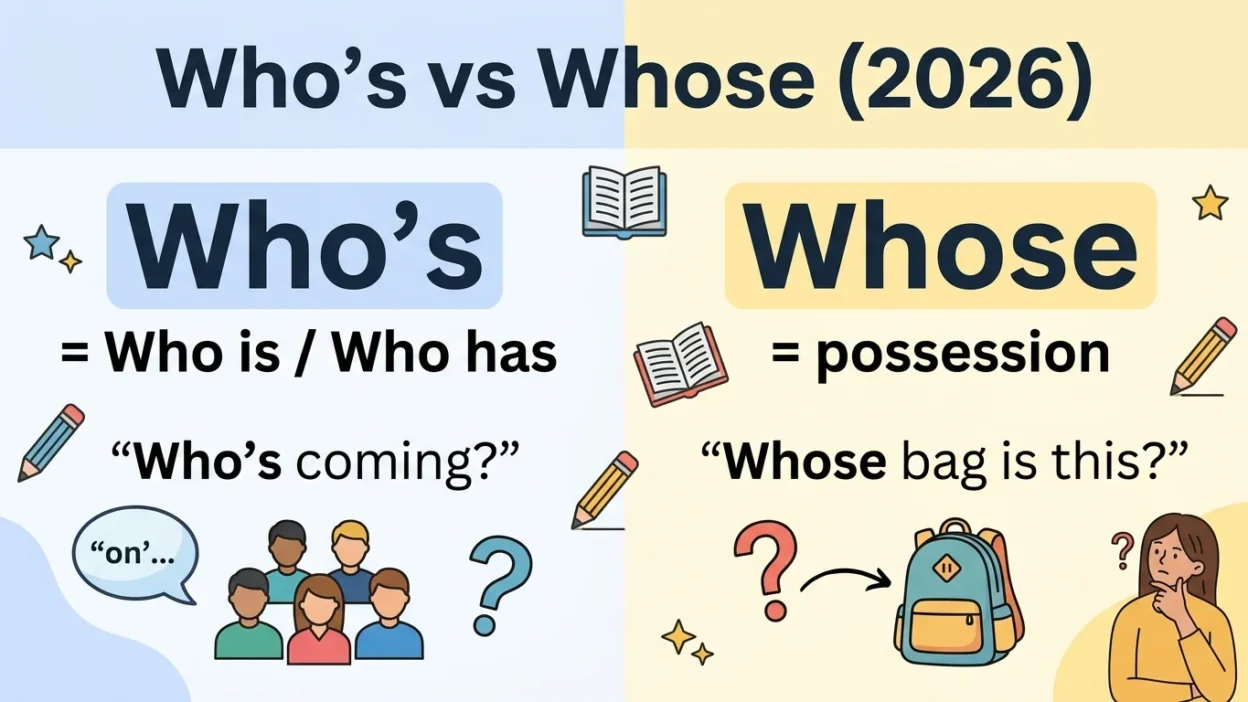
- Who’s – Short for “who is” or “who has.”
- Whose – Shows possession (something belongs to someone).
Examples:
- Who’s coming to the party? (Who is coming to the party?)
- Who’s finished their homework? (Who has finished their homework?)
- Whose bag is this? (To whom does this bag belong?)
The Origin or Background
Understanding the roots helps remember the difference:
- Who’s comes from English contractions. English speakers like to shorten “who is” and “who has” in everyday speech.
- Whose comes from Old English “hwæs”, which meant “of whom”. Over time, it became the standard way to show ownership.
Clear Explanation of the Difference
- Who’s = Who is / Who has
- Always a contraction.
- Use it when you mean someone is doing something or someone has done something.
- Whose = Belonging to someone
- Shows possession.
- Use it to ask who owns something or to describe ownership.
Comparison
| Word | Meaning | Use Example | Easy Tip |
| Who’s | Who is / Who has | Who’s at the door? (Who is at the door?) | Think: it’s a short form of “who is/has” |
| Whose | Belonging to someone | Whose keys are these? | Think: possession, something belongs to someone |
Which One to Use and When
- Use “who’s” when you can replace it with “who is” or “who has.”
- Use “whose” when asking or talking about ownership or possession.
Quick tip:
Try replacing the word in your sentence:
- If “who is” fits → use who’s
- If it doesn’t make sense → probably whose
Common Mistakes People Make
- Writing “whos” instead of “who’s.”
- ❌ Whos coming to the meeting?
- ✅ Who’s coming to the meeting?
- Confusing “who’s” and “whose.”
- ❌ Who’s book is this?
- ✅ Whose book is this?
- Forgetting apostrophes in contractions.
- Using “whose” when talking about actions.
- ❌ Whose going to help?
- ✅ Who’s going to help?
Everyday Real Life Examples
Emails:
- Who’s going to send the report today?
- Whose email is this?
News Headlines:
- Who’s winning the match tonight?
- Whose decision changed the game?
Social Media:
- Who’s excited for the concert?
- Whose dog is so cute?
Daily Life:
- Who’s at the door?
- Whose shoes are these?
Short Learning Section for Students and Beginners
- Remember: who’s = who is / who has
- Remember: whose = belongs to someone
- Check by replacement:
- Can I say “who is” instead? → who’s
- Can I say “belongs to whom”? → whose
Mini Quiz:
- ___ coming to class? → Who’s
- ___ notebook is this? → Whose
FAQ
1. Can “who’s” be used for possession?
- No. Use whose for possession.
2. Is “whos” correct?
- No. It’s a common mistake. Use who’s instead.
3. How do I know if I should use “whose”?
- Ask yourself: does it show ownership? If yes → whose.
4. Can “who’s” mean “who has”?
- Yes. For example: Who’s finished the homework? = Who has finished the homework?
5. Are these words common in spoken English?
- Very common. “Who’s” is everywhere in speech. “Whose” appears when asking about ownership.
6. Can I replace “whose” with “who is”?
- No. “Who is” does not show possession, so replacement won’t work.
7. Why do people type “whos”?
- It’s usually a typo or a misunderstanding of “who’s.”
8. How can I remember them easily?
- Think: apostrophe = contraction (who’s); no apostrophe = possession (whose)
Conclusion
The key difference is simple:
- Who’s = who is / who has → for actions
- Whose = belonging to someone → for ownership
By checking if you can replace the word with “who is”, you will always know whether to use who’s or whose. Avoid typing “whos”, and soon you’ll never confuse these words again.
With practice and a few simple rules, you’ll confidently use who’s and whose correctly every time.

Ely Joseph is a language researcher, writer, and contributor who specializes in words, meanings, and multilingual communication. With a strong interest in how language shapes understanding across cultures, Ely focuses on creating clear, accurate, and reader-friendly content for a global audience.