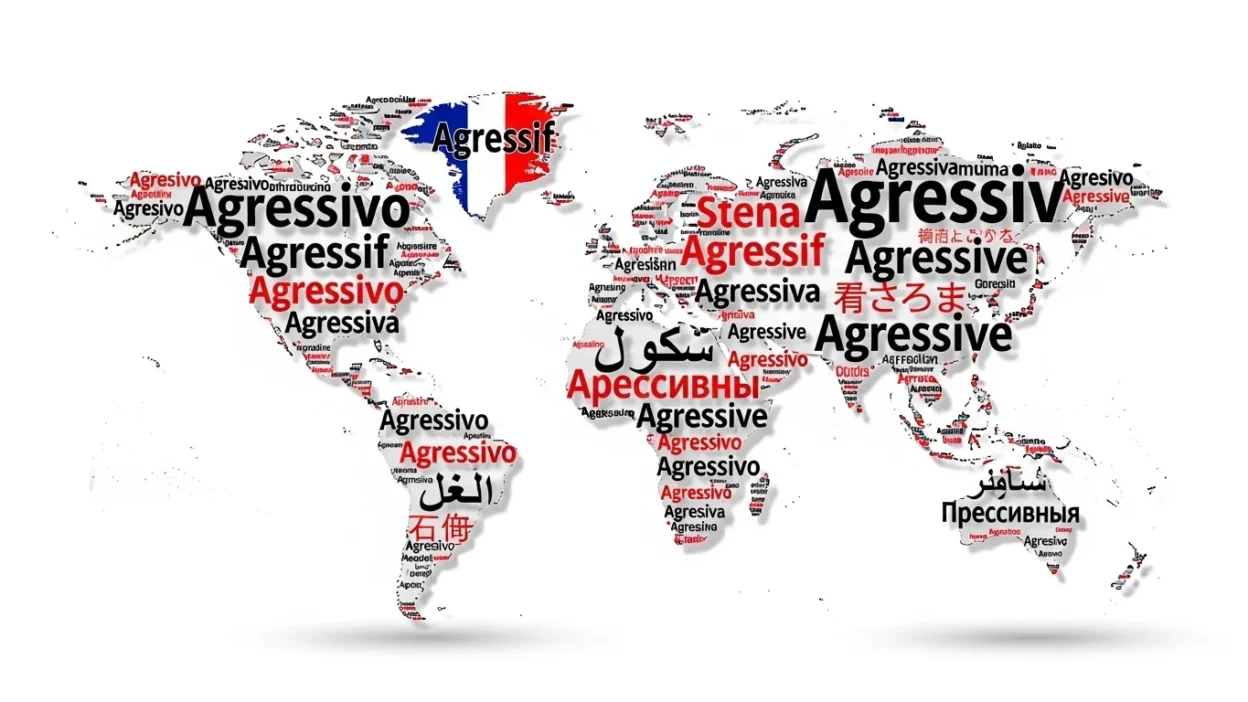
Understanding how to say “aggressive” in different languages is useful for communication, travel, language learning, and cultural awareness. This word often describes behavior, tone, or personality, and its meaning can slightly vary across cultures.
In this guide, you’ll discover aggressive translations around the world, along with pronunciation and simple real life examples. This helps you not only learn vocabulary but also understand how the word is naturally used in everyday conversations.
Aggressive in All Languages
| Language | Pronunciation | Example |
| English | uh-GREH-siv | He has an aggressive attitude. (He behaves in a forceful way.) |
| Spanish | a-gre-SEE-vo | Él es muy agresivo. (He is very aggressive.) |
| French | a-gre-seef | Il est agressif. (He is aggressive.) |
| German | ah-gre-SIV | Er ist aggressiv. (He is aggressive.) |
| Italian | ag-gres-SEE-vo | È aggressivo. (He is aggressive.) |
| Portuguese | a-gre-SEE-vo | Ele é agressivo. (He is aggressive.) |
| Dutch | a-ghre-SIEF | Hij is agressief. (He is aggressive.) |
| Russian | ah-gres-SEEV-ny | Он агрессивный. (He is aggressive.) |
| Arabic | a-djra-SEE-vi | هو عدواني. (He is aggressive.) |
| Turkish | ag-re-SIF | O agresif. (He is aggressive.) |
| Hindi | uh-greh-see-v | वह आक्रामक है। (He is aggressive.) |
| Urdu | uh-greh-see-v | وہ جارحانہ ہے۔ (He is aggressive.) |
| Bengali | a-greh-sheef | সে আক্রমণাত্মক। (He is aggressive.) |
| Punjabi | a-greh-siv | اوہ جارحانہ اے۔ (He is aggressive.) |
| Chinese (Mandarin) | gong-ji xing | 他很有攻击性。 (He is aggressive.) |
| Japanese | ko-ge-ki-teki | 彼は攻撃的です。 (He is aggressive.) |
| Korean | gong-gyeok-jeok | 그는 공격적이다. (He is aggressive.) |
| Thai | dtua-raai | เขาก้าวร้าว. (He is aggressive.) |
| Vietnamese | hung-hang | Anh ấy hung hăng. (He is aggressive.) |
| Indonesian | a-gre-sif | Dia agresif. (He is aggressive.) |
| Malay | a-gre-sif | Dia agresif. (He is aggressive.) |
| Filipino | a-gre-si-bo | Siya ay agresibo. (He is aggressive.) |
| Swahili | a-gre-see-vu | Yeye ni mkali. (He is aggressive.) |
| Zulu | u-hla-sa | Unolaka. (He is aggressive.) |
| Afrikaans | a-gre-sif | Hy is aggressief. (He is aggressive.) |
| Greek | a-gre-si-VOS | Είναι επιθετικός. (He is aggressive.) |
| Polish | a-gre-SIV-ny | On jest agresywny. (He is aggressive.) |
| Czech | a-gre-siv-nee | On je agresivní. (He is aggressive.) |
| Slovak | a-gre-siv-nee | On je agresívny. (He is aggressive.) |
| Hungarian | ag-ress-ZEEV | Ő agresszív. (He is aggressive.) |
| Romanian | a-gre-SIV | El este agresiv. (He is aggressive.) |
| Bulgarian | a-gre-SEE-ven | Той е агресивен. (He is aggressive.) |
| Serbian | a-gre-see-van | On je agresivan. (He is aggressive.) |
| Croatian | a-gre-see-van | On je agresivan. (He is aggressive.) |
| Bosnian | a-gre-see-van | On je agresivan. (He is aggressive.) |
| Slovenian | a-gre-SEE-ven | On je agresiven. (He is aggressive.) |
| Finnish | ag-greh-SIIV-nen | Hän on aggressiivinen. (He is aggressive.) |
| Swedish | ag-gre-SIV | Han är aggressiv. (He is aggressive.) |
| Norwegian | ag-gre-SIV | Han er aggressiv. (He is aggressive.) |
| Danish | ag-gre-SIV | Han er aggressiv. (He is aggressive.) |
| Icelandic | ag-gre-SIV-ur | Hann er árásargjarn. (He is aggressive.) |
| Estonian | ag-gre-SIIV-ne | Ta on agressiivne. (He is aggressive.) |
| Latvian | ag-re-SEE-vs | Viņš ir agresīvs. (He is aggressive.) |
| Lithuanian | ag-re-SYV-us | Jis agresyvus. (He is aggressive.) |
| Ukrainian | ah-gre-SEEV-ny | Він агресивний. (He is aggressive.) |
| Hebrew | a-gre-see-vee | הוא תוקפני. (He is aggressive.) |
| Persian | ta-ha-jo-mee | او تهاجمی است. (He is aggressive.) |
| Pashto | ta-ha-ju-mee | هغه تهاجمي دی. (He is aggressive.) |
| Nepali | aa-kra-ma-k | ऊ आक्रामक छ। (He is aggressive.) |
| Sinhala | a-kra-ma-ka | ඔහු ආක්රමණශීලීයි. (He is aggressive.) |
| Tamil | aak-ra-ma-kam | அவன் தாக்குதலானவன். (He is aggressive.) |
| Telugu | aa-kra-ma-ka | అతను ఆగ్రహంగా ఉన్నాడు. (He is aggressive.) |
| Kannada | aa-kra-ma-ka | ಅವನು ಆಕ್ರಮಣಕಾರಿ. (He is aggressive.) |
| Marathi | aa-kra-ma-k | तो आक्रमक आहे. (He is aggressive.) |
| Gujarati | aa-kra-ma-k | તે આક્રમક છે. (He is aggressive.) |
| Khmer | bra-har | គាត់ឈ្លានពាន។ (He is aggressive.) |
| Lao | du-raai | ລາວດຸຮ້າຍ. (He is aggressive.) |
| Burmese | a-kya-ma | သူဟာတိုက်ခိုက်တတ်တယ်။ (He is aggressive.) |
| Mongolian | do-loon | Тэр түрэмгий. (He is aggressive.) |
| Georgian | ag-re-si-u-li | ის აგრესიულია. (He is aggressive.) |
| Armenian | a-gre-see-v | Նա ագրեսիվ է։ (He is aggressive.) |
| Albanian | a-gre-see-v | Ai është agresiv. (He is aggressive.) |
| Macedonian | a-gre-see-ven | Тој е агресивен. (He is aggressive.) |
| Maltese | ag-gres-siv | Huwa aggressiv. (He is aggressive.) |
| Irish | a-gre-siv | Tá sé ionsaitheach. (He is aggressive.) |
| Welsh | ag-re-siv | Mae e’n ymosodol. (He is aggressive.) |
| Haitian Creole | a-gre-seef | Li agresif. (He is aggressive.) |
How to Say Aggressive in Different Languages
The word “aggressive” is widely used across cultures, but its tone can differ. In some languages, it strictly means hostile behavior, while in others it may also describe assertiveness or competitiveness.
Learning these variations helps you:
- Communicate clearly in multicultural environments
- Avoid misunderstandings
- Improve vocabulary for travel or study
Aggressive Translations Around the World
Across regions, aggressive translations often share similar roots, especially in European languages. For example:
- “Agresivo” (Spanish, Portuguese)
- “Agressif” (French)
- “Aggressiv” (German, Scandinavian languages)
In Asian and Middle Eastern languages, the meaning often leans more toward “attack oriented” or “hostile” behavior, reflecting cultural nuance.
When and How to Use the Word Aggressive
Use this word carefully depending on context:
- Negative context: aggressive behavior, aggressive tone
- Neutral/positive context: aggressive marketing, aggressive strategy
In professional or social situations, tone matters. What sounds normal in one culture may seem rude in another.
Conclusion
Now you know how to say aggressive in all languages with real-life examples. This knowledge helps you communicate more effectively and understand cultural differences in expression.
Whether you’re learning a language or exploring global communication, these aggressive translations give you a strong foundation.
FAQs
1. What does aggressive mean in simple words?
Aggressive means behaving in a forceful, hostile, or overly assertive way.
2. How to say aggressive in different languages easily?
You can learn common translations like “agresivo,” “agressif,” or “aggressiv,” which are widely used across languages.
3. Is aggressive always negative?
Not always. It can be positive in contexts like business or sports, meaning determined or strong.
4. Why do aggressive translations differ across cultures?
Because cultures interpret behavior differently, some see it as strength while others see it as rudeness.
5. What is the best way to learn aggressive in all languages?
Practice with example sentences and pronunciation, like in the table above, to remember usage naturally.

Ely Joseph is a language researcher, writer, and contributor who specializes in words, meanings, and multilingual communication. With a strong interest in how language shapes understanding across cultures, Ely focuses on creating clear, accurate, and reader-friendly content for a global audience.