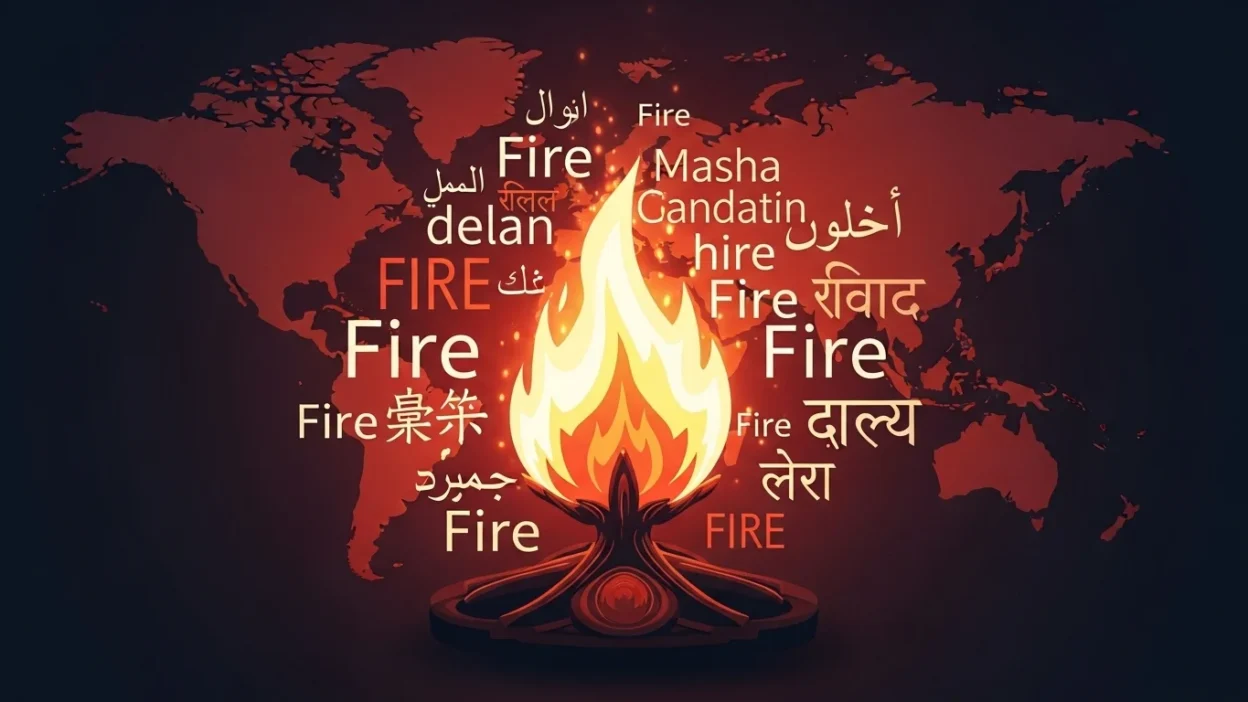
Fire is one of the most powerful and universal elements known to humans. Whether it symbolizes warmth, danger, passion, or transformation, the word “fire” exists in every language and culture. If you’re looking for fire in different languages, this guide will help you explore how to say it worldwide, along with real-life examples.
Fire in All Languages (70 Translations with Examples)
| Language | Pronunciation | Example |
| English | Fire | The fire is very hot. (English meaning: The fire is very hot.) |
| Spanish | Fuego | El fuego es peligroso. (English meaning: The fire is dangerous.) |
| French | Feu | Le feu brûle vite. (English meaning: The fire burns quickly.) |
| German | Feuer | Das Feuer ist groß. (English meaning: The fire is big.) |
| Italian | Fuoco | Il fuoco è caldo. (English meaning: The fire is hot.) |
| Portuguese | Fogo | O fogo está forte. (English meaning: The fire is strong.) |
| Dutch | Vuur | Het vuur brandt. (English meaning: The fire is burning.) |
| Russian | Ogon | Ogon yarkiy. (English meaning: The fire is bright.) |
| Chinese (Mandarin) | Huo | Huo hen da. (English meaning: The fire is big.) |
| Japanese | Hi | Hi ga atsui. (English meaning: The fire is hot.) |
| Korean | Bul | Bul-i keuda. (English meaning: The fire is big.) |
| Arabic | Naar | Al-naar harra. (English meaning: The fire is hot.) |
| Hindi | Aag | Aag tez hai. (English meaning: The fire is strong.) |
| Urdu | Aag | Aag jal rahi hai. (English meaning: The fire is burning.) |
| Bengali | Agun | Agun gorom. (English meaning: The fire is hot.) |
| Punjabi | Agg | Agg tej hai. (English meaning: The fire is strong.) |
| Turkish | Atesh | Atesh cok sicak. (English meaning: The fire is very hot.) |
| Greek | Fotia | I fotia kaiei. (English meaning: The fire burns.) |
| Polish | Ogień | Ogień jest gorący. (English meaning: The fire is hot.) |
| Swedish | Eld | Elden brinner. (English meaning: The fire is burning.) |
| Norwegian | Ild | Ilden er varm. (English meaning: The fire is warm.) |
| Danish | Ild | Ilden er stærk. (English meaning: The fire is strong.) |
| Finnish | Tuli | Tuli on kuuma. (English meaning: The fire is hot.) |
| Czech | Oheň | Oheň hoří. (English meaning: The fire is burning.) |
| Slovak | Ohen | Ohen je horuci. (English meaning: The fire is hot.) |
| Hungarian | Tuz | Tuz meleg. (English meaning: The fire is warm.) |
| Romanian | Foc | Focul arde. (English meaning: The fire burns.) |
| Bulgarian | Ogyn | Ogyn e silen. (English meaning: The fire is strong.) |
| Serbian | Vatra | Vatra gori. (English meaning: The fire is burning.) |
| Croatian | Vatra | Vatra je jaka. (English meaning: The fire is strong.) |
| Slovenian | Ogenj | Ogenj gori. (English meaning: The fire burns.) |
| Ukrainian | Vohon | Vohon palaye. (English meaning: The fire burns.) |
| Hebrew | Esh | Ha-esh chamah. (English meaning: The fire is hot.) |
| Persian | Atash | Atash garm ast. (English meaning: The fire is hot.) |
| Pashto | Or | Or garm de. (English meaning: The fire is hot.) |
| Swahili | Moto | Moto unaungua. (English meaning: The fire is burning.) |
| Zulu | Umlilo | Umlilo uyasha. (English meaning: The fire is burning.) |
| Afrikaans | Vuur | Die vuur brand. (English meaning: The fire is burning.) |
| Malay | Api | Api itu panas. (English meaning: The fire is hot.) |
| Indonesian | Api | Api menyala. (English meaning: The fire is burning.) |
| Thai | Fai | Fai ron. (English meaning: The fire is hot.) |
| Vietnamese | Lua | Lua nong. (English meaning: The fire is hot.) |
| Filipino | Apoy | Ang apoy ay mainit. (English meaning: The fire is hot.) |
| Tamil | Neruppu | Neruppu sudum. (English meaning: The fire burns.) |
| Telugu | Agni | Agni vediga undi. (English meaning: The fire is hot.) |
| Kannada | Benki | Benki bisi. (English meaning: The fire is hot.) |
| Malayalam | Thee | Thee choodu. (English meaning: The fire is hot.) |
| Marathi | Aag | Aag garam aahe. (English meaning: The fire is hot.) |
| Gujarati | Aag | Aag garam chhe. (English meaning: The fire is hot.) |
| Nepali | Aago | Aago tato cha. (English meaning: The fire is hot.) |
| Sinhala | Gini | Gini ushnai. (English meaning: The fire is hot.) |
| Burmese | Mee | Mee pyaw. (English meaning: The fire burns.) |
| Khmer | Phleung | Phleung kdao. (English meaning: The fire is hot.) |
| Lao | Fai | Fai hon. (English meaning: The fire is hot.) |
| Mongolian | Gal | Gal haluun. (English meaning: The fire is hot.) |
| Icelandic | Eldur | Eldur er heitur. (English meaning: The fire is hot.) |
| Irish | Tine | Ta an tine te. (English meaning: The fire is hot.) |
| Welsh | Tan | Mae’r tan yn boeth. (English meaning: The fire is hot.) |
| Scottish Gaelic | Teine | Tha an teine teth. (English meaning: The fire is hot.) |
| Estonian | Tuli | Tuli on kuum. (English meaning: The fire is hot.) |
| Latvian | Uguns | Uguns ir karsta. (English meaning: The fire is hot.) |
| Lithuanian | Ugnis | Ugnis karsta. (English meaning: The fire is hot.) |
| Albanian | Zjarr | Zjarri eshte i nxehte. (English meaning: The fire is hot.) |
| Macedonian | Ogan | Ogan e zheshok. (English meaning: The fire is hot.) |
| Armenian | Krag | Krag shat tak e. (English meaning: The fire is very hot.) |
| Georgian | Tsetskhli | Tsetskhli tsqhelia. (English meaning: The fire is hot.) |
| Basque | Sua | Sua beroa da. (English meaning: The fire is hot.) |
| Catalan | Foc | El foc crema. (English meaning: The fire burns.) |
| Galician | Lume | O lume arde. (English meaning: The fire burns.) |
| Maltese | Nar | In-nar hija sħuna. (English meaning: The fire is hot.) |
How to Say Fire in Different Languages
Learning how to say fire in different languages helps expand your vocabulary and cultural awareness. While the pronunciation and spelling vary widely, the concept remains universally understood.
In many languages, the word for fire is closely tied to ideas like heat, light, and energy. For example, in Latin-based languages like Spanish, Italian, and Portuguese, the words are quite similar (fuego, fuoco, fogo).
Fire Translations Around the World
When exploring fire translations around the world, you’ll notice patterns:
- European languages often share similar roots
- Asian languages have shorter, unique sounds
- African languages often use rhythmic pronunciation
These differences reflect the diversity of human language while highlighting a shared understanding of fire as a natural force.
Why Learn Fire in All Languages?
Understanding fire in all languages can be helpful for:
- Traveling and emergency communication
- Learning new languages faster
- Improving cultural knowledge
- Enhancing translation and writing skills
It’s also a fun and practical way to build a global vocabulary.
Conclusion
Fire is a universal element, and its name exists in every language across the globe. By learning these 70 translations, you gain insight into how different cultures express the same powerful concept. Whether for travel, education, or curiosity, knowing how to say fire in different languages is both useful and fascinating.
FAQs
1. What is fire in different languages?
Fire is translated differently across languages, such as “fuego” in Spanish, “feu” in French, and “aag” in Hindi.
2. How many languages have a word for fire?
Every known language has a term for fire, as it is a basic human concept.
3. Why are fire translations similar in some languages?
Many languages share historical roots, especially in Europe, leading to similar words.
4. How can I learn fire in all languages easily?
Using tables, repetition, and real life examples makes it easier to remember translations.
5. Is fire pronounced the same in all languages?
No, pronunciation varies widely depending on the language and region.

Marak Robort is a content writer and researcher with a strong interest in language, meanings, and digital information. His work focuses on presenting clear, easy-to-understand explanations that help readers quickly grasp complex ideas.