
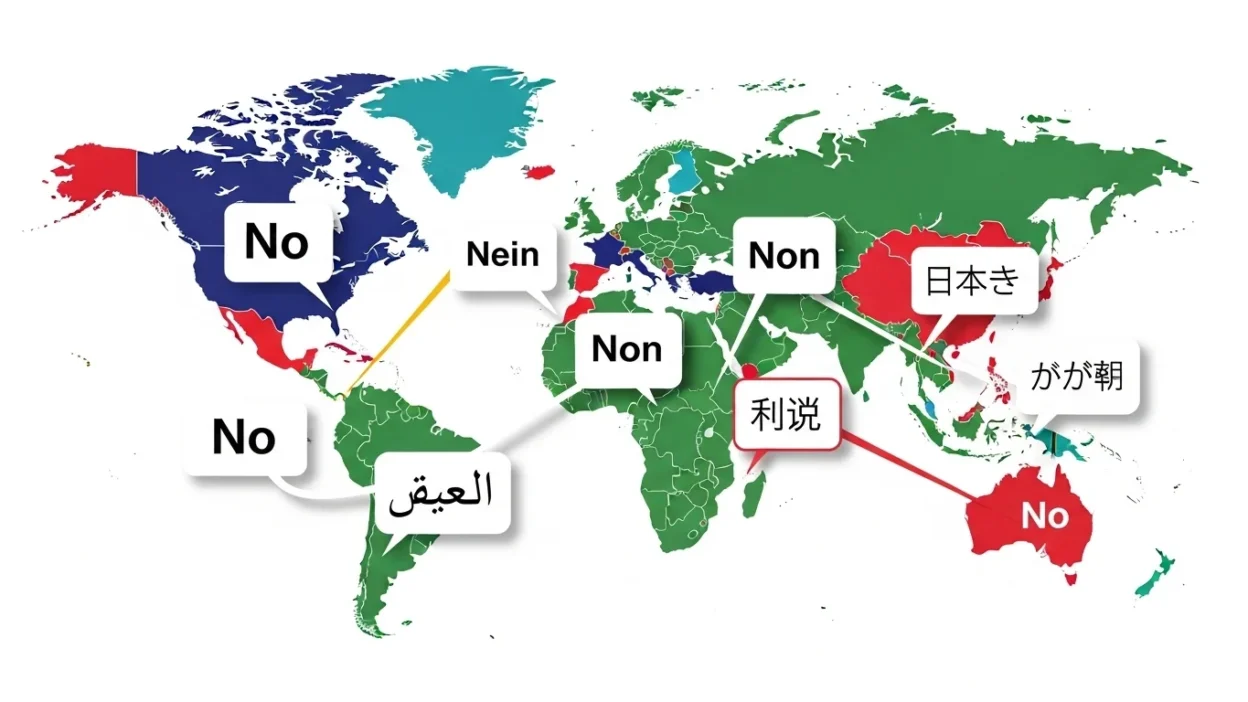
Saying “no” is one of the most essential parts of communication. Whether you’re traveling, learning a new language, or simply curious, knowing how to say “no” in different languages helps you set boundaries, respond clearly, and understand others better.
In this guide, you’ll explore “no” in all languages, with simple pronunciation and real life examples to make learning easy and practical.
How to Say “No” in Different Languages
| Language | Pronunciation | Example |
| English | noh | No, I can’t go today. (Meaning: I cannot go today.) |
| Spanish | noh | No quiero café. (Meaning: I don’t want coffee.) |
| French | nuh | Non, merci. (Meaning: No, thank you.) |
| German | nine | Nein, ich komme nicht. (Meaning: No, I am not coming.) |
| Italian | noh | No, grazie. (Meaning: No, thank you.) |
| Portuguese | naw | Não quero isso. (Meaning: I don’t want that.) |
| Dutch | nay | Nee, bedankt. (Meaning: No, thanks.) |
| Russian | nyet | Нет, не сейчас. (Meaning: No, not now.) |
| Chinese (Mandarin) | boo | 不要。 (Meaning: Don’t want.) |
| Japanese | ee-eh | いいえ、結構です。 (Meaning: No, I’m fine.) |
| Korean | ah-nee-yo | 아니요, 괜찮아요. (Meaning: No, it’s okay.) |
| Arabic | la | لا أريد. (Meaning: I don’t want.) |
| Hindi | na-hee | नहीं जाना। (Meaning: Not going.) |
| Urdu | na-heen | نہیں چاہیے۔ (Meaning: Don’t need.) |
| Turkish | ha-yer | Hayır, istemiyorum. (Meaning: No, I don’t want.) |
| Greek | okhi | Όχι, ευχαριστώ. (Meaning: No, thank you.) |
| Polish | nye | Nie chcę. (Meaning: I don’t want.) |
| Swedish | nay | Nej, tack. (Meaning: No, thanks.) |
| Norwegian | nay | Nei, takk. (Meaning: No, thanks.) |
| Danish | nye | Nej, tak. (Meaning: No, thanks.) |
| Finnish | eh-ee | Ei halua. (Meaning: Don’t want.) |
| Czech | neh | Ne, děkuji. (Meaning: No, thank you.) |
| Slovak | nye | Nie, ďakujem. (Meaning: No, thank you.) |
| Hungarian | nem | Nem kérem. (Meaning: I don’t want.) |
| Romanian | noo | Nu vreau. (Meaning: I don’t want.) |
| Bulgarian | neh | Не искам. (Meaning: I don’t want.) |
| Ukrainian | nyi | Ні, дякую. (Meaning: No, thank you.) |
| Hebrew | loh | לא רוצה. (Meaning: Don’t want.) |
| Thai | mai | ไม่เอา (Meaning: Don’t want.) |
| Vietnamese | khong | Không muốn. (Meaning: Don’t want.) |
| Indonesian | ti-dak | Tidak mau. (Meaning: Don’t want.) |
| Malay | ti-dak | Tidak mahu. (Meaning: Don’t want.) |
| Filipino | hin-dee | Hindi gusto. (Meaning: Don’t like.) |
| Swahili | ha-pa-na | Hapana, asante. (Meaning: No, thank you.) |
| Zulu | cha | Cha, angifuni. (Meaning: No, I don’t want.) |
| Afrikaans | nay | Nee, dankie. (Meaning: No, thank you.) |
| Persian | nah | نه نمیخواهم (Meaning: I don’t want.) |
| Bengali | na | না চাই। (Meaning: Don’t want.) |
| Tamil | illai | இல்லை வேண்டாம் (Meaning: No, don’t need.) |
| Telugu | ka-du | కాదు వద్దు (Meaning: No, don’t want.) |
| Kannada | illa | ಇಲ್ಲ ಬೇಡ (Meaning: No, don’t want.) |
| Malayalam | illa | ഇല്ല വേണ്ട (Meaning: No, don’t need.) |
| Marathi | na-hee | नाही पाहिजे (Meaning: Don’t want.) |
| Gujarati | na | ના જોઈએ (Meaning: Don’t want.) |
| Punjabi | na-hee | ਨਹੀਂ ਚਾਹੀਦਾ (Meaning: Don’t want.) |
| Nepali | ho-ee-na | होइन चाहिँदैन (Meaning: Don’t need.) |
| Sinhala | nae | නැහැ එපා (Meaning: No, don’t want.) |
| Khmer | ot-teh | អត់ទេ (Meaning: No.) |
| Lao | baw | ບໍ່ເອົາ (Meaning: Don’t want.) |
| Burmese | ma-hoat | မဟုတ်ဘူး (Meaning: No.) |
| Mongolian | ugui | Үгүй (Meaning: No.) |
| Icelandic | nei | Nei takk. (Meaning: No, thanks.) |
| Irish | nil | Níl mé ag iarraidh. (Meaning: I don’t want.) |
| Welsh | na | Na, diolch. (Meaning: No, thanks.) |
| Scottish Gaelic | chan eil | Chan eil mi ag iarraidh. (Meaning: I don’t want.) |
| Latvian | nay | Nē, paldies. (Meaning: No, thank you.) |
| Lithuanian | nay | Ne, ačiū. (Meaning: No, thank you.) |
| Estonian | ei | Ei taha. (Meaning: Don’t want.) |
| Albanian | jo | Jo, faleminderit. (Meaning: No, thank you.) |
| Macedonian | neh | Не сакам. (Meaning: Don’t want.) |
| Serbian | neh | Нећу. (Meaning: I won’t.) |
| Croatian | neh | Ne želim. (Meaning: I don’t want.) |
| Bosnian | neh | Neću. (Meaning: I won’t.) |
| Slovenian | neh | Ne želim. (Meaning: I don’t want.) |
| Armenian | voch | Ոչ չեմ ուզում (Meaning: I don’t want.) |
| Georgian | ara | არა მინდა (Meaning: I don’t want.) |
| Basque | ez | Ez dut nahi. (Meaning: I don’t want.) |
| Catalan | no | No vull. (Meaning: I don’t want.) |
| Esperanto | noh | Ne, dankon. (Meaning: No, thanks.) |
Why Learning “No” in All Languages Matters
Understanding how to say “no” in different languages is more than vocabulary—it’s about communication clarity. Saying “no” correctly helps you:
- Avoid misunderstandings while traveling
- Respect cultural communication styles
- Respond politely in social and professional settings
- Build confidence in speaking new languages
Tips to Use “No” Politely Around the World
Different cultures express refusal in softer or more indirect ways. While learning “no” translations, keep these tips in mind:
- Add polite words like “thank you” when possible
- Use tone and body language carefully
- In some cultures, indirect refusal is preferred
- Practice context-based responses
Conclusion
Learning “no” in all languages is a simple but powerful step toward global communication. With these 70 examples, you now understand how to say “no” clearly and politely across cultures. Keep practicing, and you’ll feel more confident navigating conversations worldwide.
FAQs
1. What is the most common word for “no” worldwide?
Many languages use short forms like “no,” “ne,” or “na,” making them easy to recognize globally.
2. How do you say no politely in different languages?
You can add polite words like “thank you” or soften your tone depending on cultural norms.
3. Why are there different words for no?
Languages evolve differently, and cultural communication styles shape how refusal is expressed.
4. Is “no” the same in all languages?
No, each language has its own unique word, pronunciation, and usage.
5. What is the easiest way to learn “no” in multiple languages?
Practice with tables, repetition, and real life example sentences like the ones above.

David William is a language enthusiast, researcher, and content creator at Lingoveb. With a deep passion for words, meanings, and global communication, he focuses on making language simple, clear, and accessible for readers around the world.