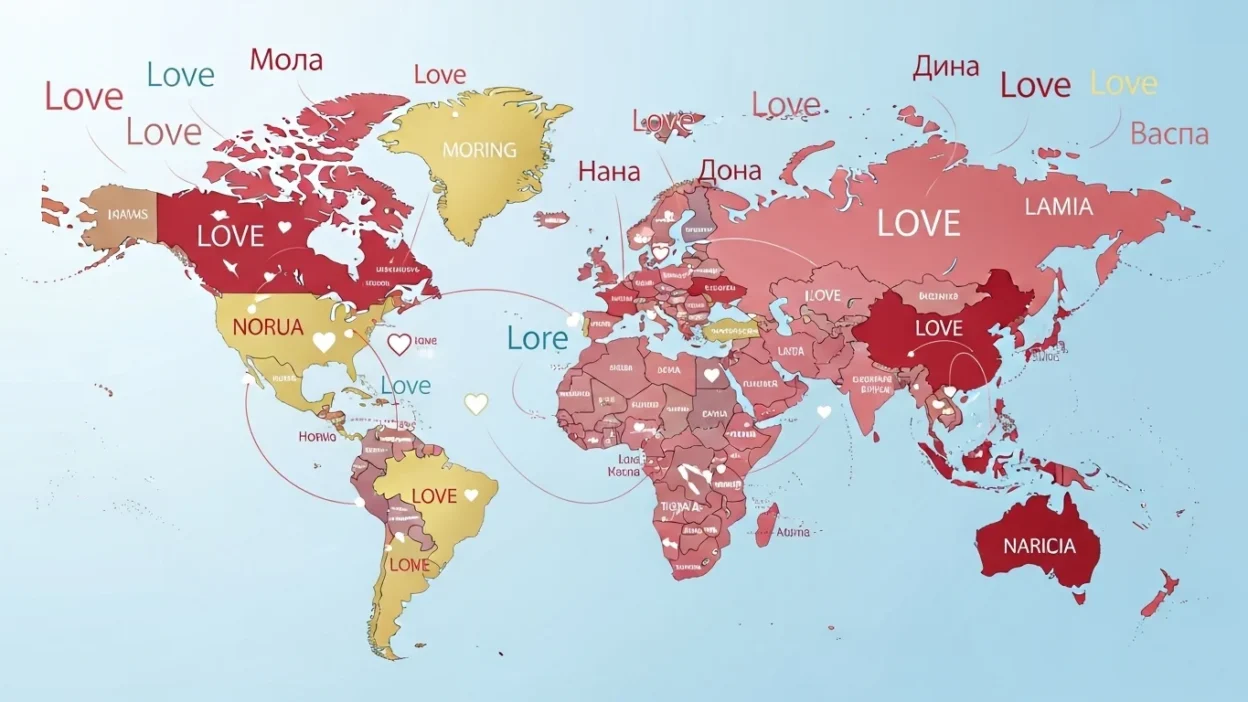
Love is a universal feeling, but the way we express it changes across cultures and languages. If you’ve ever wondered how to say “love” in different languages or wanted to explore love translations around the world, this guide is exactly what you need.
In this article, you’ll discover 70 languages and how the word “love” is spoken globally, along with pronunciation and real life examples.
Whether you’re learning a new language, writing a romantic message, or simply curious, this list will help you understand love in all languages in a simple and engaging way.
100+ Ways to Say Love in Different Languages
| Language | Pronunciation | Example |
| English | luhv | I love you. (Meaning: I have deep affection for you.) |
| Spanish | amor | Te amo. (Meaning: I love you deeply.) |
| French | amour | Je t’aime. (Meaning: I love you.) |
| German | liebe | Ich liebe dich. (Meaning: I love you.) |
| Italian | amore | Ti amo. (Meaning: I love you.) |
| Portuguese | amor | Eu te amo. (Meaning: I love you.) |
| Russian | lyubov | Ya tebya lyublyu. (Meaning: I love you.) |
| Arabic | hubb | Ana uhibbuka. (Meaning: I love you.) |
| Hindi | pyaar | Main tumse pyaar karta hoon. (Meaning: I love you.) |
| Urdu | mohabbat | Mujhe tumse mohabbat hai. (Meaning: I love you.) |
| Chinese (Mandarin) | ai | Wo ai ni. (Meaning: I love you.) |
| Japanese | ai | Aishiteru. (Meaning: I love you deeply.) |
| Korean | sarang | Saranghae. (Meaning: I love you.) |
| Turkish | ask | Seni seviyorum. (Meaning: I love you.) |
| Greek | agapi | S’agapo. (Meaning: I love you.) |
| Dutch | liefde | Ik hou van jou. (Meaning: I love you.) |
| Swedish | karlek | Jag alskar dig. (Meaning: I love you.) |
| Norwegian | kjærlighet | Jeg elsker deg. (Meaning: I love you.) |
| Danish | kaerlighed | Jeg elsker dig. (Meaning: I love you.) |
| Finnish | rakkaus | Rakastan sinua. (Meaning: I love you.) |
| Polish | milosc | Kocham cie. (Meaning: I love you.) |
| Czech | laska | Miluji te. (Meaning: I love you.) |
| Slovak | laska | Lubim ta. (Meaning: I love you.) |
| Hungarian | szerelem | Szeretlek. (Meaning: I love you.) |
| Romanian | dragoste | Te iubesc. (Meaning: I love you.) |
| Bulgarian | lyubov | Obicham te. (Meaning: I love you.) |
| Serbian | ljubav | Volim te. (Meaning: I love you.) |
| Croatian | ljubav | Volim te. (Meaning: I love you.) |
| Bosnian | ljubav | Volim te. (Meaning: I love you.) |
| Albanian | dashuri | Te dua. (Meaning: I love you.) |
| Thai | rak | Chan rak khun. (Meaning: I love you.) |
| Vietnamese | yeu | Toi yeu ban. (Meaning: I love you.) |
| Indonesian | cinta | Aku cinta kamu. (Meaning: I love you.) |
| Malay | cinta | Saya cinta kamu. (Meaning: I love you.) |
| Filipino | pag-ibig | Mahal kita. (Meaning: I love you.) |
| Swahili | upendo | Nakupenda. (Meaning: I love you.) |
| Zulu | uthando | Ngiyakuthanda. (Meaning: I love you.) |
| Afrikaans | liefde | Ek het jou lief. (Meaning: I love you.) |
| Hebrew | ahava | Ani ohev otach. (Meaning: I love you.) |
| Persian | eshgh | Dooset daram. (Meaning: I love you.) |
| Bengali | bhalobasha | Ami tomake bhalobashi. (Meaning: I love you.) |
| Punjabi | pyaar | Main tenu pyaar karda haan. (Meaning: I love you.) |
| Tamil | anbu | Naan unnai kadhalikkiren. (Meaning: I love you.) |
| Telugu | prema | Nenu ninnu premisthunnanu. (Meaning: I love you.) |
| Kannada | preeti | Naanu ninna preetisuttene. (Meaning: I love you.) |
| Malayalam | sneham | Njan ninne snehikkunnu. (Meaning: I love you.) |
| Marathi | prem | Mi tujhyavar prem karto. (Meaning: I love you.) |
| Gujarati | prem | Hu tane prem karu chu. (Meaning: I love you.) |
| Nepali | maya | Ma timilai maya garchu. (Meaning: I love you.) |
| Sinhala | adare | Mama oyata adareyi. (Meaning: I love you.) |
| Khmer | sralanh | Khnhom sralanh anak. (Meaning: I love you.) |
| Lao | hak | Khoi hak chao. (Meaning: I love you.) |
| Burmese | chit | Chit pa de. (Meaning: I love you.) |
| Mongolian | hair | Bi chamd hairtai. (Meaning: I love you.) |
| Icelandic | ast | Eg elska tig. (Meaning: I love you.) |
| Irish | gra | Ta gra agam duit. (Meaning: I love you.) |
| Scottish Gaelic | gaol | Tha gaol agam ort. (Meaning: I love you.) |
| Welsh | cariad | Rwy’n dy garu di. (Meaning: I love you.) |
| Basque | maitasun | Maite zaitut. (Meaning: I love you.) |
| Catalan | amor | T’estimo. (Meaning: I love you.) |
| Esperanto | amo | Mi amas vin. (Meaning: I love you.) |
| Latin | amor | Te amo. (Meaning: I love you.) |
| Haitian Creole | lanmou | Mwen renmen ou. (Meaning: I love you.) |
| Maori | aroha | Aroha ahau ki a koe. (Meaning: I love you.) |
| Hawaiian | aloha | Aloha wau ia oe. (Meaning: I love you.) |
| Samoan | alofa | Ou te alofa ia te oe. (Meaning: I love you.) |
| Tongan | ofa | Oku ou ofa atu. (Meaning: I love you.) |
| Fijian | loloma | Au domoni iko. (Meaning: I love you.) |
How to Say Love in Different Languages Easily
Learning how to say love in different languages doesn’t have to be difficult. Start with simple phrases like “I love you,” since they are the most commonly used. Focus on pronunciation and practice regularly with real-life examples.
Listening to native speakers and repeating phrases aloud can help you remember faster. You can also write down your favorite love translations to build familiarity.
Why Learning Love in All Languages Matters
Understanding love around the world helps you connect with people from different cultures. It shows respect, builds emotional bonds, and makes communication more meaningful.
Whether you’re traveling, dating, or learning languages, knowing how to express love globally adds a personal and heartfelt touch.
Love Translations Around the World
Different cultures express love in unique ways. Some languages have multiple words for different types of love, while others rely on context and tone.
For example, Japanese and Korean often use softer expressions instead of direct phrases, while Romance languages like Spanish and Italian are more expressive and passionate.
This diversity makes learning love in all languages both fascinating and meaningful.
Conclusion
Love is one of the most powerful emotions, and learning how to express it in different languages opens the door to deeper human connections. From simple phrases to cultural meanings, these 70 translations show how love truly connects the world.
FAQs
1. How many languages have a word for love?
Almost every language has at least one word for love, though meanings and usage can vary across cultures.
2. What is the most common way to say I love you globally?
“I love you” is most commonly translated into simple, direct phrases like “Te amo,” “Je t’aime,” or “Wo ai ni.”
3. Are love translations the same in every culture?
No, love translations differ widely. Some languages have multiple words for different types of love.
4. Which language sounds most romantic for love?
Languages like French, Italian, and Spanish are often considered the most romantic due to their pronunciation and cultural association.
5. Why should I learn love in different languages?
It helps you connect emotionally with people, understand cultures better, and communicate more meaningfully.

Ely Joseph is a language researcher, writer, and contributor who specializes in words, meanings, and multilingual communication. With a strong interest in how language shapes understanding across cultures, Ely focuses on creating clear, accurate, and reader-friendly content for a global audience.