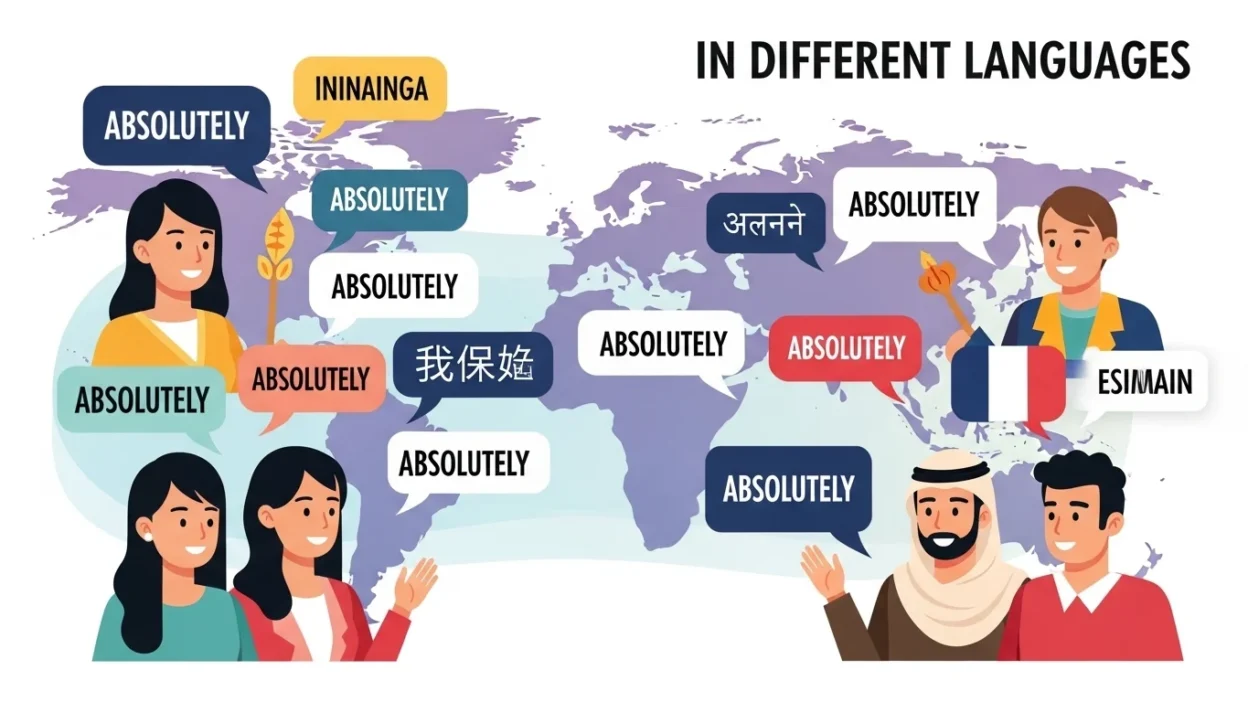
Understanding how to say “absolutely” in different languages can make your communication clearer, more expressive, and globally relevant.
Whether you’re traveling, learning a new language, or improving your conversational skills, knowing these translations helps you confidently agree, confirm, or emphasize your thoughts.
In this guide, you’ll discover how to say “absolutely” around the world, along with pronunciation and real-life example sentences to make learning practical and memorable.
“Absolutely” in All Languages
| Language | Pronunciation | Example |
| English | ab-so-lute-lee | Absolutely, I agree with you. (Meaning: I completely agree.) |
| Spanish | ab-so-loo-ta-men-te | Absolutamente, tienes razón. (Meaning: You are completely right.) |
| French | ab-so-loo-mon | Absolument, je comprends. (Meaning: I completely understand.) |
| German | ab-zo-loot | Absolut, das ist richtig. (Meaning: That is completely correct.) |
| Italian | ab-so-loo-ta-men-te | Assolutamente, lo farò. (Meaning: I will definitely do it.) |
| Portuguese | ab-so-loo-ta-men-chee | Absolutamente, concordo. (Meaning: I fully agree.) |
| Dutch | ab-so-loot | Absoluut, dat klopt. (Meaning: That is absolutely correct.) |
| Russian | ab-so-lyut-no | Абсолютно, я согласен. (Meaning: I completely agree.) |
| Chinese (Mandarin) | wan-chuan | 完全同意。 (Meaning: Completely agree.) |
| Japanese | zet-tai-ni | 絶対にそうです。 (Meaning: That is absolutely so.) |
| Korean | wan-jeon-hi | 완전히 동의해요. (Meaning: I completely agree.) |
| Arabic | ta-ma-man | تمامًا، أوافق. (Meaning: I totally agree.) |
| Hindi | bil-kul | बिल्कुल सही है। (Meaning: That is absolutely right.) |
| Urdu | bil-kul | بالکل درست ہے۔ (Meaning: That is absolutely correct.) |
| Turkish | ke-sin-lik-le | Kesinlikle katılıyorum. (Meaning: I absolutely agree.) |
| Greek | a-po-lee-ta | Απολύτως σωστό. (Meaning: Absolutely correct.) |
| Polish | ab-so-lut-nye | Absolutnie się zgadzam. (Meaning: I completely agree.) |
| Swedish | ab-so-loot | Absolut, det är sant. (Meaning: That is absolutely true.) |
| Danish | ab-so-loot | Absolut, jeg er enig. (Meaning: I completely agree.) |
| Norwegian | ab-so-loot | Absolutt, det stemmer. (Meaning: That is absolutely correct.) |
| Finnish | eh-dot-to-mas-ti | Ehdottomasti samaa mieltä. (Meaning: I absolutely agree.) |
| Czech | ab-so-loot-nye | Absolutně souhlasím. (Meaning: I completely agree.) |
| Hungarian | tel-ye-shen | Teljesen igaz. (Meaning: Completely true.) |
| Romanian | ab-so-loot | Absolut, ai dreptate. (Meaning: You are absolutely right.) |
| Bulgarian | ab-so-lyut-no | Абсолютно вярно. (Meaning: Absolutely true.) |
| Croatian | ap-so-loot-no | Apsolutno se slažem. (Meaning: I completely agree.) |
| Serbian | ap-so-loot-no | Апсолутно тачно. (Meaning: Absolutely correct.) |
| Slovak | ab-so-loot-nye | Absolútne súhlasím. (Meaning: I completely agree.) |
| Slovenian | ap-so-loot-no | Absolutno pravilno. (Meaning: Absolutely correct.) |
| Ukrainian | ab-so-lyut-no | Абсолютно правильно. (Meaning: Absolutely correct.) |
| Hebrew | le-gam-rei | לגמרי נכון. (Meaning: Completely correct.) |
| Persian | ka-me-lan | کاملاً درست است. (Meaning: Completely correct.) |
| Thai | yang-nae-non | อย่างแน่นอน (Meaning: Absolutely/definitely.) |
| Vietnamese | hoan-toan | Hoàn toàn đúng. (Meaning: Completely correct.) |
| Indonesian | se-pe-nu-hnya | Sepenuhnya benar. (Meaning: Completely true.) |
| Malay | se-pe-nuh-nya | Sepenuhnya setuju. (Meaning: Completely agree.) |
| Filipino | lu-bos | Lubos akong sang-ayon. (Meaning: I fully agree.) |
| Swahili | ka-bi-sa | Kabisa, nakubali. (Meaning: I absolutely agree.) |
| Zulu | ka-khu-lu | Ngiyavuma ngokuphelele. (Meaning: I completely agree.) |
| Afrikaans | ab-so-loot | Absoluut reg. (Meaning: Absolutely correct.) |
| Icelandic | al-ger-lega | Algerlega rétt. (Meaning: Completely right.) |
| Latvian | ab-so-loo-ti | Absolūti pareizi. (Meaning: Absolutely correct.) |
| Lithuanian | ab-so-loo-chee-ai | Absoliučiai teisinga. (Meaning: Absolutely correct.) |
| Estonian | tä-ie-li-kult | Täielikult nõus. (Meaning: Completely agree.) |
| Albanian | ab-so-lu-tisht | Absolutisht e vërtetë. (Meaning: Absolutely true.) |
| Macedonian | ap-so-loot-no | Апсолутно точно. (Meaning: Absolutely correct.) |
| Armenian | am-bo-gh-ju-tyun | Ամբողջությամբ ճիշտ է։ (Meaning: Completely correct.) |
| Georgian | srul-i-ad | სრულიად სწორი. (Meaning: Completely correct.) |
| Bengali | ek-do-m | একদম ঠিক। (Meaning: Absolutely right.) |
| Tamil | mu-zhuk-ka | முழுக்க சரி. (Meaning: Completely correct.) |
| Telugu | poorthi-ga | పూర్తిగా సరైనది. (Meaning: Completely correct.) |
| Marathi | ag-di | अगदी बरोबर. (Meaning: Absolutely correct.) |
| Gujarati | bil-kul | બિલકુલ સાચું. (Meaning: Absolutely correct.) |
| Punjabi | bil-kul | ਬਿਲਕੁਲ ਠੀਕ। (Meaning: Absolutely correct.) |
| Nepali | bil-kul | बिल्कुल ठीक। (Meaning: Absolutely correct.) |
| Sinhala | mu-lu-manin | මුළුමනින්ම හරි. (Meaning: Completely correct.) |
| Khmer | tɑŋ-sruol | ត្រឹមត្រូវទាំងស្រុង។ (Meaning: Completely correct.) |
| Lao | yang-sin-cheng | ຢ່າງສິ້ນເຊີງ (Meaning: Absolutely.) |
| Mongolian | bur-en | Бүрэн зөв. (Meaning: Completely correct.) |
| Kazakh | to-lyq | Толық дұрыс. (Meaning: Completely correct.) |
| Uzbek | to-liq | To‘liq to‘g‘ri. (Meaning: Completely correct.) |
| Azerbaijani | tam-a-men | Tamamilə doğrudur. (Meaning: Completely correct.) |
| Basque | guz-ti-z | Guztiz zuzena. (Meaning: Completely correct.) |
| Catalan | ab-so-lu-ta-ment | Absolutament correcte. (Meaning: Absolutely correct.) |
| Galician | ab-so-lu-ta-men-te | Absolutamente correcto. (Meaning: Absolutely correct.) |
| Maltese | as-so-lu-ta-ment | Assolutament tajjeb. (Meaning: Absolutely correct.) |
| Irish | go hi-om-lan | Go hiomlán ceart. (Meaning: Completely correct.) |
| Welsh | yn ho-llol | Yn hollol gywir. (Meaning: Completely correct.) |
How to Say “Absolutely” in Different Languages
The phrase “absolutely” is commonly used to show strong agreement or certainty. Across languages, it often translates to words meaning “completely,” “totally,” or “definitely.” Learning these variations helps in both formal and casual conversations worldwide.
Why Learn “Absolutely” Translations?
Knowing “absolutely translations” is useful for:
- Expressing strong agreement clearly
- Building better cross-cultural communication
- Enhancing travel and business conversations
- Improving fluency in multiple languages
Tips to Use “Absolutely” Around the World
- Use it in polite conversations to confirm agreement
- Pair it with body language like nodding for clarity
- Practice pronunciation to sound natural
- Learn context, as some cultures prefer softer agreement words
Conclusion
Learning how to say “absolutely in all languages” opens the door to clearer, more confident communication across cultures. These translations help you express certainty and agreement wherever you go, making your conversations more impactful and meaningful.
FAQs
1. What is the most common translation of “absolutely”?
Most languages translate it as “completely” or “totally.”
2. How do you say absolutely in Asian languages?
Examples include “Zettai ni” (Japanese) and “Wan quan” (Chinese).
3. Is “absolutely” formal or informal?
It can be both, depending on tone and context.
4. Can I use “absolutely” in business communication?
Yes, it is commonly used to show strong agreement professionally.
5. Why are there different translations for “absolutely”?
Languages vary in structure and culture, so expressions differ slightly.

Marak Robort is a content writer and researcher with a strong interest in language, meanings, and digital information. His work focuses on presenting clear, easy-to-understand explanations that help readers quickly grasp complex ideas.