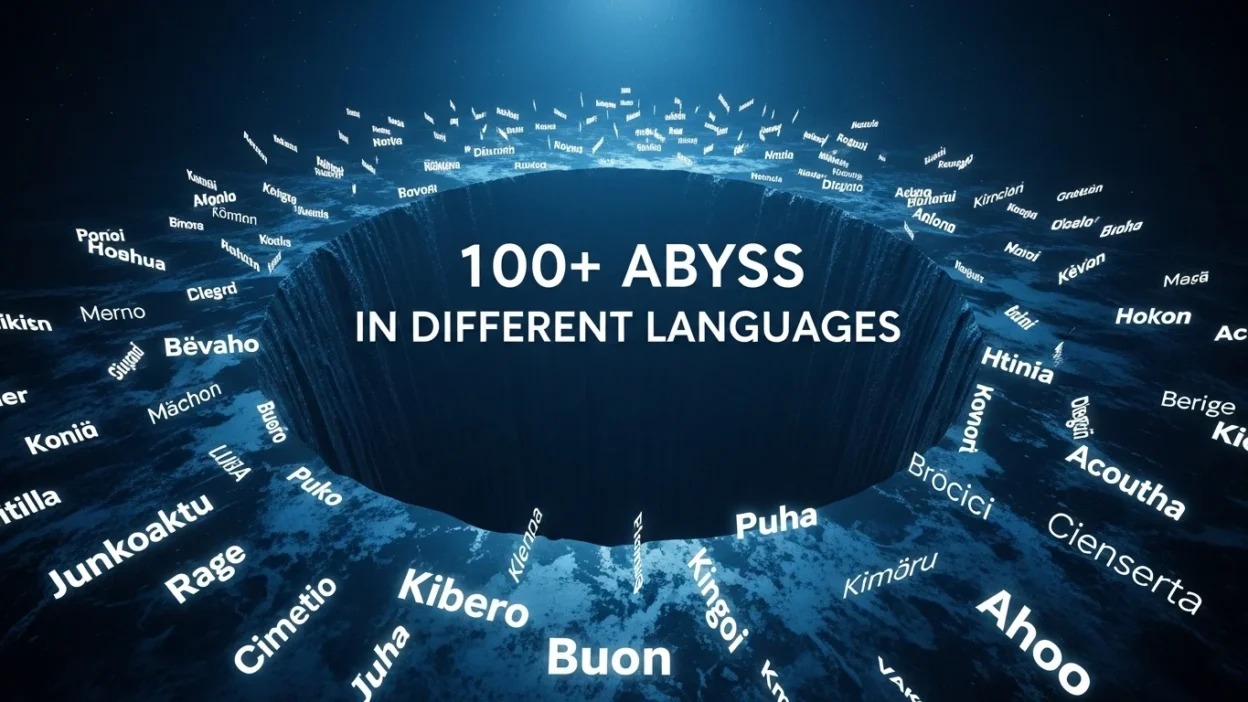
The word “abyss” carries deep meaning often symbolizing something vast, endless, or unknown.
Whether you’re a language enthusiast, traveler, writer, or student, learning how to say “abyss” in different languages helps you expand your vocabulary and cultural understanding.
This guide presents “abyss” translations around the world in a simple, easy to read format designed for quick learning and reference.
Abyss in All Languages
| Language | Pronunciation | Example |
| English | uh-bis | He stared into the abyss. (Meaning: He looked into a deep void.) |
| Spanish | a-bis-mo | Miró el abismo con miedo. (Meaning: He looked at the abyss with fear.) |
| French | a-bis | Il a vu l’abîme. (Meaning: He saw the abyss.) |
| German | a-bgrund | Er fiel in den Abgrund. (Meaning: He fell into the abyss.) |
| Italian | a-bis-so | Guardava l’abisso. (Meaning: He was looking at the abyss.) |
| Portuguese | a-bis-mo | Ele caiu no abismo. (Meaning: He fell into the abyss.) |
| Dutch | a-bis | Hij zag de afgrond. (Meaning: He saw the abyss.) |
| Russian | be-zdna | Он увидел бездну. (Meaning: He saw the abyss.) |
| Ukrainian | bez-dna | Він впав у бездну. (Meaning: He fell into the abyss.) |
| Polish | a-bis | Patrzył w otchłań. (Meaning: He stared into the abyss.) |
| Turkish | u-chu-rum | Uçuruma baktı. (Meaning: He looked at the abyss.) |
| Arabic | haw-ya | نظر إلى الهاوية. (Meaning: He looked into the abyss.) |
| Persian | dar-reh | به دره نگاه کرد. (Meaning: He looked at the abyss.) |
| Hindi | a-gadh | उसने अगाध देखा। (Meaning: He saw the abyss.) |
| Urdu | kha-ee | اس نے کھائی دیکھی۔ (Meaning: He saw the abyss.) |
| Bengali | go-bhir goh-bor | সে গভীর গহ্বর দেখল। (Meaning: He saw the abyss.) |
| Punjabi | kha-ee | اس نے کھائی ویکھیا۔ (Meaning: He saw the abyss.) |
| Tamil | aazham | அவன் ஆழத்தை பார்த்தான்। (Meaning: He saw the abyss.) |
| Telugu | a-gaa-dham | అతను అగాధాన్ని చూశాడు। (Meaning: He saw the abyss.) |
| Marathi | a-gadh | त्याने अगाध पाहिले। (Meaning: He saw the abyss.) |
| Gujarati | a-gadh | તેણે અગાધ જોયું। (Meaning: He saw the abyss.) |
| Chinese (Mandarin) | shen yuan | 他看到了深渊。 (Meaning: He saw the abyss.) |
| Japanese | shin-en | 彼は深淵を見た。 (Meaning: He saw the abyss.) |
| Korean | shim-yeon | 그는 심연을 보았다. (Meaning: He saw the abyss.) |
| Thai | ha-wei | เขามองเห็นเหว (Meaning: He saw the abyss.) |
| Vietnamese | tham-vuc | Anh thấy vực sâu. (Meaning: He saw the abyss.) |
| Indonesian | ju-rang | Dia melihat jurang. (Meaning: He saw the abyss.) |
| Malay | ju-rang | Dia melihat jurang. (Meaning: He saw the abyss.) |
| Filipino | bang-in | Nakita niya ang bangin. (Meaning: He saw the abyss.) |
| Swahili | shu-mo | Aliona shimo. (Meaning: He saw the abyss.) |
| Zulu | u-ma-ho | Wabona umhume. (Meaning: He saw the abyss.) |
| Afrikaans | af-grond | Hy sien die afgrond. (Meaning: He saw the abyss.) |
| Greek | a-vy-sos | Είδε την άβυσσο. (Meaning: He saw the abyss.) |
| Latin | a-byss-us | Abyssum vidit. (Meaning: He saw the abyss.) |
| Czech | pro-past | Viděl propast. (Meaning: He saw the abyss.) |
| Slovak | pro-past | Videl priepasť. (Meaning: He saw the abyss.) |
| Hungarian | me-lyseg | Látta a mélységet. (Meaning: He saw the abyss.) |
| Romanian | a-bis | A văzut abisul. (Meaning: He saw the abyss.) |
| Bulgarian | bez-dna | Той видя бездната. (Meaning: He saw the abyss.) |
| Serbian | bez-dan | Видео је бездан. (Meaning: He saw the abyss.) |
| Croatian | po-nor | Vidio je ponor. (Meaning: He saw the abyss.) |
| Slovenian | pre-pad | Videl je prepad. (Meaning: He saw the abyss.) |
| Finnish | ku-ilu | Hän näki kuilun. (Meaning: He saw the abyss.) |
| Swedish | av-grund | Han såg avgrunden. (Meaning: He saw the abyss.) |
| Norwegian | av-grunn | Han så avgrunnen. (Meaning: He saw the abyss.) |
| Danish | af-grund | Han så afgrunden. (Meaning: He saw the abyss.) |
| Icelandic | hy-pi | Hann sá hyldýpið. (Meaning: He saw the abyss.) |
| Estonian | kur-is-tik | Ta nägi kuristikku. (Meaning: He saw the abyss.) |
| Latvian | bez-dib-enis | Viņš redzēja bezdibeni. (Meaning: He saw the abyss.) |
| Lithuanian | be-dug-ne | Jis matė bedugnę. (Meaning: He saw the abyss.) |
| Hebrew | te-hom | הוא ראה תהום. (Meaning: He saw the abyss.) |
| Amharic | ge-bet | እርሱ ገበትን አየ. (Meaning: He saw the abyss.) |
| Somali | go-don | Wuxuu arkay godka. (Meaning: He saw the abyss.) |
| Yoruba | i-ho | Ó rí iho. (Meaning: He saw the abyss.) |
| Hausa | ra-mi | Ya ga rami. (Meaning: He saw the abyss.) |
| Igbo | o-gha-ra | Ọ hụrụ oghara. (Meaning: He saw the abyss.) |
| Malagasy | la-vaka | Nahita lavaka izy. (Meaning: He saw the abyss.) |
| Khmer | jru-ng | គាត់ឃើញជ្រុង។ (Meaning: He saw the abyss.) |
| Lao | ho | ລາວເຫັນຮໍ. (Meaning: He saw the abyss.) |
| Burmese | a-nout | သူသည် အနောက်မြင်ခဲ့သည်။ (Meaning: He saw the abyss.) |
| Nepali | ga-hi-ro | उसले गहिरो देख्यो। (Meaning: He saw the abyss.) |
| Sinhala | ga-bu-ru | ඔහු ගැබුරු දැක්කා. (Meaning: He saw the abyss.) |
| Mongolian | gun | Тэр гүнийг харсан. (Meaning: He saw the abyss.) |
| Kazakh | tu-bis | Ол түбіс көрді. (Meaning: He saw the abyss.) |
| Uzbek | jar-lik | U jarlikni ko‘rdi. (Meaning: He saw the abyss.) |
| Azerbaijani | u-chu-rum | O uçurumu gördü. (Meaning: He saw the abyss.) |
| Georgian | kha-re-zi | მან ხარვეზი ნახა. (Meaning: He saw the abyss.) |
| Armenian | kha-or | Նա խորը տեսավ։ (Meaning: He saw the abyss.) |
How to Say “Abyss” in Different Languages
The word “abyss” often translates into terms meaning deep hole, bottomless pit, or vast emptiness. While pronunciation and structure differ, the core idea remains similar across cultures. Learning these variations helps you better understand both language and symbolism.
Abyss Translations Around the World
Across continents, “abyss” reflects both physical depth and emotional intensity. In European languages, it often relates to cliffs or voids, while in Asian and African languages, it may connect more with depth or darkness. This diversity shows how language shapes perception.
Why Learn “Abyss” in Multiple Languages?
Understanding “abyss in all languages” can be useful for:
- Writers creating global or poetic content
- Travelers exploring new cultures
- Students improving vocabulary
- Language learners building deeper comprehension
It also helps you recognize shared human ideas expressed differently across the world.
Conclusion
Learning how to say “abyss” in different languages opens a window into global expression and meaning. While the word may change in sound and structure, its essence remains universal representing depth, mystery, and the unknown. Use this guide as a quick reference to explore “abyss” translations and expand your linguistic knowledge.
FAQs
1. What does “abyss” mean in simple terms?
It means a very deep or bottomless space, often used literally or metaphorically.
2. How do you say abyss in Asian languages?
Examples include “Shen Yuan” (Chinese), “Shin-en” (Japanese), and “Shim-yeon” (Korean).
3. Is “abyss” used metaphorically worldwide?
Yes, many languages use it to describe emotional depth or difficult situations.
4. Are abyss translations the same in every language?
No, they vary but generally reflect ideas like depth, void, or emptiness.
5. Why is learning translations important?
It improves communication, cultural awareness, and vocabulary skills.

Ely Joseph is a language researcher, writer, and contributor who specializes in words, meanings, and multilingual communication. With a strong interest in how language shapes understanding across cultures, Ely focuses on creating clear, accurate, and reader-friendly content for a global audience.