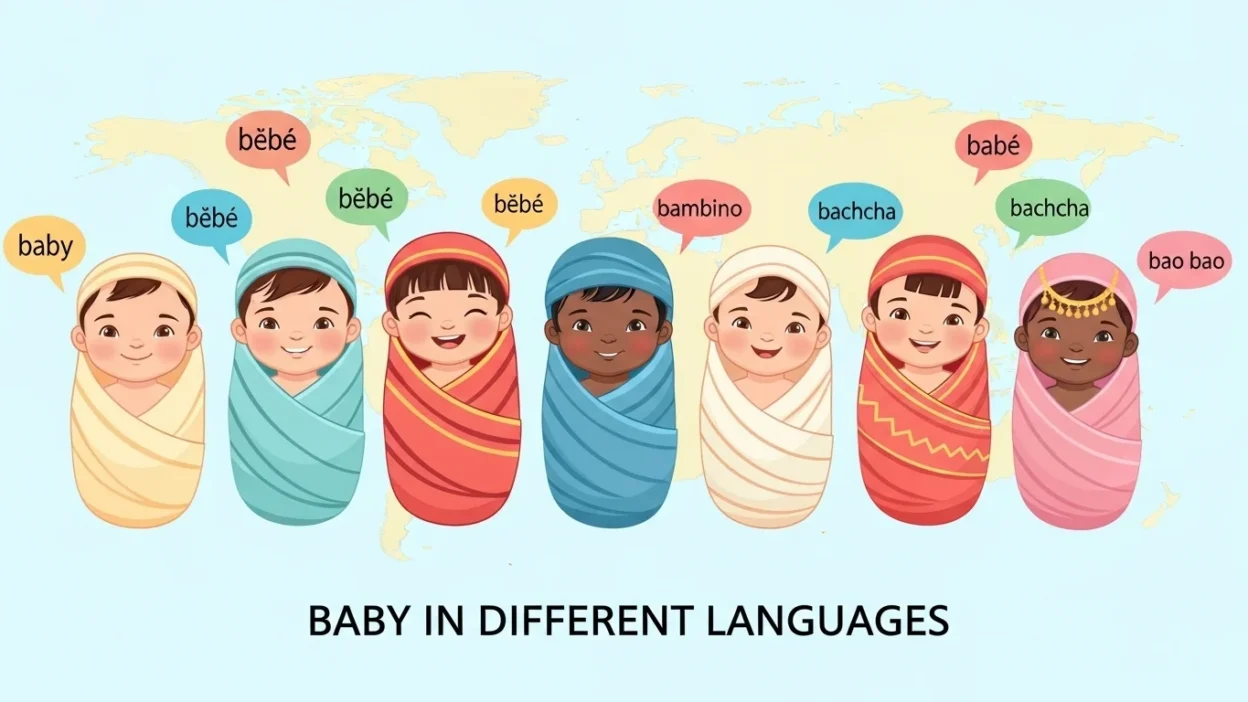
Understanding how to say baby in different languages is more than just a fun linguistic exercise; it helps you connect with cultures, improve communication, and expand your vocabulary.
Whether you’re learning a new language, traveling, or simply curious, this guide gives you a complete look at baby translations across the globe.
Below, you’ll find a carefully organized table showing how to say baby in different languages, including pronunciation and simple real-life examples to make learning easy and practical.
Baby in All Languages
| Language | Pronunciation | Example |
| English | bay-bee | The baby is sleeping. (Meaning: The baby is resting.) |
| Spanish | be-beh | El bebé está durmiendo. (Meaning: The baby is sleeping.) |
| French | beh-beh | Le bébé pleure. (Meaning: The baby is crying.) |
| German | bahy-bee | Das Baby schläft. (Meaning: The baby sleeps.) |
| Italian | beh-beh | Il bambino dorme. (Meaning: The baby sleeps.) |
| Portuguese | beh-beh | O bebê está feliz. (Meaning: The baby is happy.) |
| Dutch | bahy-bee | De baby lacht. (Meaning: The baby laughs.) |
| Russian | ma-lysh | Малыш спит. (Meaning: The baby sleeps.) |
| Chinese (Mandarin) | bao-bao | 宝宝在笑。 (Meaning: The baby is smiling.) |
| Japanese | ah-kah-chan | 赤ちゃんが寝ています。 (Meaning: The baby is sleeping.) |
| Korean | ah-gi | 아기가 울어요. (Meaning: The baby cries.) |
| Arabic | tifl | الطفل نائم. (Meaning: The baby is asleep.) |
| Hindi | bach-cha | बच्चा सो रहा है। (Meaning: The baby is sleeping.) |
| Urdu | bach-cha | بچہ ہنس رہا ہے۔ (Meaning: The baby is laughing.) |
| Turkish | beh-bek | Bebek uyuyor. (Meaning: The baby is sleeping.) |
| Greek | mo-ro | Το μωρό κοιμάται. (Meaning: The baby sleeps.) |
| Polish | djee-tsko | Dziecko śpi. (Meaning: The baby sleeps.) |
| Swedish | bahn | Barnet sover. (Meaning: The baby sleeps.) |
| Norwegian | bahn | Barnet gråter. (Meaning: The baby cries.) |
| Danish | bahn | Barnet sover. (Meaning: The baby sleeps.) |
| Finnish | lahp-see | Lapsi nukkuu. (Meaning: The baby sleeps.) |
| Hungarian | bah-bah | A baba alszik. (Meaning: The baby sleeps.) |
| Czech | mi-min-ko | Miminko spí. (Meaning: The baby sleeps.) |
| Slovak | beh-bat-ko | Bábätko spí. (Meaning: The baby sleeps.) |
| Romanian | beh-bey | Bebelușul doarme. (Meaning: The baby sleeps.) |
| Bulgarian | beh-beh | Бебето спи. (Meaning: The baby sleeps.) |
| Croatian | beh-bah | Beba spava. (Meaning: The baby sleeps.) |
| Serbian | beh-bah | Beba spava. (Meaning: The baby sleeps.) |
| Slovenian | doh-jen-chek | Dojenček spi. (Meaning: The baby sleeps.) |
| Ukrainian | nem-lyah | Немовля спить. (Meaning: The baby sleeps.) |
| Hebrew | tee-nok | התינוק ישן. (Meaning: The baby sleeps.) |
| Persian | koo-dak | کودک خواب است. (Meaning: The baby sleeps.) |
| Bengali | ba-cha | বাচ্চা ঘুমাচ্ছে। (Meaning: The baby is sleeping.) |
| Punjabi | ba-cha | ਬੱਚਾ ਸੋ ਰਿਹਾ ਹੈ। (Meaning: The baby sleeps.) |
| Tamil | ku-lan-thai | குழந்தை தூங்குகிறது. (Meaning: The baby sleeps.) |
| Telugu | pi-lla | పిల్ల నిద్రపోతుంది. (Meaning: The baby sleeps.) |
| Marathi | baal | बाळ झोपले आहे. (Meaning: The baby sleeps.) |
| Gujarati | baal | બાળક સુઈ રહ્યું છે. (Meaning: The baby sleeps.) |
| Thai | tah-rohk | ทารกนอนหลับ (Meaning: The baby sleeps.) |
| Vietnamese | em-beh | Em bé đang ngủ. (Meaning: The baby sleeps.) |
| Indonesian | bahy-ee | Bayi tidur. (Meaning: The baby sleeps.) |
| Malay | bahy-ee | Bayi tidur. (Meaning: The baby sleeps.) |
| Filipino | sahn-gohl | Sanggol ay natutulog. (Meaning: The baby sleeps.) |
| Swahili | mah-tah-too | Mtoto analala. (Meaning: The baby sleeps.) |
| Zulu | in-gah-neh | Ingane ilele. (Meaning: The baby sleeps.) |
| Afrikaans | bahy-bee | Die baba slaap. (Meaning: The baby sleeps.) |
| Somali | il-moh | Ilmuhu seexdaa. (Meaning: The baby sleeps.) |
| Amharic | lihj | ሕፃኑ ተኛ. (Meaning: The baby sleeps.) |
| Hausa | yah-roh | Yaro yana barci. (Meaning: The baby sleeps.) |
| Yoruba | oh-moh | Ọmọ ń sun. (Meaning: The baby sleeps.) |
| Igbo | nwa | Nwa na-ehi ụra. (Meaning: The baby sleeps.) |
| Malagasy | zah-zah | Zaza matory. (Meaning: The baby sleeps.) |
| Icelandic | bah-rn | Barnið sefur. (Meaning: The baby sleeps.) |
| Irish | bah-nee | Tá an baba ina chodladh. (Meaning: The baby sleeps.) |
| Welsh | bah-bee | Mae’r babi yn cysgu. (Meaning: The baby sleeps.) |
| Scottish Gaelic | pah-shay | Tha an paisde a’ cadal. (Meaning: The baby sleeps.) |
| Albanian | beh-beh | Bebja fle. (Meaning: The baby sleeps.) |
| Macedonian | beh-beh | Бебето спие. (Meaning: The baby sleeps.) |
| Estonian | lahps | Laps magab. (Meaning: The baby sleeps.) |
| Latvian | bah-erns | Bērns guļ. (Meaning: The baby sleeps.) |
| Lithuanian | kuh-dee-kee | Kūdikis miega. (Meaning: The baby sleeps.) |
| Armenian | meh-gah | Մանկիկը քնած է։ (Meaning: The baby sleeps.) |
| Georgian | bav-shvi | ბავშვი სძინავს. (Meaning: The baby sleeps.) |
| Mongolian | hoo-hed | Хүүхэд унтаж байна. (Meaning: The baby sleeps.) |
| Khmer | koh-mah | កុមារគេង (Meaning: The baby sleeps.) |
| Lao | dek | ເດັກນ້ອຍນອນ (Meaning: The baby sleeps.) |
| Burmese | keh-lay | ကလေးအိပ်နေသည် (Meaning: The baby sleeps.) |
| Nepali | bah-cha | बच्चा सुतिरहेको छ। (Meaning: The baby sleeps.) |
| Sinhala | lamaya | ළමයා නිදාගෙන ඉන්නවා (Meaning: The baby sleeps.) |
How to Say Baby in Different Languages Easily
Learning baby in all languages becomes easier when you notice patterns. Many languages use soft sounds like “ba,” “be,” or “ma,” which are naturally easy for humans to pronounce. That’s why words like “baba,” “bébé,” and “baby” appear across cultures.
Why Learn Baby Translations Around the World
Knowing how to say baby in different languages can be useful for:
- Traveling and communicating with families
- Language learning and vocabulary building
- Cultural understanding
- Parenting or childcare in multilingual settings
It’s also one of the first words people learn when studying a new language.
Tips to Remember Baby in All Languages
- Focus on pronunciation patterns (many are similar)
- Practice with simple sentences
- Use repetition and real-life examples
- Group similar languages together
Conclusion
Learning baby in different languages is a simple yet powerful way to explore global communication. With these 70 translations, you now have a strong foundation to understand and use this universal word anywhere in the world.
FAQs
1. What is the most common word for baby worldwide?
“Baby,” “baba,” and “bébé” are among the most widely recognized forms globally.
2. How do you say baby in Asian languages?
Examples include “bao bao” (Chinese), “akachan” (Japanese), and “agi” (Korean).
3. Why do many languages use similar sounds for baby?
Because these sounds are easy for infants to pronounce and are naturally adopted into language.
4. Is baby the same word in Hindi and Urdu?
Yes, both use “bachcha,” though pronunciation may slightly vary.
5. How can I memorize baby translations quickly?
Practice daily, use flashcards, and repeat example sentences.

David William is a language enthusiast, researcher, and content creator at Lingoveb. With a deep passion for words, meanings, and global communication, he focuses on making language simple, clear, and accessible for readers around the world.