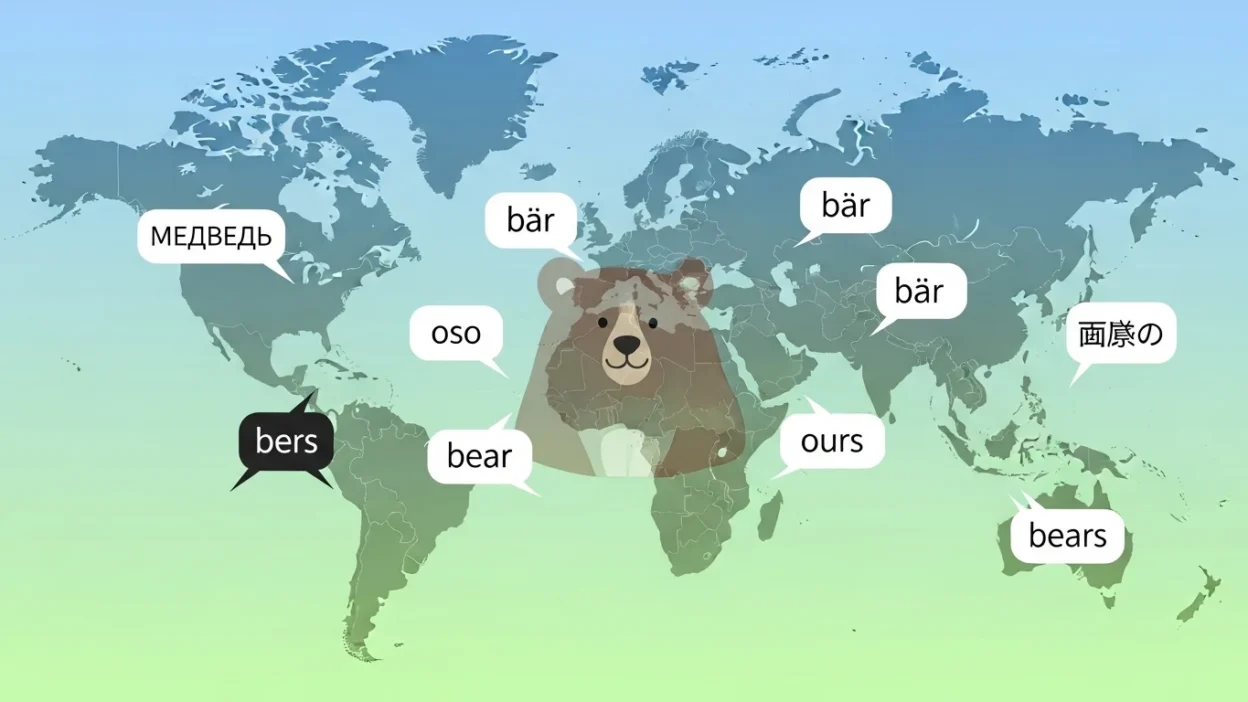
If you are searching for bear in different languages, you are in the right place. The word “bear” is used in stories, wildlife discussions, education, and travel conversations across the world. Learning how to say bear in different languages around the world not only improves your vocabulary but also helps you understand cultural expressions and global communication.
In this guide, you will discover bear translations in all languages, including pronunciation and real-life example sentences. This is perfect for language learners, writers, students, and anyone curious about how to say bear in different languages in a natural and practical way.
Bear in Different Languages (70 Translations Worldwide)
| Language | Pronunciation | Example |
| English | behr | I saw a bear in the forest. (English meaning: I saw a large wild animal in the forest.) |
| Spanish | oso | Vi un oso en el bosque. (English meaning: I saw a bear in the forest.) |
| French | ours | J’ai vu un ours dans la forêt. (English meaning: I saw a bear in the forest.) |
| German | Bär | Ich sah einen Bär im Wald. (English meaning: I saw a bear in the forest.) |
| Italian | orso | Ho visto un orso nel bosco. (English meaning: I saw a bear in the forest.) |
| Portuguese | urso | Vi um urso na floresta. (English meaning: I saw a bear in the forest.) |
| Dutch | beer | Ik zag een beer in het bos. (English meaning: I saw a bear in the forest.) |
| Swedish | björn | Jag såg en björn i skogen. (English meaning: I saw a bear in the forest.) |
| Norwegian | bjørn | Jeg så en bjørn i skogen. (English meaning: I saw a bear in the forest.) |
| Danish | bjørn | Jeg så en bjørn i skoven. (English meaning: I saw a bear in the forest.) |
| Finnish | karhu | Näin karhun metsässä. (English meaning: I saw a bear in the forest.) |
| Icelandic | björn | Ég sá björn í skóginum. (English meaning: I saw a bear in the forest.) |
| Polish | niedźwiedź | Widziałem niedźwiedzia w lesie. (English meaning: I saw a bear in the forest.) |
| Czech | medvěd | Viděl jsem medvěda v lese. (English meaning: I saw a bear in the forest.) |
| Slovak | medveď | Videl som medveďa v lese. (English meaning: I saw a bear in the forest.) |
| Hungarian | medve | Láttam egy medvét az erdőben. (English meaning: I saw a bear in the forest.) |
| Romanian | urs | Am văzut un urs în pădure. (English meaning: I saw a bear in the forest.) |
| Bulgarian | мечка | Видях мечка в гората. (English meaning: I saw a bear in the forest.) |
| Greek | αρκούδα | Είδα μια αρκούδα στο δάσος. (English meaning: I saw a bear in the forest.) |
| Russian | медведь | Я видел медведя в лесу. (English meaning: I saw a bear in the forest.) |
| Ukrainian | ведмідь | Я бачив ведмедя в лісі. (English meaning: I saw a bear in the forest.) |
| Serbian | медвед | Видео сам медведа у шуми. (English meaning: I saw a bear in the forest.) |
| Croatian | medvjed | Vidio sam medvjeda u šumi. (English meaning: I saw a bear in the forest.) |
| Bosnian | medvjed | Vidio sam medvjeda u šumi. (English meaning: I saw a bear in the forest.) |
| Slovene | medved | Videl sem medveda v gozdu. (English meaning: I saw a bear in the forest.) |
| Albanian | ari | Pashë një ari në pyll. (English meaning: I saw a bear in the forest.) |
| Turkish | ayı | Ormanda bir ayı gördüm. (English meaning: I saw a bear in the forest.) |
| Arabic | دب | رأيت دبًا في الغابة. (English meaning: I saw a bear in the forest.) |
| Hebrew | דוב | ראיתי דוב ביער. (English meaning: I saw a bear in the forest.) |
| Persian | خرس | من یک خرس در جنگل دیدم. (English meaning: I saw a bear in the forest.) |
| Urdu | ریچھ | میں نے جنگل میں ریچھ دیکھا۔ (English meaning: I saw a bear in the forest.) |
| Hindi | भालू | मैंने जंगल में भालू देखा। (English meaning: I saw a bear in the forest.) |
| Bengali | ভালুক | আমি জঙ্গলে একটি ভালুক দেখেছি। (English meaning: I saw a bear in the forest.) |
| Punjabi | ਰਿੱਛ | ਮੈਂ ਜੰਗਲ ਵਿੱਚ ਰਿੱਛ ਵੇਖਿਆ। (English meaning: I saw a bear in the forest.) |
| Gujarati | રીંછ | મેં જંગલમાં રીંછ જોયો. (English meaning: I saw a bear in the forest.) |
| Marathi | अस्वल | मी जंगलात अस्वल पाहिले. (English meaning: I saw a bear in the forest.) |
| Tamil | கரடி | நான் காட்டில் கரடியைக் கண்டேன். (English meaning: I saw a bear in the forest.) |
| Telugu | ఎలుగుబంటి | నేను అడవిలో ఎలుగుబంటిని చూశాను. (English meaning: I saw a bear in the forest.) |
| Kannada | ಕರಡಿ | ನಾನು ಕಾಡಿನಲ್ಲಿ ಕರಡಿಯನ್ನು ನೋಡಿದೆ. (English meaning: I saw a bear in the forest.) |
| Malayalam | കരടി | ഞാൻ കാട്ടിൽ കരടിയെ കണ്ടു. (English meaning: I saw a bear in the forest.) |
| Sinhala | වලහා | මම වනාන්තරයේ වලහෙක් දැක්කා. (English meaning: I saw a bear in the forest.) |
| Nepali | भालु | मैले जंगलमा भालु देखेँ। (English meaning: I saw a bear in the forest.) |
| Thai | หมี | ฉันเห็นหมีในป่า (English meaning: I saw a bear in the forest.) |
| Lao | ໝີ | ຂ້ອຍເຫັນໝີໃນປ່າ (English meaning: I saw a bear in the forest.) |
| Vietnamese | gấu | Tôi thấy gấu trong rừng. (English meaning: I saw a bear in the forest.) |
| Indonesian | beruang | Saya melihat beruang di hutan. (English meaning: I saw a bear in the forest.) |
| Malay | beruang | Saya nampak beruang di hutan. (English meaning: I saw a bear in the forest.) |
| Filipino | oso | Nakakita ako ng oso sa kagubatan. (English meaning: I saw a bear in the forest.) |
| Chinese (Simplified) | 熊 | 我在森林里看到了熊。 (English meaning: I saw a bear in the forest.) |
| Chinese (Traditional) | 熊 | 我在森林裡看到了熊。 (English meaning: I saw a bear in the forest.) |
| Japanese | 熊 | 森で熊を見ました。 (English meaning: I saw a bear in the forest.) |
| Korean | 곰 | 나는 숲에서 곰을 보았다. (English meaning: I saw a bear in the forest.) |
| Mongolian | баавгай | Би ойд баавгай харсан. (English meaning: I saw a bear in the forest.) |
| Tibetan | དོམ | ངས་ནགས་ཚལ་ནང་དོམ་མཐོང་། (English meaning: I saw a bear in the forest.) |
| Burmese | ဝက်ဝံ | ငါ တောထဲမှာ ဝက်ဝံကို တွေ့ခဲ့တယ်။ (English meaning: I saw a bear in the forest.) |
| Khmer | ខ្លាឃ្មុំ | ខ្ញុំបានឃើញខ្លាឃ្មុំក្នុងព្រៃ។ (English meaning: I saw a bear in the forest.) |
| Swahili | dubu | Niliona dubu msituni. (English meaning: I saw a bear in the forest.) |
| Hausa | beyar | Na ga beyar a daji. (English meaning: I saw a bear in the forest.) |
| Yoruba | bea | Mo ri bea ninu igbo. (English meaning: I saw a bear in the forest.) |
| Igbo | bea | Ahụrụ m bea n’ọhịa. (English meaning: I saw a bear in the forest.) |
| Zulu | ibhere | Ngibone ibhere ehlathini. (English meaning: I saw a bear in the forest.) |
| Afrikaans | beer | Ek het ’n beer in die bos gesien. (English meaning: I saw a bear in the forest.) |
| Amharic | ድብ | በጫካ ውስጥ ድብ አየሁ። (English meaning: I saw a bear in the forest.) |
| Somali | orso | Waxaan arkay orso kaynta dhexdeeda. (English meaning: I saw a bear in the forest.) |
| Malagasy | orsa | Nahita orsa tany an’ala aho. (English meaning: I saw a bear in the forest.) |
| Māori | pea | I kite au i te pea i te ngahere. (English meaning: I saw a bear in the forest.) |
| Hawaiian | bea | Ua ʻike au i ka bea i ka nahele. (English meaning: I saw a bear in the forest.) |
| Irish | béar | Chonaic mé béar sa choill. (English meaning: I saw a bear in the forest.) |
| Welsh | arth | Gwelais arth yn y goedwig. (English meaning: I saw a bear in the forest.) |
| Scottish Gaelic | mathan | Chunnaic mi mathan sa choille. (English meaning: I saw a bear in the forest.) |
How to Say Bear in Different Languages Around the World
Learning how to say bear in different languages helps you explore linguistic diversity. Across Europe, Asia, Africa, and the Americas, the word changes but the meaning stays the same. This makes bear translations in all languages an interesting study for global communication.
Bear Translations and Language Learning Benefits
Studying bear in different languages translations improves memory, vocabulary, and cultural awareness. It is especially useful for students, travelers, and language enthusiasts who want to expand their multilingual knowledge.
Conclusion
The word “bear” is used worldwide in many forms, but its meaning remains universal. From bear in different languages around the world to local expressions, each language adds its own unique sound and identity. Learning these translations helps you connect with global cultures more deeply.
FAQs
1. What is bear in different languages most commonly used in Europe?
Most European languages use similar roots like “bjørn,” “urso,” or “medved.”
2. Why should I learn bear translations in all languages?
It improves vocabulary, memory, and understanding of global languages.
3. Is bear in different languages similar across Slavic languages?
Yes, many Slavic languages use variations of “medved.”
4. How to say bear in Asian languages?
Examples include “kuma” in Japanese, “xióng” in Chinese, and “gom” in Korean.
5. What is the easiest way to remember bear in different languages?
Group similar language families and practice with example sentences.

David William is a language enthusiast, researcher, and content creator at Lingoveb. With a deep passion for words, meanings, and global communication, he focuses on making language simple, clear, and accessible for readers around the world.