
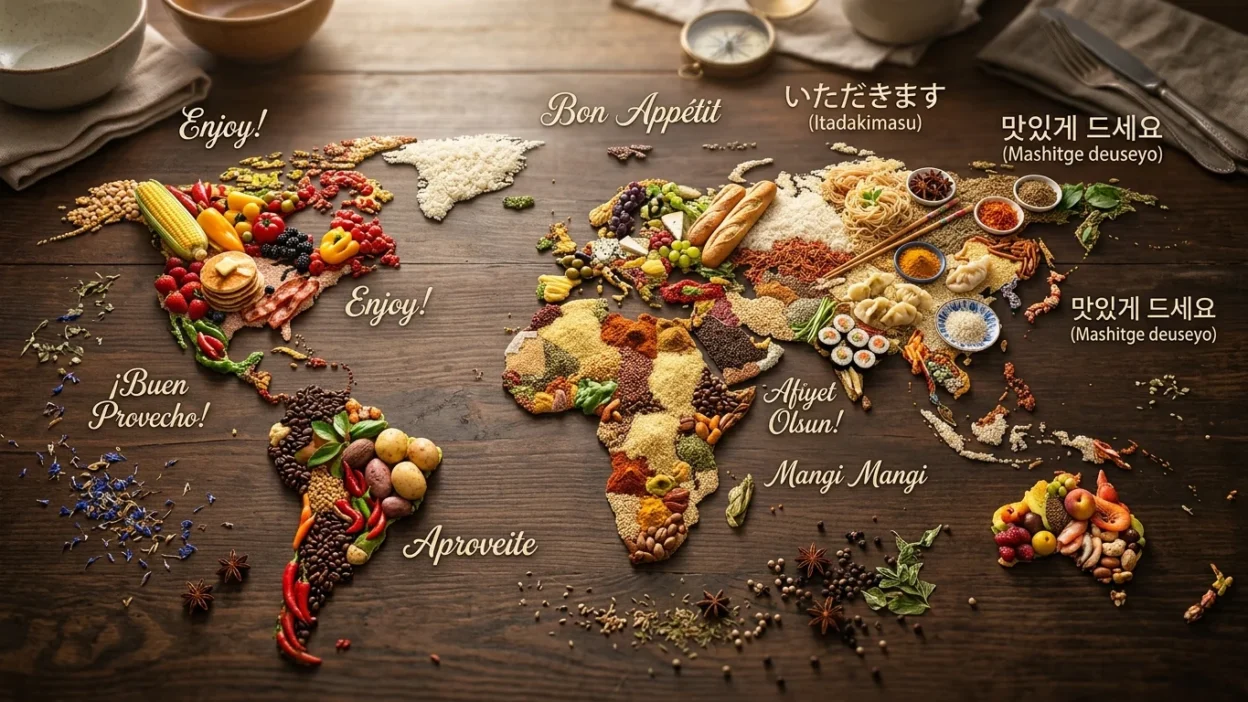
Saying “Bon Appetit” is more than just a phrase it is a warm wish for someone to enjoy their meal. Around the world, every culture has its own beautiful way of expressing this idea.
If you are searching for “100+ bon appetit in different languages”, this guide gives you clear, accurate, and practical translations used in real conversations globally.
Whether you are learning languages, traveling, or simply curious, this guide shows you how to say bon appétit in different languages, its variations, and real-life usage examples.
Bon Appetit in Different Languages Around the World
| Language | Pronunciation | Example |
| English | bon uh-puh-teet | Enjoy your meal! Bon appétit! Meaning: Wishing someone a good meal in English. |
| Spanish | buen provecho | ¡Buen provecho con tu comida! Meaning: Enjoy your meal in Spanish. |
| French | bon appétit | Bon appétit à tous! Meaning: Enjoy your meal everyone in French. |
| German | guten appetit | Guten Appetit beim Essen! Meaning: Enjoy your meal in German. |
| Italian | buon appetito | Buon appetito a tutti! Meaning: Enjoy your meal to everyone in Italian. |
| Portuguese | bom apetite | Bom apetite para você! Meaning: Enjoy your meal in Portuguese. |
| Russian | priyatnogo appetita | Приятного аппетита! Meaning: Enjoy your meal in Russian. |
| Chinese (Simplified) | màn màn chī | 慢慢吃!Meaning: Eat slowly and enjoy in Chinese. |
| Chinese (Traditional) | maan maan si | 慢慢食!Meaning: Enjoy your meal in Traditional Chinese. |
| Japanese | itadakimasu | いただきます!Meaning: I humbly receive this meal in Japanese. |
| Korean | jal meokgesseumnida | 잘 먹겠습니다! Meaning: I will eat well in Korean. |
| Arabic | sahtain | صحتين! Meaning: Double health/enjoy your meal in Arabic. |
| Hindi | shubh bhojan | शुभ भोजन! Meaning: Have a good meal in Hindi. |
| Urdu | khush rahiye khana khayen | خوش رہیے کھانا کھائیں! Meaning: Enjoy your meal in Urdu. |
| Bengali | shubho bhojon | শুভ ভোজন! Meaning: Good meal wishes in Bengali. |
| Turkish | afiyet olsun | Afiyet olsun! Meaning: May it be healthy in Turkish. |
| Persian | noosh-e jaan | نوش جان! Meaning: Enjoy your food in Persian. |
| Dutch | eet smakelijk | Eet smakelijk! Meaning: Enjoy your meal in Dutch. |
| Greek | kali orexi | Καλή όρεξη! Meaning: Good appetite in Greek. |
| Swedish | smaklig måltid | Smaklig måltid! Meaning: Enjoy your meal in Swedish. |
| Norwegian | god appetitt | God appetitt! Meaning: Enjoy your food in Norwegian. |
| Danish | velbekomme | Velbekomme! Meaning: Enjoy your meal in Danish. |
| Finnish | hyvää ruokahalua | Hyvää ruokahalua! Meaning: Good appetite in Finnish. |
| Polish | smacznego | Smacznego! Meaning: Enjoy your meal in Polish. |
| Czech | dobrou chuť | Dobrou chuť! Meaning: Good taste in Czech. |
| Slovak | dobrú chuť | Dobrú chuť! Meaning: Enjoy your meal in Slovak. |
| Hungarian | jó étvágyat | Jó étvágyat! Meaning: Good appetite in Hungarian. |
| Romanian | poftă bună | Poftă bună! Meaning: Enjoy your meal in Romanian. |
| Bulgarian | dobŭr apetit | Добър апетит! Meaning: Good appetite in Bulgarian. |
| Ukrainian | smachnoho | Смачного! Meaning: Enjoy your meal in Ukrainian. |
| Hebrew | bte’avon | בתיאבון! Meaning: Enjoy your meal in Hebrew. |
| Thai | gin hai aroi | กินให้อร่อย! Meaning: Eat deliciously in Thai. |
| Vietnamese | chúc ngon miệng | Chúc ngon miệng! Meaning: Enjoy your meal in Vietnamese. |
| Indonesian | selamat makan | Selamat makan! Meaning: Enjoy eating in Indonesian. |
| Malay | selamat makan | Selamat makan! Meaning: Enjoy your meal in Malay. |
| Filipino | kain na | Kain na! Meaning: Let’s eat in Filipino. |
| Swahili | karibuni chakula | Karibuni chakula! Meaning: Welcome to the meal in Swahili. |
| Zulu | jabula ukudla kwakho | Jabula ukudla kwakho! Meaning: Enjoy your food in Zulu. |
| Afrikaans | geniet jou ete | Geniet jou ete! Meaning: Enjoy your meal in Afrikaans. |
| Amharic | enjera yistilign | እንጀራ ይስጥልኝ! Meaning: Enjoy your meal in Amharic. |
| Tamil | saapidu nalla irukattum | சாப்பிட நல்லா இருக்கட்டும்! Meaning: Enjoy your food in Tamil. |
| Telugu | ruchiga tinandi | రుచిగా తినండి! Meaning: Eat tasty food in Telugu. |
| Marathi | jevan kara | जेवण करा! Meaning: Have your meal in Marathi. |
| Gujarati | jamvanu shubh ho | જમવાનું શુભ હો! Meaning: Have a good meal in Gujarati. |
| Punjabi | changa khana khao | ਚੰਗਾ ਖਾਣਾ ਖਾਓ! Meaning: Eat good food in Punjabi. |
| Nepali | mitho khana khanu hos | मीठो खाना खानुहोस्! Meaning: Enjoy tasty food in Nepali. |
| Sinhala | rasa kema kanna | රස කෑම කන්න! Meaning: Eat delicious food in Sinhala. |
| Khmer | nyam bai ngon | ញាំបាយឆ្ងាញ់! Meaning: Eat tasty rice in Khmer. |
| Lao | kin khao aroi | ກິນເຂົ້າອະຫຼອຍ! Meaning: Enjoy your meal in Lao. |
| Burmese | sa pyaw deh | စားပျော်ပါစေ! Meaning: Enjoy your food in Burmese. |
| Icelandic | góða máltíð | Góða máltíð! Meaning: Good meal in Icelandic. |
| Latvian | labu apetīti | Labu apetīti! Meaning: Enjoy your meal in Latvian. |
| Lithuanian | skanaus | Skanaus! Meaning: Tasty meal in Lithuanian. |
| Estonian | head isu | Head isu! Meaning: Good appetite in Estonian. |
| Serbian | prijatno | Пријатно! Meaning: Enjoy your meal in Serbian. |
| Croatian | dobar tek | Dobar tek! Meaning: Good appetite in Croatian. |
| Bosnian | prijatno | Prijatno! Meaning: Enjoy your meal in Bosnian. |
| Slovenian | dober tek | Dober tek! Meaning: Good appetite in Slovenian. |
| Albanian | ju bëftë mirë | Ju bëftë mirë! Meaning: May it do you good in Albanian. |
| Macedonian | prijatno | Пријатно! Meaning: Enjoy your meal in Macedonian. |
| Maltese | bon appettit | Bon appettit! Meaning: Enjoy your meal in Maltese. |
| Basque | on egin | On egin! Meaning: Have a good meal in Basque. |
| Catalan | bon profit | Bon profit! Meaning: Enjoy your meal in Catalan. |
| Galician | bo proveito | Bo proveito! Meaning: Good benefit in Galician. |
| Welsh | mwynhewch eich bwyd | Mwynhewch eich bwyd! Meaning: Enjoy your food in Welsh. |
| Irish | bain taitneamh as do bhia | Bain taitneamh as do bhia! Meaning: Enjoy your food in Irish. |
| Scottish Gaelic | biadh math | Biadh math! Meaning: Good food in Scottish Gaelic. |
| Maori | kia pai to kai | Kia pai tō kai! Meaning: Enjoy your food in Maori. |
| Samoan | manuia le taumafataga | Manuia le taumafataga! Meaning: Enjoy your meal in Samoan. |
| Haitian Creole | bon apeti | Bon apeti! Meaning: Enjoy your meal in Haitian Creole. |
How to Say Bon Appetit in Different Languages
The phrase “bon appétit” translations vary globally but always carry the same warm meaning: wishing someone enjoyment of food. In many cultures, it is used before eating as a sign of politeness and hospitality.
Bon Appetit Translations Around the World
From Europe to Asia and Africa, each region expresses mealtime blessings differently. While French uses “Bon appétit,” German says “Guten Appetit,” and Japanese uses “Itadakimasu,” all reflect gratitude and respect for food.
Cultural Meaning of Saying Bon Appetit
In many cultures, saying “bon appétit” or its equivalent is more than tradition—it reflects:
- Respect for food
- Gratitude before eating
- Social bonding during meals
Why Learning Food Phrases Matters
Understanding phrases like bon appétit in all languages helps travelers:
- Connect with locals
- Show cultural respect
- Improve language learning
- Enhance dining experiences
Conclusion
Learning how to say “bon appétit” in different languages is a simple yet powerful way to connect with people worldwide. Whether you are traveling, learning languages, or exploring cultures, these expressions make shared meals more meaningful and respectful.
FAQs
1. What does Bon Appetit mean in English?
It means “Enjoy your meal” or wishing someone a good eating experience.
2. How many languages can Bon Appetit be translated into?
It can be translated into hundreds of languages, each with unique expressions.
3. Is Bon Appetit used worldwide?
Yes, especially in French-speaking regions, but many cultures have their own version.
4. What is the most common alternative to Bon Appetit?
“Enjoy your meal” is the most common global alternative.
5. Why do people say Bon Appetit before eating?
It is a polite tradition to wish good health and enjoyment during meals.

Marak Robort is a content writer and researcher with a strong interest in language, meanings, and digital information. His work focuses on presenting clear, easy-to-understand explanations that help readers quickly grasp complex ideas.