Many English learners get confused between “countrys” and “countries.” At first, both words may look correct because they sound similar when spoken. But in English grammar, only one spelling is correct.
This confusion usually happens because English plural rules can be tricky. Some words simply add -s, while others change their ending before becoming plural.
The good news is that this rule is actually very easy once you understand it clearly. After reading this article, you will know exactly:
- Which word is correct
- Why the other one is wrong
- When to use the correct form
- How to avoid this mistake forever
Quick Answer
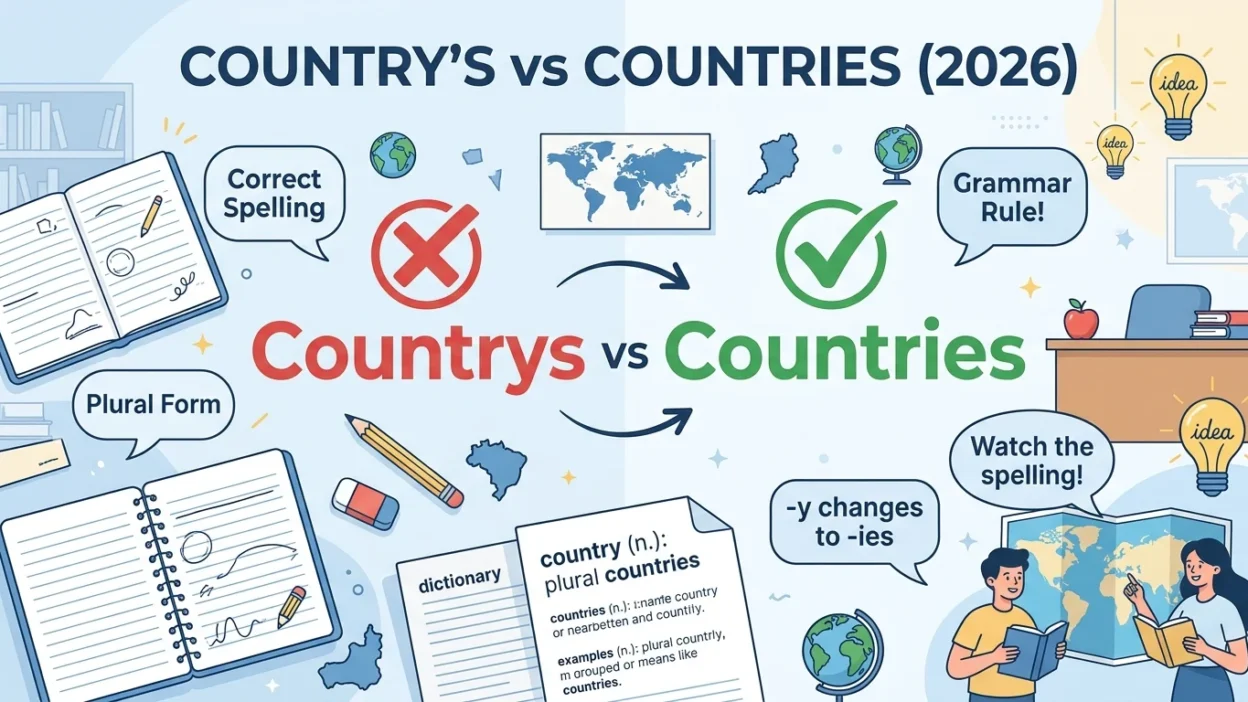
- ✅ Countries = Correct plural form of “country”
- ❌ Countrys = Incorrect spelling
Example:
- Correct: Many countries celebrate national holidays.
- Wrong: Many countrys celebrate national holidays.
Easy Rule:
When a word ends with consonant + y, change y → ies to make it plural.
So:
- country → countries
- city → cities
- baby → babies
Simple Origin or Background Explanation
The word “country” is a noun. It means a nation, land, or state.
Examples:
- Pakistan is a country.
- Japan is a country.
- Canada is a country.
In English, nouns often change form when talking about more than one thing.
For many words, we simply add -s:
- book → books
- car → cars
- apple → apples
But some words follow a different rule.
When a word ends in:
- a consonant + y
the y changes into ies.
That is why:
- country → countries
and not:
- countrys
This rule has been used in English for a very long time.
Clear Explanation of the Difference
The difference is very simple.
“Countries” = Correct
“Countries” is the proper plural form of “country.”
You use it when talking about two or more nations.
Examples:
- Many countries speak English.
- European countries have different cultures.
- Some countries are very small.
“Countrys” = Incorrect
“Countrys” is not accepted in standard English grammar.
Native English speakers, teachers, schools, and dictionaries do not use this spelling.
If you write “countrys” in school, exams, emails, or social media, it will usually be marked as a spelling mistake.
Comparison
| Word | Correct or Wrong? | Meaning | Example |
| country | ✅ Correct | One nation | India is a country. |
| countries | ✅ Correct | More than one nation | Many countries trade together. |
| countrys | ❌ Wrong | No correct meaning | Incorrect spelling |
Which One to Use and When
Use “country”
Use “country” when talking about one nation.
Examples:
- Brazil is a large country.
- My country is beautiful.
- This country has many rivers.
Use “countries”
Use “countries” when talking about more than one nation.
Examples:
- Asian countries have different languages.
- Some countries are very rich.
- Countries work together in global events.
Never Use “countrys”
This spelling is grammatically wrong.
Even if it sounds okay while speaking, it should not be used in writing.
Common Mistakes People Make
Many learners make the same small mistakes with words ending in y.
Mistake 1: Adding only “s”
❌ countrys
✅ countries
People often think every plural simply needs an s, but that is not always true.
Mistake 2: Forgetting the “y → ies” Rule
Words ending in consonant + y usually change like this:
| Singular | Plural |
| country | countries |
| city | cities |
| family | families |
| baby | babies |
| story | stories |
Mistake 3: Mixing Singular and Plural
❌ This countries is large.
✅ This country is large.
❌ These country are famous.
✅ These countries are famous.
Mistake 4: Using Wrong Spellings Online
Sometimes people type quickly on social media and write:
- countrys
- countrie’s
- countrys’
These are incorrect in normal English writing.
Everyday Real Life Examples
Emails
People often use the word “countries” in work and study emails.
Examples:
- We ship products to many countries.
- Students from different countries joined the meeting.
- The company operates in several countries.
News
News reporters frequently use the word when discussing world events.
Examples:
- Countries are working together on climate issues.
- Several countries signed the agreement.
- Rich countries often provide aid.
Social Media
Travel posts and online discussions use this word very often.
Examples:
- I want to visit more countries.
- Which countries have the best food?
- Different countries celebrate differently.
Daily Conversations
People use “countries” in normal speech every day.
Examples:
- How many countries have you visited?
- Some countries are colder than others.
- Countries have different laws.
Short Learning Section for Students and Beginners
Here is an easy way to remember the rule forever.
Step 1: Look at the Last Letter
The word is:
- country
It ends with:
- tr + y
The letter before y is r, which is a consonant.
Step 2: Change “y” to “ies”
So:
- country → countries
Easy Memory Trick
If a word ends in:
- consonant + y
then:
- remove y
- add ies
Examples:
- lady → ladies
- puppy → puppies
- army → armies
But Be Careful
If the word ends in:
- vowel + y
then just add s.
Examples:
- toy → toys
- key → keys
- boy → boys
This is why:
- country → countries
- but
- toy → toys
FAQ
Is “countrys” a real word?
No. “Countrys” is not a correct English word.
What is the correct plural of “country”?
The correct plural is “countries.”
Why does “country” become “countries”?
Because the word ends with a consonant + y. In English, the y changes to ies in many plural forms.
Can I use “countrys” in informal writing?
No. Even in casual writing, it is considered incorrect.
Is “countries” singular or plural?
“Countries” is plural. It means more than one country.
What is the singular form of “countries”?
The singular form is “country.”
Are there other words like “country”?
Yes. Many English words follow the same rule.
Examples:
- city → cities
- family → families
- baby → babies
How can I avoid this mistake?
Remember this simple rule:
- consonant + y = change y to ies
Practice writing examples often until it feels natural.
Conclusion
The confusion between “countrys” and “countries” is very common, especially for students and English learners. But the rule is actually simple once you learn it.
- ✅ “Countries” is the correct plural form.
- ❌ “Countrys” is incorrect.
Whenever a word ends in a consonant + y, English usually changes the y into ies in the plural form.
So always write:
- country → countries
Understanding this small grammar rule will help you write more clearly and confidently in school, exams, emails, social media, and daily English conversations.

Ely Joseph is a language researcher, writer, and contributor who specializes in words, meanings, and multilingual communication. With a strong interest in how language shapes understanding across cultures, Ely focuses on creating clear, accurate, and reader-friendly content for a global audience.