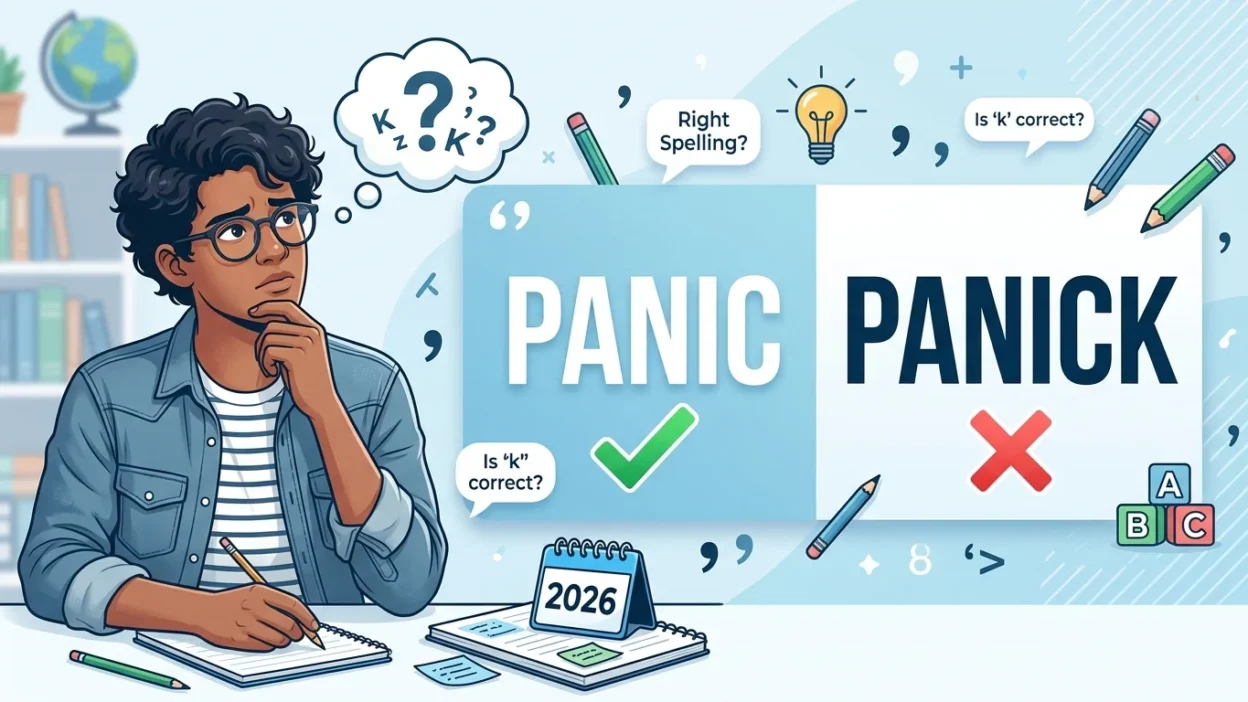
Many English learners and even native speakers get confused between “panic” and “panick.” The two words look very similar, and both seem like they could be correct.
The confusion usually happens because English spelling rules are not always simple. Some words add a “k” before endings like -ed or -ing, while others do not. Because of this, people sometimes think “panick” is a correct word.
The good news is that the answer is actually very simple once you understand the rule.
Quick Answer
- Panic is the correct spelling.
- Panick is incorrect in modern English.
- Use panic as a noun or verb.
- When adding endings:
- panic → panicked
- panic → panicking
- The extra k only appears before some endings, not in the base word itself.
Examples
- Correct: “I started to panic.”
- Correct: “She panicked during the storm.”
- Incorrect: “I started to panick.”
Simple Origin or Background Explanation
The word panic comes from an old Greek word connected to sudden fear. Over time, it became part of English and kept the spelling panic.
English later created forms like:
- panicked
- panicking
In these forms, the extra k helps keep the hard “k” sound before endings like -ed and -ing.
Without the extra k, the pronunciation could become confusing.
For example:
- panic + ing = panicking
- panic + ed = panicked
But the base word itself always stays:
- panic
Not:
- panick
Clear Explanation of the Difference
The biggest difference is very simple:
| Word | Correct or Incorrect? | Meaning |
| panic | Correct | Sudden fear or anxiety |
| panick | Incorrect | Not a standard English word |
What Does “Panic” Mean?
“Panic” means a strong feeling of fear that comes suddenly.
It can be used as:
A Noun
Example:
- “There was panic in the crowd.”
Here, “panic” is a thing or feeling.
A Verb
Example:
- “Don’t panic.”
Here, “panic” is an action.
Why Do People Write “Panick”?
People often add the extra k because of words like:
- panicked
- panicking
When they see these forms, they assume the main word must also be “panick.” But that is not true.
The root word is still:
- panic
The k is only added before certain endings.
Comparison
| Feature | Panic | Panick |
| Correct English spelling | Yes | No |
| Found in dictionaries | Yes | No |
| Used in schools and books | Yes | No |
| Can be a noun | Yes | No |
| Can be a verb | Yes | No |
| Example | “Do not panic.” | Incorrect |
| Past form | Panicked | Not “panicked from panick” |
| -ing form | Panicking | Incorrect base word |
Which One to Use and When
You should always use panic when writing or speaking.
Use “panic” when talking about fear
Examples:
- “I felt panic before the exam.”
- “People panic during emergencies.”
- “Try not to panic.”
Use “panicked” for past actions
Examples:
- “She panicked when she lost her phone.”
- “They panicked after hearing the noise.”
Use “panicking” for actions happening now
Examples:
- “He is panicking about the interview.”
- “Everyone was panicking during the storm.”
Common Mistakes People Make
Many learners make the same small spelling mistakes. Here are the most common ones.
Mistake 1: Writing “panick”
Incorrect:
- “I panick easily.”
Correct:
- “I panic easily.”
Mistake 2: Forgetting the Extra K in “Panicked”
Incorrect:
- “She paniced.”
Correct:
- “She panicked.”
Why?
The extra k keeps the hard sound.
Mistake 3: Forgetting the Extra K in “Panicking”
Incorrect:
- “He is panicing.”
Correct:
- “He is panicking.”
Mistake 4: Thinking “Panick” Is British English
Some learners think:
- panic = American English
- panick = British English
This is not true.
Both American and British English use:
- panic
Everyday Real Life Examples
Emails
- “Please do not panic about the schedule change.”
- “I panicked after missing your message.”
News
- “Shoppers began to panic during the storm warning.”
- “There was panic in the city center.”
Social Media
- “I always panic before presentations.”
- “Why is everyone panicking today?”
Daily Conversations
- “Don’t panic. Everything is okay.”
- “She panicked when the lights went out.”
- “I started panicking before the test.”
Short Learning Section for Students and Beginners
Here is an easy way to remember the rule.
Simple Memory Trick
Think of it like this:
- Base word = panic
- Add endings = sometimes add k
Formula
- panic
- panic + ed = panicked
- panic + ing = panicking
Another Easy Tip
If the word is alone, use:
- panic
If you add:
- -ed
- -ing
then add:
- k
Practice Sentences
Fill in the blanks:
- Don’t ______ during the exam.
- She ______ when she heard the noise.
- They are ______ about the results.
Answers:
- panic
- panicked
- panicking
FAQ
Is “panick” a real English word?
No. “Panick” is not considered correct standard English.
Why does “panicked” have a k?
The extra k keeps the hard sound before -ed.
Is “panic” a noun or a verb?
It can be both.
Examples:
- Noun: “There was panic everywhere.”
- Verb: “Do not panic.”
Which spelling should students use?
Students should always use:
- panic
Never:
- panick
Is “panick” used in British English?
No. British English also uses:
- panic
What is the present participle of panic?
The present participle is:
- panicking
What is the past tense of panic?
The past tense is:
- panicked
Why do people make this mistake?
People see words like “panicked” and “panicking” and think the base word must also include a k.
Conclusion
The difference between panic and panick is actually very simple once you know the spelling rule.
- Panic is the correct word.
- Panick is incorrect.
- Use panic for the main form.
- Add a k only when using endings like:
- panicked
- panicking
This small spelling rule can help you write more clearly and avoid common English mistakes. Once you practice it a few times, the correct form becomes easy to remember.

David William is a language enthusiast, researcher, and content creator at Lingoveb. With a deep passion for words, meanings, and global communication, he focuses on making language simple, clear, and accessible for readers around the world.