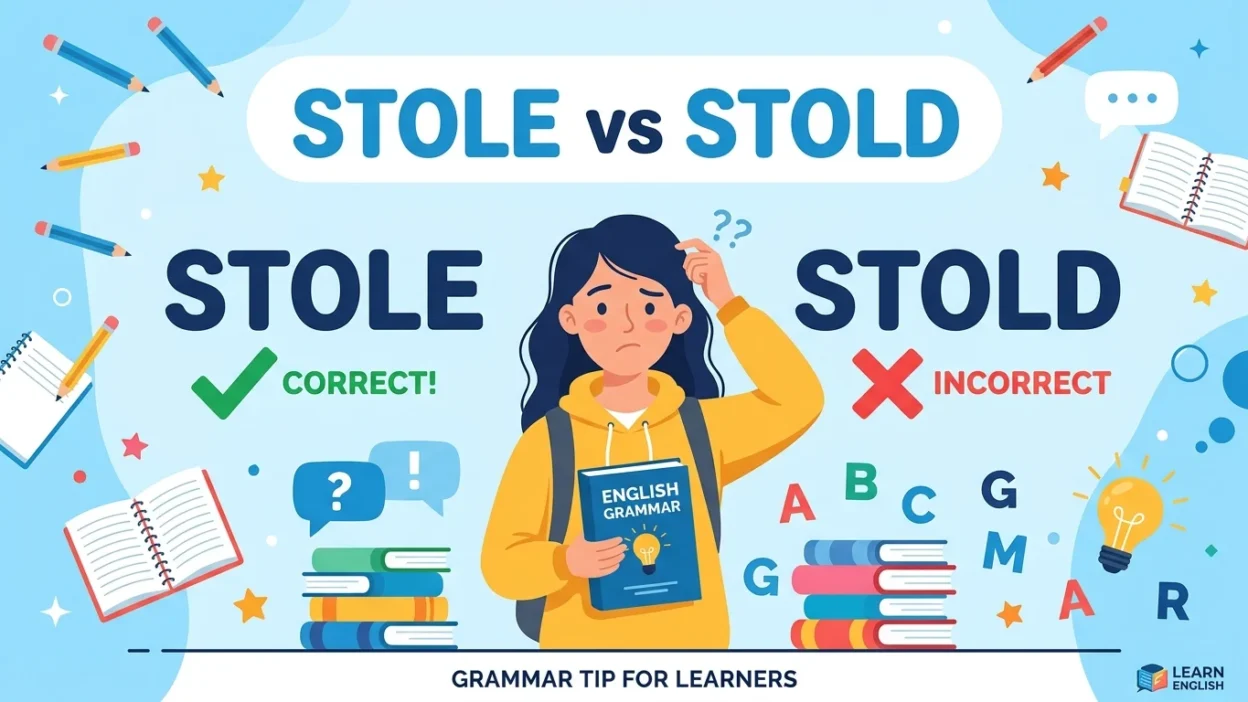
Many English learners get confused between stole and stold because the two words sound similar. English has many irregular verbs, and it is easy to guess the wrong form of a word.
For example, some people think:
- tell → told
- sell → sold
- So maybe steal → stold?
This seems logical, but it is actually incorrect.
The truth is simple: “stold” is not an English word. The correct past form of steal is stole.
This article will explain everything in easy English so you never confuse these words again.
Quick Answer
- ✅ Steal = present tense
- Someone steals my pencil every week.
- ✅ Stole = past tense of steal
- Someone stole my pencil yesterday.
- ✅ Stolen = past participle of steal
- My pencil has been stolen.
- ❌ Stold = incorrect word
- He stold my phone. ✗
Remember:
| Verb Form | Correct Word |
| Present | steal |
| Past | stole |
| Past participle | stolen |
Simple Origin or Background Explanation
English verbs do not always follow one rule.
Many verbs add -ed to make the past tense:
- walk → walked
- play → played
- jump → jumped
But some verbs are irregular. They change in different ways.
Examples:
- go → went
- eat → ate
- speak → spoke
- steal → stole
Because some words end in -old, learners sometimes create the word stold by mistake.
For example:
- sell → sold
- tell → told
This pattern makes people think:
- steal → stold
But English does not work that way. The language developed over many hundreds of years, and many irregular verbs simply have unique forms that must be memorized.
Clear Explanation of the Difference
The difference is very simple.
What Does “Stole” Mean?
Stole is the past tense of steal.
Steal means to take something that belongs to another person without permission.
Examples:
- Someone stole my bicycle.
- A thief stole money from the store.
- She stole my idea.
The action happened in the past.
What Does “Stold” Mean?
Stold has no meaning in standard English.
It is a grammar mistake.
Examples:
- ❌ He stold my wallet.
- ❌ They stold the car.
The correct sentences are:
- ✅ He stole my wallet.
- ✅ They stole the car.
Comparison Table
| Feature | Stole | Stold |
| Is it a real English word? | Yes | No |
| Part of speech | Verb | Not a standard word |
| Meaning | Past tense of “steal” | No meaning |
| Correct grammar | Yes | No |
| Used by native speakers | Yes | No |
| Example | She stole my pen. | She stold my pen. ✗ |
Which One to Use and When
You should use stole whenever you talk about stealing something in the past.
Use “stole”
- Yesterday someone stole my bag.
- The thief stole a watch.
- My brother stole my cookies.
Never use “stold”
- ❌ She stold my notebook.
- ❌ Someone stold my phone.
Always replace stold with stole.
A simple rule:
If the past action is “take without permission,” use stole, never stold.
Common Mistakes People Make
Mistake 1: Following the Pattern of Other Verbs
People think:
- tell → told
- sell → sold
- therefore steal → stold
This is wrong.
The correct form is:
- steal → stole
Mistake 2: Mixing Up “Stole” and “Stolen”
Incorrect:
- ❌ My phone was stole.
Correct:
- ✅ My phone was stolen.
Incorrect:
- ❌ I have stole a cookie.
Correct:
- ✅ I have stolen a cookie.
Remember:
- stole = simple past
- stolen = used with has, have, or was
Mistake 3: Using “Stold” in Writing
Many beginners write:
- ❌ Someone stold my idea.
Correct:
- ✅ Someone stole my idea.
Everyday Real Life Examples
Emails
- Someone stole my laptop from the office.
- My bag was stolen during the trip.
News
- Police said the thief stole several phones.
- A car was stolen last night.
Social Media
- Somebody stole my picture and posted it online.
- My account was stolen by a hacker.
Daily Conversations
- My brother stole my fries.
- Someone stole my seat.
- The dog stole my sandwich.
At School
- Someone stole my pencil.
- A student stole money from another student.
Short Learning Section for Students and Beginners
The easiest way to remember this verb is to learn all three forms together.
Verb Forms
| Base Form | Past Form | Past Participle |
| steal | stole | stolen |
Try saying them aloud:
steal – stole – stolen
Repeat them several times.
Practice Sentences
- I ______ my friend’s pen yesterday.
- Answer: stole
- My bike was ______ last week.
- Answer: stolen
- Someone ______ my lunch.
- Answer: stole
Memory Trick
Think of this sentence:
Yesterday I stole it. Today it is stolen.
This helps you remember the difference between stole and stolen.
FAQ
Is “stold” a real word?
No. Stold is not a standard English word.
What is the past tense of “steal”?
The past tense of steal is stole.
What is the past participle of “steal”?
The past participle is stolen.
Why do people say “stold”?
People often guess the word because of verbs like told and sold.
Which sentence is correct: “He stole my phone” or “He stold my phone”?
The correct sentence is:
He stole my phone.
Can I use “stold” in formal writing?
No. It is considered a grammar mistake.
Is “my wallet was stole” correct?
No.
The correct sentence is:
My wallet was stolen.
How can I remember the correct forms?
Memorize this pattern:
steal → stole → stolen
Simple and Clear Conclusion
The confusion between stole and stold is very common, especially for English learners. However, the rule is easy to remember.
- Steal = present tense
- Stole = past tense
- Stolen = past participle
- Stold = incorrect word
Whenever you talk about someone taking something without permission in the past, always use stole.
A final sentence to remember:
Someone stole my bike.
Never say:
Someone stold my bike. ✗
Once you remember steal – stole – stolen, this mistake becomes easy to avoid forever.

David William is a language enthusiast, researcher, and content creator at Lingoveb. With a deep passion for words, meanings, and global communication, he focuses on making language simple, clear, and accessible for readers around the world.