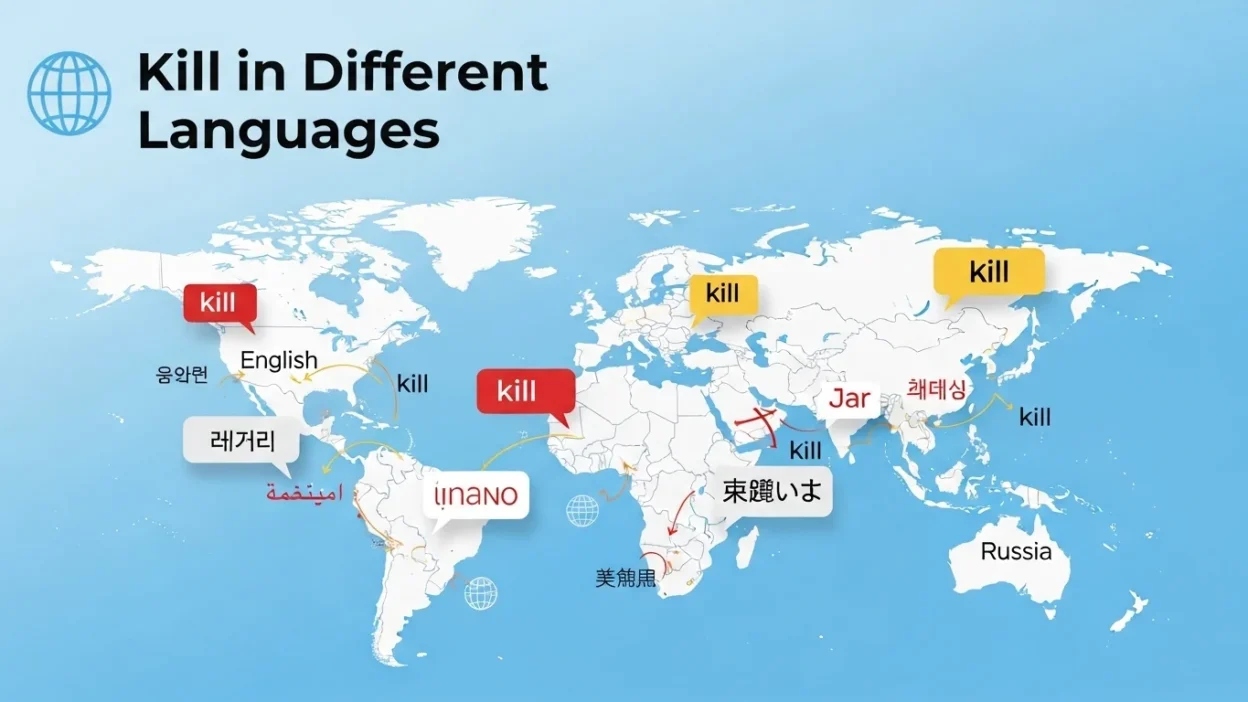
Understanding how to say kill in different languages can be fascinating for linguists, travelers, writers, and language enthusiasts.
Knowing these translations not only broadens your vocabulary but also helps in understanding cultural contexts and media, such as movies, books, and news from around the world.
In this guide, we’ll explore kill translations in 70 languages, with pronunciation tips and real life examples to make learning easier.
Kill in Different Languages: Pronunciation and Examples
| Language | Pronunciation | Example | English Meaning |
| Arabic | qatala | قتل الرجل العنكبوت | The man killed the spider |
| Spanish | matar | Él mató al ratón | He killed the mouse |
| French | tuer | Elle a tué l’insecte | She killed the insect |
| German | töten | Er tötete die Schlange | He killed the snake |
| Italian | uccidere | Hanno ucciso il coniglio | They killed the rabbit |
| Portuguese | matar | Ela matou a mosca | She killed the fly |
| Russian | убить (ubit’) | Он убил муху | He killed a fly |
| Japanese | 殺す (korosu) | 彼はハエを殺した | He killed the fly |
| Chinese (Mandarin) | 杀 (shā) | 他杀了一只蚂蚁 | He killed an ant |
| Korean | 죽이다 (jugida) | 그는 파리를 죽였다 | He killed the fly |
| Hindi | मारना (maarna) | उसने मक्खी को मारा | He killed the fly |
| Bengali | হত্যা করা (hatya kôra) | সে মাকড়সা মারল | He killed the spider |
| Urdu | مارنا (maar-na) | اس نے مکھی مار دی | He killed the fly |
| Turkish | öldürmek | O sineği öldürdü | He killed the fly |
| Persian | کشتن (koshtan) | او مورچه را کشت | He killed the ant |
| Greek | σκοτώνω (skotóno) | Σκότωσε τη μύγα | He killed the fly |
| Hebrew | להרוג (leharog) | הוא הרג את הזבוב | He killed the fly |
| Thai | ฆ่า (khâa) | เขาฆ่ายุง | He killed the mosquito |
| Vietnamese | giết | Anh ấy giết con ruồi | He killed the fly |
| Swahili | kuuua | Alimuua ndege | He killed the bird |
| Malay | membunuh | Dia membunuh nyamuk | He killed the mosquito |
| Indonesian | membunuh | Dia membunuh lalat | He killed the fly |
| Dutch | doden | Hij heeft de vlieg gedood | He killed the fly |
| Polish | zabić | Zabił muchę | He killed the fly |
| Czech | zabít | Zabil mouchu | He killed the fly |
| Slovak | zabiť | Zabil mušku | He killed the fly |
| Hungarian | ölni | Megölte a legyet | He killed the fly |
| Finnish | tappaa | Hän tappoi kärpäsen | He killed the fly |
| Swedish | döda | Han dödade flugan | He killed the fly |
| Norwegian | drepe | Han drepte flua | He killed the fly |
| Danish | dræbe | Han dræbte fluen | He killed the fly |
| Romanian | ucide | A ucis musca | He killed the fly |
| Bulgarian | убивам (ubivam) | Той уби муха | He killed the fly |
| Serbian | убити (ubiti) | Убио је муву | He killed the fly |
| Croatian | ubiti | Ubio je muhu | He killed the fly |
| Bosnian | ubiti | Ubio je muhu | He killed the fly |
| Slovenian | ubiti | Ubil je muho | He killed the fly |
| Albanian | vrava | Ai vrau fluturën | He killed the fly |
| Lithuanian | nužudyti | Jis nužudė musę | He killed the fly |
| Latvian | nogalināt | Viņš nogalināja mušas | He killed the fly |
| Estonian | tappa | Ta tappis kärbse | He killed the fly |
| Georgian | მოკლა (mokla) | ის მოკლა ფრინველი | He killed the bird |
| Armenian | սպանել (spanel) | Նա սպանեց մոծակին | He killed the mosquito |
| Nepali | मार्नु (maarnu) | उसले भृङ्ग मार्यो | He killed the fly |
| Sinhala | මරන්න (maranna) | ඔහු මැස්සා මරා දාලා | He killed the fly |
| Burmese | သတ် (thut) | သူသည်ပျားကိုသတ်သည် | He killed the fly |
| Khmer | សម្លាប់ (samlap) | គាត់សម្លាប់មូស | He killed the mosquito |
| Lao | ฆ่า (khaa) | ລາວຆ່າແມງມຸກ | He killed the fly |
| Mongolian | алах (alakh) | Тэр ялаа алав | He killed the fly |
| Uzbek | o‘ldirmoq | U hasharotni o‘ldirdi | He killed the insect |
| Kazakh | өлтіру (öltiru) | Ол шыбын өлтірді | He killed the fly |
| Tajik | куштан (kushtan) | Ӯ мӯриро кушт | He killed the ant |
| Pashto | وژل (wazhal) | هغه مچ وژله | He killed the fly |
| Kurdish | kuştin | Ew tîrêjê kuşt | He killed the fly |
| Maltese | joqtol | Hu qatel l-ġurdien | He killed the mouse |
| Irish | marú | Mharaigh sé an luch | He killed the mouse |
| Scottish Gaelic | murt | Mhara e am luch | He killed the mouse |
| Welsh | lladd | Lladdodd e’r pry cop | He killed the fly |
| Basque | hil | Hiltzen zuen intsektua | He killed the insect |
| Catalan | matar | Va matar la mosca | He killed the fly |
| Galician | matar | Matou a mosca | He killed the fly |
| Hawaiian | pepehi | Ua pepehi ʻo ia i ka ʻelepū | He killed the mosquito |
| Maori | patu | I patu ia i te pakaru | He killed the fly |
| Filipino | pumatay | Pumatay siya ng langgam | He killed the ant |
| Haitian Creole | touye | Li touye mouch la | He killed the fly |
| Yoruba | pa | Ó pa kokoro | He killed the insect |
| Igbo | igbu | O gburu nwunye | He killed the fly |
| Zulu | ukubulala | Ubulele inhlwathi | He killed the fly |
How to Say “Kill” in Different Languages
Learning kill in different languages helps improve cross-cultural understanding. For writers, it adds authenticity to dialogue. For travelers or language learners, it gives insight into verbs used in various situations. These kill translations show the diversity of expression across the globe.
Tips for Remembering Kill Translations
- Group by language families (e.g., Romance, Germanic, Slavic).
- Practice with real sentences like the ones above.
- Use pronunciation aids to improve memory and speaking.
Conclusion
Mastering how to say kill in different languages is a small but fascinating step into the world of global communication. These 70 translations, pronunciations, and examples give you practical insight into kill around the world, making language learning more engaging and memorable.
FAQs
1. What does “kill” mean in different languages?
It generally translates to “to cause death” but has unique pronunciations and contexts in each language.
2. How do you pronounce “kill” in Japanese and Korean?
Japanese: 殺す (korosu), Korean: 죽이다 (jugida).
3. Why is it important to know “kill” translations?
It helps in understanding foreign media, literature, and conversation about serious topics.
4. Can I use the word “kill” in polite conversation in other languages?
Context matters some languages use euphemisms or indirect expressions to sound polite.
5. How can I remember all “kill” translations?
Practice with real life sentences, group by language families, and repeat pronunciation daily.

Marak Robort is a content writer and researcher with a strong interest in language, meanings, and digital information. His work focuses on presenting clear, easy-to-understand explanations that help readers quickly grasp complex ideas.