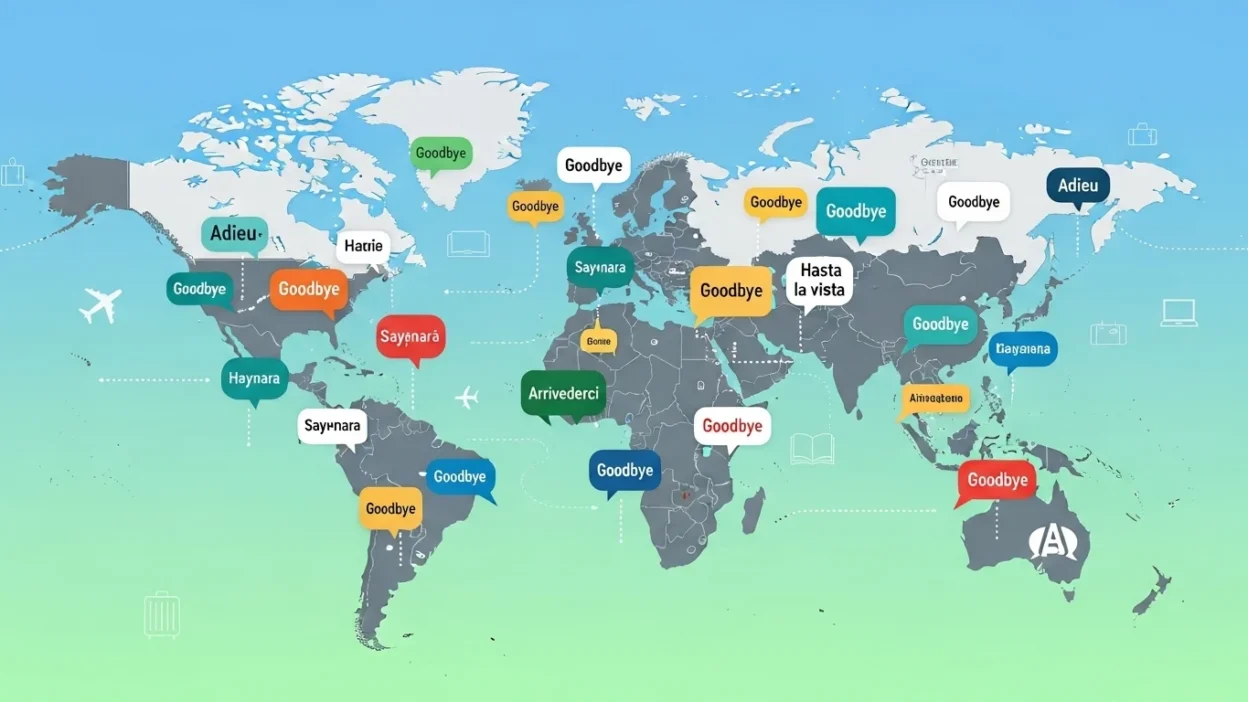
Saying goodbye is a universal part of human communication, yet every culture expresses it in a unique and meaningful way.
Whether you’re traveling, learning a new language, or simply curious, understanding how to say goodbye in different languages helps you connect with people globally.
In this guide, you’ll discover how to say goodbye in different languages, including pronunciation and real life examples.
Goodbye in Different Languages
| Language | Pronunciation | Example |
| English | gud-bai | Goodbye, see you tomorrow. (English: Goodbye, see you tomorrow.) |
| Spanish | ah-dee-os | Adiós amigo. (English: Goodbye friend.) |
| French | oh-reh-vwar | Au revoir, à bientôt. (English: Goodbye, see you soon.) |
| German | tsoos | Tschüss, bis später. (English: Goodbye, see you later.) |
| Italian | chao | Ciao, a dopo. (English: Goodbye, see you later.) |
| Portuguese | ah-deh-oosh | Adeus, meu amigo. (English: Goodbye, my friend.) |
| Dutch | doo | Doei, tot morgen. (English: Goodbye, see you tomorrow.) |
| Russian | da-svee-da-nya | До свидания! (English: Goodbye!) |
| Chinese (Mandarin) | dzai-jyen | 再见! (English: Goodbye!) |
| Japanese | sa-yo-na-ra | さようなら。 (English: Goodbye.) |
| Korean | an-nyeong | 안녕! (English: Goodbye!) |
| Arabic | maa-sa-laa-ma | مع السلامة (English: Goodbye.) |
| Hindi | al-vee-da | अलविदा। (English: Goodbye.) |
| Urdu | al-vee-da | الوداع (English: Goodbye.) |
| Turkish | goo-leh goo-leh | Güle güle! (English: Goodbye!) |
| Greek | ya-su | Γεια σου! (English: Goodbye!) |
| Polish | do-vee-dze-nya | Do widzenia. (English: Goodbye.) |
| Swedish | hey-do | Hejdå! (English: Goodbye!) |
| Danish | hi-doh | Hej då! (English: Goodbye!) |
| Norwegian | hay-duh | Ha det! (English: Goodbye!) |
| Finnish | nah-kee-meen | Näkemiin! (English: Goodbye!) |
| Hungarian | vee-sont-lah-tash-ra | Viszontlátásra! (English: Goodbye!) |
| Czech | nah-skhlay-da-noh | Na shledanou. (English: Goodbye.) |
| Slovak | doh-vee-de-nya | Dovidenia. (English: Goodbye.) |
| Romanian | lah reh-veh-deh-reh | La revedere! (English: Goodbye!) |
| Bulgarian | doh-vizh-da-ne | Довиждане! (English: Goodbye!) |
| Serbian | doh-vee-je-nya | Doviđenja! (English: Goodbye!) |
| Croatian | doh-vee-je-nya | Doviđenja! (English: Goodbye!) |
| Slovenian | nas-vee-je-nye | Nasvidenje! (English: Goodbye!) |
| Ukrainian | doh-svee-da-nya | До побачення! (English: Goodbye!) |
| Hebrew | leh-hit-ra-ot | להתראות (English: Goodbye.) |
| Persian | kho-dah-hah-fez | خداحافظ (English: Goodbye.) |
| Pashto | da-khuda-pa-aman | د خدای په امان (English: Goodbye.) |
| Bengali | bi-dai | বিদায় (English: Goodbye.) |
| Tamil | pohy-vaa | போய்வா (English: Goodbye.) |
| Telugu | vel-ta-nu | వెళ్తాను (English: Goodbye.) |
| Marathi | al-vee-da | अलविदा (English: Goodbye.) |
| Gujarati | aa-voh-jo | આવજો (English: Goodbye.) |
| Punjabi | rab-rakha | ਰੱਬ ਰਾਖਾ (English: Goodbye.) |
| Swahili | kwa-heh-ree | Kwaheri! (English: Goodbye!) |
| Zulu | ham-bah gah-shle | Hamba kahle! (English: Goodbye!) |
| Afrikaans | tot-see-ens | Totsiens! (English: Goodbye!) |
| Amharic | dehna hun | ደህና ሁን (English: Goodbye.) |
| Somali | nabad-gelyo | Nabad gelyo! (English: Goodbye!) |
| Thai | sa-wat-dee | สวัสดี (English: Goodbye.) |
| Vietnamese | tam-biet | Tạm biệt! (English: Goodbye!) |
| Indonesian | sa-lah-mat ting-gal | Selamat tinggal! (English: Goodbye!) |
| Malay | sa-lah-mat jal-an | Selamat jalan! (English: Goodbye!) |
| Filipino | pah-alam | Paalam! (English: Goodbye!) |
| Hawaiian | ah-lo-ha | Aloha! (English: Goodbye!) |
| Maori | hai-reh-rah | Haere rā! (English: Goodbye!) |
| Samoan | toh-fah | Tofa! (English: Goodbye!) |
| Fijian | moo-lah | Moce! (English: Goodbye!) |
| Icelandic | bless | Bless! (English: Goodbye!) |
| Irish | slawn | Slán! (English: Goodbye!) |
| Welsh | hoo-il | Hwyl! (English: Goodbye!) |
| Scottish Gaelic | mar sin leat | Mar sin leat! (English: Goodbye!) |
| Latvian | uz-red-ze-sha-nos | Uz redzēšanos! (English: Goodbye!) |
| Lithuanian | vee-soh ge-roh | Viso gero! (English: Goodbye!) |
| Estonian | nah-gay-mis-tee | Nägemist! (English: Goodbye!) |
| Albanian | mee-roo-pah-fshim | Mirupafshim! (English: Goodbye!) |
| Macedonian | doh-vee-duh-va-nye | Довидување! (English: Goodbye!) |
| Armenian | tsa-tes-utyun | Ցտեսություն (English: Goodbye.) |
| Georgian | nah-khva-mdis | ნახვამდის (English: Goodbye.) |
| Mongolian | bayr-tai | Баяртай (English: Goodbye.) |
| Khmer | lee-hai | លាហើយ (English: Goodbye.) |
| Lao | la-gon | ລາກ່ອນ (English: Goodbye.) |
| Burmese | thwa-meh-naw | သွားမယ်နော် (English: Goodbye.) |
| Nepali | feri bhetaula | फेरि भेटौला (English: See you again.) |
How to Say Goodbye in Different Languages
Learning how to say goodbye in different languages is useful for travel, business, and cultural understanding. Some languages use formal and informal versions, while others reflect emotions like respect or affection.
For example:
- Formal goodbyes are common in professional settings.
- Informal ones are used among friends and family.
- Some phrases literally mean “until we meet again.”
Goodbye Translations Around the World
The way people say goodbye varies across cultures. In some countries, goodbye is brief and casual, while in others it includes gestures, blessings, or extended phrases.
Understanding goodbye translations helps you:
- Communicate respectfully
- Avoid cultural misunderstandings
- Build stronger relationships
Why Learn Goodbye in All Languages?
Knowing goodbye in all languages may not be practical, but learning a variety gives you an advantage when interacting globally.
Benefits include:
- Better travel experiences
- Improved language skills
- Cultural awareness
- Stronger first and last impressions
Conclusion
Saying goodbye is more than just ending a conversation—it reflects culture, respect, and connection. By learning how to say goodbye in different languages, you open doors to meaningful communication around the world. Whether casual or formal, each phrase carries its own charm and significance.
FAQs
1. How do you say goodbye in different languages?
You can say goodbye using phrases like “Adiós” (Spanish), “Au revoir” (French), or “Sayonara” (Japanese), depending on the language.
2. What is the most common way to say goodbye worldwide?
Simple and short phrases like “Bye,” “Ciao,” and “Adiós” are widely recognized across many cultures.
3. Why are there different goodbye translations?
Languages reflect culture, so goodbye expressions vary based on traditions, formality, and social norms.
4. Is goodbye the same in every language?
No, each language has its own unique word or phrase for goodbye, often with multiple variations.
5. How can I remember goodbye in many languages?
Practice regularly, group similar languages, and use real life examples to reinforce memory.