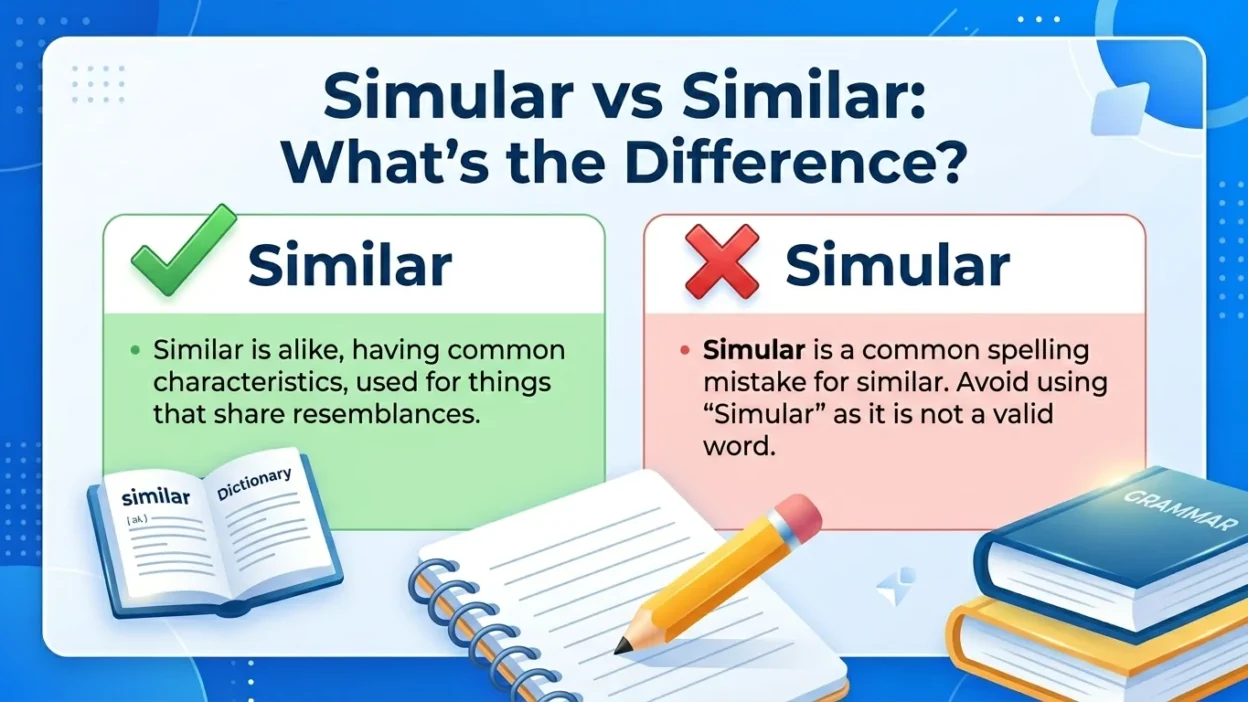
Many English learners become confused by simular and similar because the two words look almost the same. They differ by only one letter, so it is easy to think that both are correct.
You may have seen simular in social media posts, text messages, or online comments. Because it appears so often, some people believe it is a real English word.
The truth is much simpler:
- Similar is the correct English word.
- Simular is usually a spelling mistake.
Understanding this small difference can help you avoid writing errors and improve your English.
Quick Answer
- ✅ Similar = Correct English word.
- ❌ Simular = Incorrect spelling in most situations.
- Use similar when you want to say that two or more things are almost the same.
- Never replace similar with simular in school writing, emails, or professional communication.
Examples:
✅ These two phones are similar.
❌ These two phones are simular.
Simple Origin or Background Explanation
The word similar has been used in English for hundreds of years. It comes from an old Latin word that means like or resembling another thing.
Over time, English kept the spelling similar, and it became the accepted form used in books, schools, and dictionaries.
The word simular does not have the same history in standard English. Most of the time, people write it by mistake because:
- They type too quickly.
- They pronounce the word differently.
- They confuse the letters i and u.
This is why spell check programs often change simular to similar.
Clear Explanation of the Difference
The difference is actually very easy.
Similar
Similar is an adjective. It describes things that are nearly the same but not exactly the same.
Examples:
- My shoes are similar to yours.
- The two houses look similar.
- Their ideas are very similar.
Simular
Simular is generally considered a spelling error.
Examples:
❌ The cars are simular.
✅ The cars are similar.
Whenever you need this meaning, always choose similar.
Comparison Table
| Feature | Similar | Simular |
| Correct English word? | Yes | No |
| Found in dictionaries? | Yes | Usually no |
| Means “almost the same”? | Yes | No |
| Safe to use in writing? | Yes | No |
| Common among learners? | Yes | Often used by mistake |
| Should you learn this spelling? | Yes | No |
Which One to Use and When
The answer is simple: use similar every time you want to talk about things that are alike.
Use “similar” when comparing things.
Examples:
- These paintings are similar.
- Our opinions are similar.
- The new model is similar to the old one.
Do not use “simular.”
Examples:
❌ The books are simular.
✅ The books are similar.
❌ Their ideas are simular.
✅ Their ideas are similar.
A good way to remember this is:
If you mean “almost the same,” write similar.
Common Mistakes People Make
Many learners make the same mistakes when using this word.
Writing “simular” instead of “similar”
This is the most common mistake.
❌ The dresses are simular.
✅ The dresses are similar.
Forgetting to use “to”
The word similar is often followed by to.
❌ My car is similar yours.
✅ My car is similar to yours.
Thinking “similar” means exactly the same
The word does not mean identical.
For example:
- Two blue shirts can be similar, but they may have different sizes or designs.
Using it in formal writing without checking spelling
Even one small spelling mistake can make writing look less professional.
Always double check the word:
✅ Similar
❌ Simular
Everyday Real Life Examples
Emails
✅ Your report is similar to last year’s report.
✅ The two project ideas are very similar.
News
✅ Experts say the weather pattern is similar to the one seen last year.
✅ The new law is similar to older rules.
Social Media
✅ This movie is similar to my favorite film.
✅ Your new profile picture looks similar to the old one.
Daily Conversations
✅ Our bags look similar.
✅ Their houses are very similar.
✅ My schedule is similar to yours.
Short Learning Section for Students and Beginners
Here are some easy tips to remember the correct word.
Tip 1: Remember the Letter “I”
The correct word has an i in the middle:
sim-i-lar
Not:
sim-u-lar
Tip 2: Think of “same”
If two things are almost the same, use similar.
Example:
- Cats and tigers are similar in some ways.
Tip 3: Read the Word Slowly
Break it into parts:
sim + i + lar
Reading it slowly can help you spell it correctly.
Tip 4: Practice With Sentences
- My shoes are similar to yours.
- The twins look similar.
- These games are similar.
The more you practice, the easier it becomes.
Frequently Asked Questions (FAQ)
Is “simular” a real English word?
No. In normal English writing, it is considered a spelling mistake.
Which spelling is correct: simular or similar?
Similar is the correct spelling.
What does “similar” mean?
It means that things are almost the same or look alike.
Can I use “simular” in school assignments?
No. Teachers expect you to write similar.
Why do people write “simular”?
Usually because they type too quickly or confuse the spelling.
Is “similar” an adjective?
Yes. It describes nouns that are alike.
Example:
- The two cars are similar.
Do I need the word “to” after “similar”?
Usually, yes.
Example:
- This phone is similar to mine.
Does “similar” mean exactly the same?
No. It means nearly the same, not identical.
Simple Practice Exercise
Choose the correct word.
- The two pictures are ______.
- My jacket is ______ to yours.
- Their ideas are very ______.
Answers:
- similar
- similar
- similar
There is never a correct answer using simular in these sentences.
Conclusion
The confusion between simular and similar is easy to fix.
Remember these important points:
- ✅ Similar is the correct English word.
- ❌ Simular is usually a spelling mistake.
- Similar means that two or more things are almost the same.
- Use similar in school work, emails, conversations, and everyday writing.
Whenever you are unsure, ask yourself this simple question:
Do I mean “almost the same”?
If the answer is yes, the word you need is similar.

Ely Joseph is a language researcher, writer, and contributor who specializes in words, meanings, and multilingual communication. With a strong interest in how language shapes understanding across cultures, Ely focuses on creating clear, accurate, and reader-friendly content for a global audience.