Many English learners get confused when writing the plural form of the word “story.” Some people write storys, while others write stories. Since English spelling rules can sometimes feel tricky, this mistake is very common.
The confusion usually happens because many English words simply add -s to become plural. For example:
- book → books
- car → cars
- apple → apples
So learners naturally think:
- story → storys
But English has a special spelling rule for words ending in -y. That is why the correct plural form is different.
The good news is that this rule is easy to learn once you see how it works.
Quick Answer
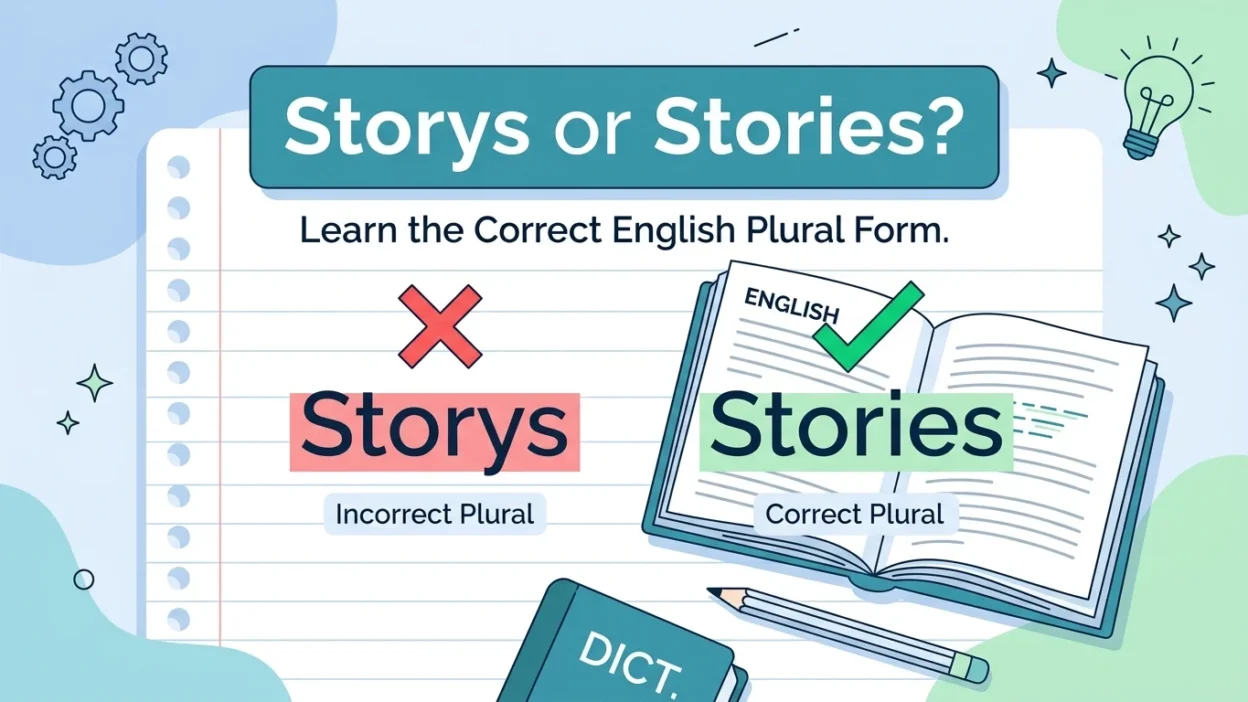
- ✅ Stories is the correct plural form of “story.”
- ❌ Storys is incorrect in standard English.
- Use stories when talking about more than one story.
Examples:
- I read two interesting stories yesterday.
- Her grandmother tells funny stories.
Never write:
- ❌ I read many storys.
Simple Origin or Background Explanation
The word story comes from older forms of English and French. Over time, English developed spelling rules for plural nouns.
One important rule says:
If a word ends in a consonant + y, change the y to i and add -es.
That is exactly what happens with:
- story → stories
- baby → babies
- city → cities
- country → countries
Since the letter before y in “story” is r (a consonant), the spelling changes from y to ies.
That is why:
- ✅ stories
- ❌ storys
Clear Explanation of the Difference
The main difference is very simple:
| Word | Correct or Incorrect | Meaning |
| storys | Incorrect | Not accepted in standard English |
| stories | Correct | More than one story |
The word stories follows the normal English grammar rule for nouns ending in consonant + y.
Why “Storys” Is Wrong
English spelling rules do not allow most consonant + y nouns to become plural by only adding s.
For example:
- baby → babies
- family → families
- lady → ladies
So “story” follows the same pattern:
- story → stories
Writing “storys” breaks this spelling rule.
Why “Stories” Is Correct
The word “stories” follows the proper plural rule:
- Remove the y
- Add ies
Like this:
- story → stories
This is the correct spelling used in books, schools, newspapers, emails, and everyday English.
Comparison
| Singular Form | Plural Form | Correct? |
| story | stories | ✅ Yes |
| story | storys | ❌ No |
| baby | babies | ✅ Yes |
| city | cities | ✅ Yes |
| family | families | ✅ Yes |
Easy Rule to Remember
| Ending | Plural Rule | Example |
| consonant + y | change y to ies | story → stories |
| vowel + y | add s only | boy → boys |
Examples with vowel + y:
- boy → boys
- toy → toys
- key → keys
Because “story” has a consonant before y, it becomes stories.
Which One to Use and When
You should always use stories when talking about more than one story.
Use “Stories” in These Situations
Books and Reading
- I love mystery stories.
- She writes short stories.
School Work
- Students shared their favorite stories in class.
Social Media
- People post personal stories online every day.
News and Journalism
- The newspaper published several important stories.
Daily Conversation
- Grandpa tells amazing stories about his childhood.
Never Use “Storys”
Even in casual writing, texting, or social media, “storys” is still considered incorrect.
Common Mistakes People Make
Learning English spelling takes practice, so mistakes are normal. Here are some common errors people make with “story” and “stories.”
Adding Only “S”
Many learners write:
- ❌ storys
This happens because they follow simple plural patterns like:
- cat → cats
- pen → pens
But “story” follows a different rule.
Forgetting the “Y” Rule
Some students do not remember that consonant + y words change to ies.
Examples:
- ❌ babys
- ❌ citys
- ❌ familys
Correct forms:
- babies
- cities
- families
Mixing Singular and Plural Forms
Sometimes learners write:
- ❌ One stories
- ❌ Many story
Correct versions:
- ✅ One story
- ✅ Many stories
Spelling Fast Without Checking
People sometimes type quickly and forget grammar rules in emails, chats, or homework.
A quick spelling check can help avoid this mistake.
Everyday Real Life Examples
Emails
- We received many customer stories this week.
- Thank you for sharing your personal stories with us.
News
- The reporter covered several breaking stories.
- Local stories often appear in small newspapers.
Social Media
- People enjoy sharing travel stories online.
- Her Instagram stories are funny and creative.
School and Study
- The teacher asked students to write short stories.
- Children usually enjoy adventure stories.
Daily Conversation
- My father tells bedtime stories every night.
- We heard interesting stories during dinner.
Short Learning Section for Students and Beginners
Here is a very easy way to remember the rule.
Step by Step Rule
If a word ends with:
- consonant + y
Then:
- remove the y
- add ies
Example:
- story → stories
Practice Words
| Singular | Plural |
| story | stories |
| baby | babies |
| city | cities |
| country | countries |
| lady | ladies |
Mini Exercise
Choose the correct word:
- I like reading short ______.
- storys
- stories
✅ Correct answer: stories
- The teacher shared funny ______.
- stories
- storys
✅ Correct answer: stories
Memory Trick
Think:
“Consonant + y = ies”
This small rule can help you spell many English words correctly.
FAQ
Is “storys” ever correct?
No. “Storys” is not correct in standard English spelling.
What is the correct plural of “story”?
The correct plural form is stories.
Why does “story” become “stories”?
Because the word ends in a consonant + y. English grammar changes the y to ies.
Is “stories” singular or plural?
“Stories” is plural.
“Story” is singular.
Can I use “storys” in informal writing?
No. Even in texting or casual writing, “stories” is the correct spelling.
What are similar words to “story”?
Words with the same spelling rule include:
- baby → babies
- city → cities
- family → families
What if a word ends in a vowel + y?
Then you usually add only s.
Examples:
- toy → toys
- boy → boys
- key → keys
How can beginners remember this rule?
Remember this simple pattern:
consonant + y → ies
Example:
- story → stories
Conclusion
The difference between storys and stories is actually very simple once you know the spelling rule.
- ✅ Stories is the correct plural form.
- ❌ Storys is incorrect.
The word “story” ends with a consonant + y, so English grammar changes the y to ies when making it plural.
Examples:
- one story
- two stories
This rule also works for many other English words like:
- baby → babies
- city → cities
- family → families
If you remember the simple pattern “consonant + y = ies,” you will avoid this mistake easily in school, writing, emails, social media, and everyday English.

Marak Robort is a content writer and researcher with a strong interest in language, meanings, and digital information. His work focuses on presenting clear, easy-to-understand explanations that help readers quickly grasp complex ideas.