
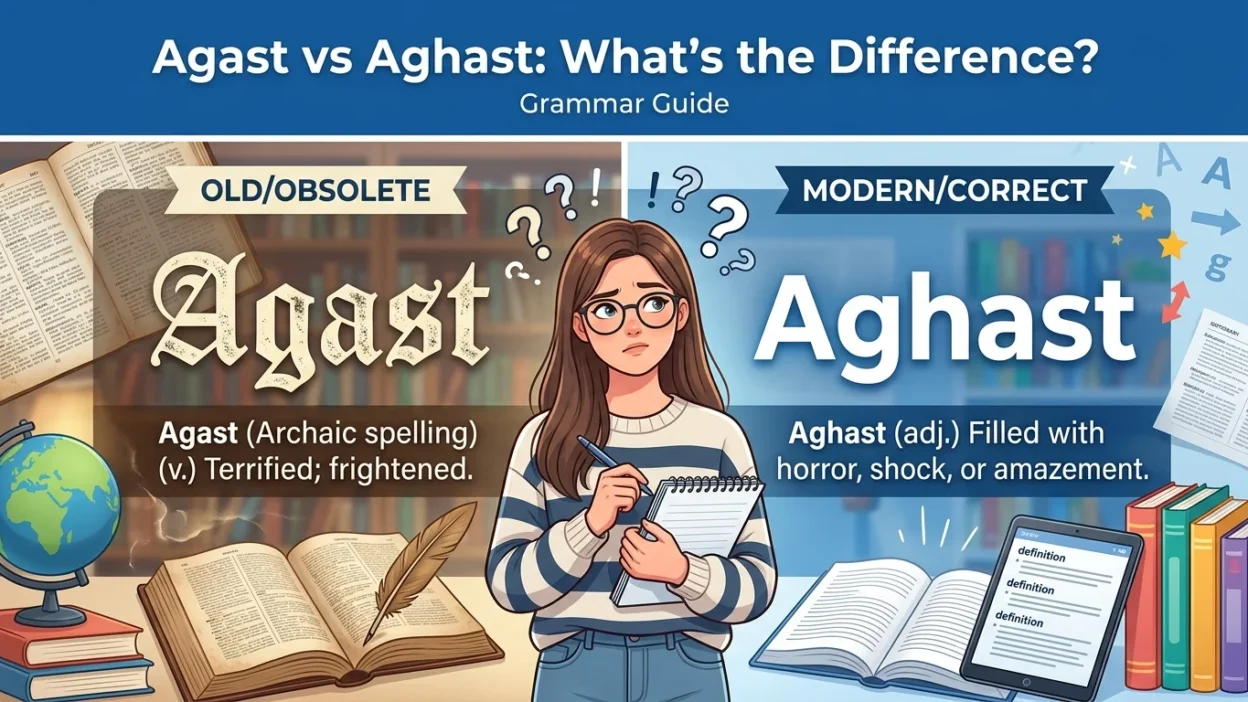
When I first came across AghastDefinition, I honestly thought agast and aghast were both acceptable, but the truth is very clear in 2026 English usage. The correct spelling is Aghast, which is a strong adjective used to express horror, shock, amazement, and a sudden dismay when someone faces an unexpected unpleasant situation.
The word carries deep grammar usage, often seen in formal writing, storytelling, journalism, and even literature novels where a vivid narrative description is needed. Its pronunciation is often written as uh-GAST, but the silent h is what makes many learners confused, especially when they rely only on sound instead of spelling aid mnemonic recall learning tip techniques like thinking of ghost gh or a-g-h-a-s-t structure.
The origin goes back to Old English gæstan, showing its linguistic origin, historical development, and evolution of language through Middle English word traces. It is commonly used in a predicative structure, such as He was aghast, often followed by a preposition at in example sentence usage. In real life, people may say they were aghast at the news, price increase, market collapse, or any shocking disaster scene.
On the other side, AgastStatus is considered an incorrect spelling, a typographical error, and a wrong form caused by missing h omission silent letter confusion. It is not part of standard English, so it should be avoided in professional writing, communication, email, essay, or social media, where clarity readability writing quality credibility professionalism accuracy polished tone really matter. Many grammar checkers, style guides, and even spellcheck autocorrect error detection tools flag it as a mistake because modern English prefers one uniform rule: always use aghast, never use agast.
Quick Answer
- Aghast is the correct and modern English word.
- Aghast means shocked, surprised, frightened, or amazed by something.
- Agast is an old spelling of aghast.
- In modern writing, you should almost always use aghast.
- Most dictionaries and style guides prefer aghast.
- Using agast may look like a spelling mistake to many readers.
Simple Example
✅ I was aghast when I heard the news.
❌ I was agast when I heard the news. (rare and outdated)
Simple Origin or Background Explanation
The word aghast has been part of English for many centuries.
Long ago, English spelling was not as fixed as it is today. Writers often spelled words in different ways. Because of this, both agast and aghast appeared in older texts.
Over time, English became more standardized. The spelling aghast became the accepted form, while agast slowly disappeared from common use.
Today, when people want to describe strong shock or surprise, they almost always use aghast.
Meaning of Aghast
The word means:
- Extremely shocked
- Very surprised
- Deeply upset
- Filled with horror or disbelief
It describes a strong emotional reaction to something unexpected.
Clear Explanation of the Difference
The difference is actually very simple.
Aghast
Aghast is the standard modern spelling.
People use it when they want to describe someone who feels shocked or horrified.
Examples:
- She was aghast at the mistake.
- We were aghast when we saw the damage.
- The teacher looked aghast after hearing the excuse.
Agast
Agast is an old spelling.
It has the same meaning as aghast, but it is rarely used today.
You may find it in:
- Very old books
- Historical texts
- Poetry
- Discussions about language history
Most modern readers expect to see aghast, not agast.
The Easy Rule
If you are writing in modern English:
Use “aghast.”
That is the safest and most correct choice.
Comparison Table
| Feature | Agast | Aghast |
| Meaning | Shocked or horrified | Shocked or horrified |
| Modern usage | Rare | Common |
| Preferred spelling today | No | Yes |
| Seen in old texts | Yes | Yes |
| Seen in modern writing | Very rarely | Frequently |
| Suitable for school writing | Usually no | Yes |
| Suitable for emails | Usually no | Yes |
| Recommended choice | No | Yes |
Which One to Use and When
Use “Aghast” in Modern English
Use aghast when writing:
- School assignments
- Essays
- Emails
- Reports
- Articles
- Social media posts
- Everyday messages
Examples:
- I was aghast when I saw the final bill.
- The family was aghast at the accident.
- Everyone was aghast by the sudden announcement.
Use “Agast” Only in Special Situations
You might see or use agast when:
- Reading historical literature
- Studying old English texts
- Discussing language history
- Quoting an old source
For normal writing, it is best to avoid it.
Quick Memory Tip
Think of it this way:
Aghast = Modern and correct
Agast = Old and uncommon
Common Mistakes People Make
Mistake 1: Thinking They Have Different Meanings
Some learners believe that agast and aghast mean different things.
They do not.
Both words express shock or horror.
The difference is mainly spelling and usage.
Mistake 2: Using Agast in Modern Writing
Many people accidentally write:
- I was agast at the news.
Most readers will expect:
- I was aghast at the news.
Mistake 3: Assuming Agast Is a Typo
In many cases, it is simply an older spelling rather than a mistake.
However, in modern writing, readers may think it is an error because it is so uncommon.
Mistake 4: Confusing Aghast with Angry
Being aghast does not necessarily mean being angry.
Someone can be aghast because they are:
- Shocked
- Surprised
- Horrified
- Deeply disappointed
Anger may be present, but it is not required.
Everyday Real Life Examples
Emails
Example 1:
I was aghast when I discovered the payment had been sent to the wrong account.
Example 2:
The team was aghast to learn that the project files had been deleted.
News
Example 1:
Residents were aghast after seeing the extent of the storm damage.
Example 2:
Viewers were aghast at the shocking report.
Social Media
Example 1:
I’m absolutely aghast at what happened today!
Example 2:
Fans were aghast after the unexpected result.
Daily Conversations
Example 1:
Mom was aghast when she saw the broken window.
Example 2:
I was aghast when I realized I had left my phone on the bus.
Example 3:
Everyone looked aghast after hearing the announcement.
Short Learning Section for Students and Beginners
Easy Definition
Aghast means very shocked, surprised, or horrified.
Easy Sentence Pattern
You can use:
Someone + was + aghast + at/by + something
Examples:
- She was aghast at the mistake.
- They were aghast by the news.
- We were aghast at the result.
Vocabulary Friends of Aghast
- Shocked
- Surprised
- Horrified
- Amazed
- Stunned
- Speechless
Quick Practice
Choose the correct word.
- I was _____ when I heard the news.
- Agast
- Aghast
Answer: Aghast
- The family looked _____ after the accident.
- Aghast
- Agast
Answer: Aghast
- Which spelling is preferred in modern English?
- Agast
- Aghast
Answer: Aghast
FAQ
Is agast a real word?
Yes. It is an older spelling of aghast, but it is rarely used today.
Is aghast the correct spelling?
Yes. Aghast is the standard spelling used in modern English.
Do agast and aghast have different meanings?
No. They share the same basic meaning of being shocked, horrified, or surprised.
Which word should students use?
Students should use aghast because it is the accepted modern form.
Why do some old books use agast?
Older English texts often used different spellings. Agast was one of those older forms.
Can I use agast in an essay?
It is generally better to use aghast unless you are discussing historical language or quoting an old text.
Is aghast a positive or negative word?
It is usually negative because it describes shock, horror, or disbelief.
What is an easy synonym for aghast?
A simple synonym is shocked.
Conclusion
The difference between agast and aghast is much simpler than many people think. Both words carry the same meaning of being shocked, horrified, or deeply surprised. The key difference is that aghast is the modern and widely accepted spelling, while agast is an older form that is rarely used today.
For schoolwork, professional writing, emails, articles, and everyday communication, choose aghast. It is the spelling most readers recognize and expect. Remember the simple rule: use “aghast” for modern English and think of “agast” as an old historical spelling. Once you know this, the confusion disappears completely.

Ely Joseph is a language researcher, writer, and contributor who specializes in words, meanings, and multilingual communication. With a strong interest in how language shapes understanding across cultures, Ely focuses on creating clear, accurate, and reader-friendly content for a global audience.