
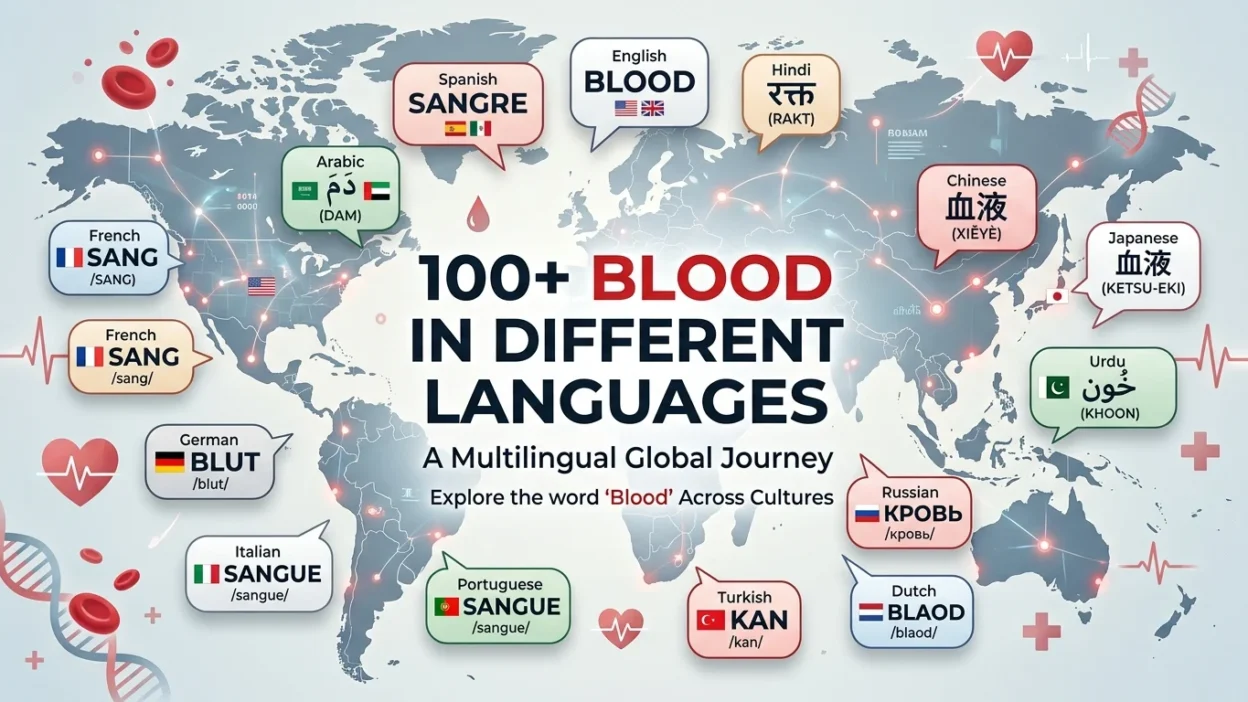
Blood is one of the most important words related to health, medicine, biology, and everyday conversation. People often search for “blood in different languages” to learn translations, improve vocabulary, travel confidently, or understand global cultures. Whether you are a language learner, student, traveler, or translator, knowing how to say blood around the world can be extremely useful.
Blood in Different Languages
| Language | Pronunciation | Example |
| English | bluhd | Blood saves lives. (Meaning: Blood helps save people’s lives.) |
| Spanish | sangre (SAHN-greh) | La sangre es importante. (Meaning: Blood is important.) |
| French | sang (sahn) | Le sang est rouge. (Meaning: Blood is red.) |
| German | blut (bloot) | Blut ist lebenswichtig. (Meaning: Blood is vital for life.) |
| Italian | sangue (SAHN-gweh) | Il sangue circola nel corpo. (Meaning: Blood circulates in the body.) |
| Portuguese | sangue (SAHN-geh) | O sangue transporta oxigênio. (Meaning: Blood carries oxygen.) |
| Dutch | bloed (bloot) | Bloed stroomt door aderen. (Meaning: Blood flows through veins.) |
| Russian | кровь (krov) | Кровь нужна человеку. (Meaning: Blood is needed by humans.) |
| Ukrainian | кров (krov) | Кров дуже важлива. (Meaning: Blood is very important.) |
| Polish | krew (krev) | Krew ratuje życie. (Meaning: Blood saves life.) |
| Czech | krev (krev) | Krev je červená. (Meaning: Blood is red.) |
| Slovak | krv (kurv) | Krv je potrebná. (Meaning: Blood is necessary.) |
| Slovenian | kri (kree) | Kri teče po telesu. (Meaning: Blood flows through the body.) |
| Croatian | krv (kurv) | Krv je važna. (Meaning: Blood is important.) |
| Serbian | крв (kurv) | Крв је живот. (Meaning: Blood is life.) |
| Bosnian | krv (kurv) | Krv spašava živote. (Meaning: Blood saves lives.) |
| Bulgarian | кръв (kruv) | Кръвта е червена. (Meaning: Blood is red.) |
| Romanian | sânge (SUHN-jeh) | Sângele este esențial. (Meaning: Blood is essential.) |
| Greek | αίμα (EH-ma) | Το αίμα είναι σημαντικό. (Meaning: Blood is important.) |
| Turkish | kan (kahn) | Kan hayat verir. (Meaning: Blood gives life.) |
| Arabic | دم (dam) | الدم مهم للجسم. (Meaning: Blood is important for the body.) |
| Hebrew | דם (dam) | דם זורם בגוף. (Meaning: Blood flows in the body.) |
| Persian | خون (khoon) | خون برای بدن ضروری است. (Meaning: Blood is necessary for the body.) |
| Urdu | خون (khoon) | خون زندگی ہے۔ (Meaning: Blood is life.) |
| Hindi | खून (khoon) | खून शरीर में बहता है। (Meaning: Blood flows in the body.) |
| Bengali | রক্ত (rokto) | রক্ত জীবন বাঁচায়। (Meaning: Blood saves lives.) |
| Punjabi | ਖੂਨ (khoon) | ਖੂਨ ਸਰੀਰ ਲਈ ਜ਼ਰੂਰੀ ਹੈ। (Meaning: Blood is necessary for the body.) |
| Gujarati | લોહી (lohi) | લોહી જીવન માટે જરૂરી છે. (Meaning: Blood is necessary for life.) |
| Marathi | रक्त (rakt) | रक्त शरीरात फिरते. (Meaning: Blood moves through the body.) |
| Tamil | இரத்து (raththam) | இரத்து உயிரைக் காக்கிறது. (Meaning: Blood protects life.) |
| Telugu | రక్తం (raktham) | రక్తం చాలా ముఖ్యమైనది. (Meaning: Blood is very important.) |
| Kannada | ರಕ್ತ (rakta) | ರಕ್ತ ಜೀವ ಉಳಿಸುತ್ತದೆ. (Meaning: Blood saves life.) |
| Malayalam | രക്തം (raktham) | രക്തം ശരീരത്തിൽ ഒഴുകുന്നു. (Meaning: Blood flows in the body.) |
| Sinhala | ලේ (lay) | ලේ ජීවිතයට වැදගත්ය. (Meaning: Blood is important for life.) |
| Nepali | रगत (ragat) | रगतले जीवन बचाउँछ। (Meaning: Blood saves life.) |
| Chinese (Mandarin) | 血 (xue) | 血很重要。 (Meaning: Blood is important.) |
| Japanese | 血 (chi) | 血は大切です。 (Meaning: Blood is important.) |
| Korean | 피 (pi) | 피는 생명입니다. (Meaning: Blood is life.) |
| Vietnamese | máu (mao) | Máu rất quan trọng. (Meaning: Blood is very important.) |
| Thai | เลือด (lueat) | เลือดช่วยชีวิตคนได้. (Meaning: Blood can save lives.) |
| Indonesian | darah (dah-rah) | Darah penting bagi tubuh. (Meaning: Blood is important for the body.) |
| Malay | darah (dah-rah) | Darah mengalir dalam badan. (Meaning: Blood flows in the body.) |
| Filipino | dugo (doo-go) | Ang dugo ay mahalaga. (Meaning: Blood is important.) |
| Swahili | damu (DAH-moo) | Damu huokoa maisha. (Meaning: Blood saves lives.) |
| Zulu | igazi (ee-GAH-zee) | Igazi libalulekile. (Meaning: Blood is important.) |
| Afrikaans | bloed (bloot) | Bloed gee lewe. (Meaning: Blood gives life.) |
| Somali | dhiig (dheeg) | Dhiiggu waa muhiim. (Meaning: Blood is important.) |
| Hausa | jini (JEE-nee) | Jini yana da muhimmanci. (Meaning: Blood is important.) |
| Yoruba | ẹjẹ (eh-jeh) | Ẹjẹ ṣe pataki. (Meaning: Blood is important.) |
| Igbo | ọbara (oh-bah-rah) | Ọbara dị mkpa. (Meaning: Blood is important.) |
| Amharic | ደም (dem) | ደም አስፈላጊ ነው። (Meaning: Blood is important.) |
| Finnish | veri (VEH-ree) | Veri on tärkeää. (Meaning: Blood is important.) |
| Swedish | blod (bloo-d) | Blod räddar liv. (Meaning: Blood saves lives.) |
| Norwegian | blod (bloo) | Blod er viktig. (Meaning: Blood is important.) |
| Danish | blod (blohth) | Blod giver liv. (Meaning: Blood gives life.) |
| Icelandic | blóð (bloath) | Blóð er mikilvægt. (Meaning: Blood is important.) |
| Estonian | veri (veh-ri) | Veri päästab elusid. (Meaning: Blood saves lives.) |
| Latvian | asinis (ah-si-nis) | Asinis ir svarīgas. (Meaning: Blood is important.) |
| Lithuanian | kraujas (KROW-yas) | Kraujas gelbsti gyvybes. (Meaning: Blood saves lives.) |
| Hungarian | vér (vair) | A vér fontos. (Meaning: Blood is important.) |
| Albanian | gjak (gyak) | Gjaku shpëton jetë. (Meaning: Blood saves lives.) |
| Georgian | სისხლი (sis-khli) | სისხლი მნიშვნელოვანია. (Meaning: Blood is important.) |
| Armenian | արյուն (aryoon) | Արյունը կյանք է։ (Meaning: Blood is life.) |
| Azerbaijani | qan (ghan) | Qan həyatı xilas edir. (Meaning: Blood saves life.) |
| Kazakh | қан (qan) | Қан өте маңызды. (Meaning: Blood is very important.) |
| Uzbek | qon (qon) | Qon hayot uchun zarur. (Meaning: Blood is necessary for life.) |
| Mongolian | цус (tsus) | Цус амьдралын үндэс. (Meaning: Blood is the basis of life.) |
| Khmer | ឈាម (chhiam) | ឈាមសំខាន់ណាស់។ (Meaning: Blood is very important.) |
| Lao | ເລືອດ (lueat) | ເລືອດສຳຄັນ. (Meaning: Blood is important.) |
| Burmese | သွေး (thway) | သွေးသည် အရေးကြီးသည်။ (Meaning: Blood is important.) |
| Maori | toto (TOH-toh) | He mea nui te toto. (Meaning: Blood is important.) |
| Hawaiian | koko (KOH-koh) | He mea nui ke koko. (Meaning: Blood is important.) |
| Latin | sanguis (SAN-gwis) | Sanguis vita est. (Meaning: Blood is life.) |
How to Say Blood in Different Languages
The word blood changes across cultures and languages, but its importance remains universal. Some languages use words that sound similar because of shared linguistic roots. For example, many European languages have related blood translations derived from ancient Latin or Proto-Indo-European origins.
Learning blood in all languages can help with:
- Travel communication
- Medical vocabulary
- Language learning
- Cultural understanding
- Translation studies
Blood Translations Around the World
Blood translations often reflect cultural and historical influences. In Asian languages, the word may connect closely with life energy and health. In European languages, many blood-related terms come from ancient linguistic families. African and Middle Eastern languages also have unique pronunciations and expressions linked to blood and life.
This makes learning how to say blood in different languages both educational and culturally interesting.
Why Learn Blood in Different Languages?
Understanding blood translations can be useful in real-life situations, especially for travelers, healthcare workers, students, and multilingual learners.
Benefits include:
- Improving global communication
- Understanding medical terms
- Building multilingual vocabulary
- Enhancing translation skills
- Learning cultural expressions
Common Uses of the Word Blood
The word blood is commonly used in:
- Hospitals and healthcare
- Emergency situations
- Biology and science education
- Blood donation campaigns
- Daily conversation and idioms
Because of its universal importance, blood around the world remains one of the most recognized and meaningful words in every language.
Conclusion
Learning blood in different languages is a great way to improve your vocabulary and understand cultures worldwide. From European and Asian languages to African and Middle Eastern translations, the word blood carries deep meaning connected to life, health, and humanity. This guide helps you explore blood translations in all languages with pronunciation and practical examples for everyday learning.
FAQs
1. How do you say blood in different languages?
Blood is spoken differently around the world, such as sangre in Spanish, sang in French, Blut in German, and khoon in Hindi and Urdu.
2. Why is learning blood translations useful?
Learning blood translations helps with travel, healthcare communication, language studies, and understanding global cultures.
3. What is the most common word for blood worldwide?
Many languages use unique words for blood, but terms derived from Latin roots are common in European languages.
4. How can I remember blood in all languages?
You can remember blood translations by practicing pronunciation, reading example sentences, and grouping languages by region.
5. Are blood translations similar in related languages?
Yes, related languages often share similar words for blood because of historical and linguistic connections.

Marak Robort is a content writer and researcher with a strong interest in language, meanings, and digital information. His work focuses on presenting clear, easy-to-understand explanations that help readers quickly grasp complex ideas.