
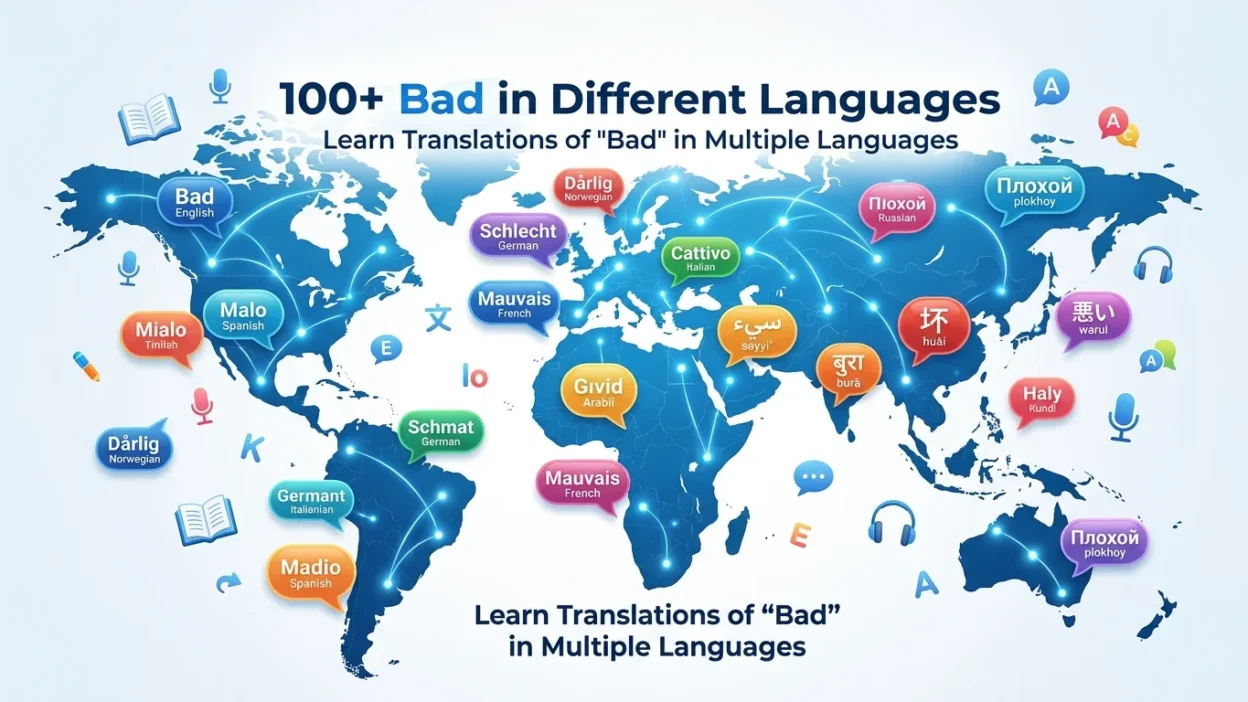
Learning how to say “bad” in different languages is useful for travelers, language learners, students, and anyone interested in global communication.
Whether you want to understand movies, improve your vocabulary, or explore cultural expressions, knowing bad translations around the world can help you communicate more naturally.
In this guide, you will discover how to say “bad” in different languages with pronunciation and real life example sentences.
This easy to read table is designed for quick learning and featured snippet optimization, making it simple to compare “bad” in all languages at once.
How to Say “Bad” in Different Languages
| Language | Pronunciation | Example |
| English | Bad | This food is bad. (Meaning: The food tastes terrible.) |
| Spanish | Malo | Este clima es malo. (Meaning: This weather is bad.) |
| French | Mauvais | Ce film est mauvais. (Meaning: This movie is bad.) |
| German | Schlecht | Das Essen ist schlecht. (Meaning: The food is bad.) |
| Italian | Cattivo | Questo vino è cattivo. (Meaning: This wine is bad.) |
| Portuguese | Mau | O serviço é mau. (Meaning: The service is bad.) |
| Dutch | Slecht | Het weer is slecht. (Meaning: The weather is bad.) |
| Russian | Плохой (Plokhoy) | Это плохая идея. (Meaning: This is a bad idea.) |
| Ukrainian | Поганий (Pohanyy) | Це поганий день. (Meaning: This is a bad day.) |
| Polish | Zły | To jest zły znak. (Meaning: This is a bad sign.) |
| Czech | Špatný | To je špatný hotel. (Meaning: This is a bad hotel.) |
| Slovak | Zlý | Toto je zlý výsledok. (Meaning: This is a bad result.) |
| Hungarian | Rossz | Ez rossz étel. (Meaning: This is bad food.) |
| Romanian | Rău | Vremea este rea. (Meaning: The weather is bad.) |
| Bulgarian | Лош (Losh) | Това е лошо. (Meaning: This is bad.) |
| Greek | Κακός (Kakos) | Αυτό είναι κακό. (Meaning: This is bad.) |
| Turkish | Kötü | Bu kötü bir fikir. (Meaning: This is a bad idea.) |
| Arabic | سيء (Sayyi) | هذا يوم سيء. (Meaning: This is a bad day.) |
| Hebrew | רע (Ra) | זה רע מאוד. (Meaning: This is very bad.) |
| Persian | بد (Bad) | این غذا بد است. (Meaning: This food is bad.) |
| Hindi | बुरा (Bura) | यह बुरा मौसम है। (Meaning: This is bad weather.) |
| Urdu | برا (Bura) | یہ برا خیال ہے۔ (Meaning: This is a bad idea.) |
| Punjabi | ਮਾੜਾ (Maada) | ਇਹ ਮਾੜਾ ਦਿਨ ਹੈ। (Meaning: This is a bad day.) |
| Bengali | খারাপ (Kharap) | এটা খারাপ খাবার। (Meaning: This is bad food.) |
| Gujarati | ખરાબ (Kharab) | આ ખરાબ છે. (Meaning: This is bad.) |
| Marathi | वाईट (Vaait) | हे वाईट आहे. (Meaning: This is bad.) |
| Tamil | மோசம் (Mosam) | இது மோசமான படம். (Meaning: This is a bad movie.) |
| Telugu | చెడు (Chedhu) | ఇది చెడు ఆలోచన. (Meaning: This is a bad idea.) |
| Kannada | ಕೆಟ್ಟ (Ketta) | ಇದು ಕೆಟ್ಟ ದಿನ. (Meaning: This is a bad day.) |
| Malayalam | മോശം (Mosham) | ഇത് മോശം ഭക്ഷണം ആണ്. (Meaning: This is bad food.) |
| Sinhala | නරක (Naraka) | මේ නරකයි. (Meaning: This is bad.) |
| Nepali | खराब (Kharab) | यो खराब मौसम हो। (Meaning: This is bad weather.) |
| Chinese | 坏 (Huài) | 这是坏消息。 (Meaning: This is bad news.) |
| Japanese | 悪い (Warui) | それは悪い考えです。 (Meaning: That is a bad idea.) |
| Korean | 나쁜 (Nappeun) | 이것은 나쁜 습관입니다. (Meaning: This is a bad habit.) |
| Vietnamese | Xấu | Đây là tin xấu. (Meaning: This is bad news.) |
| Thai | แย่ (Yae) | วันนี้อากาศแย่. (Meaning: The weather is bad today.) |
| Indonesian | Buruk | Film ini buruk. (Meaning: This movie is bad.) |
| Malay | Buruk | Cuaca hari ini buruk. (Meaning: Today’s weather is bad.) |
| Filipino | Masama | Masama ang serbisyo. (Meaning: The service is bad.) |
| Swahili | Mbaya | Hii ni habari mbaya. (Meaning: This is bad news.) |
| Zulu | Kubi | Lokhu kubi. (Meaning: This is bad.) |
| Afrikaans | Sleg | Die kos is sleg. (Meaning: The food is bad.) |
| Somali | Xun | Tani waa fikrad xun. (Meaning: This is a bad idea.) |
| Amharic | መጥፎ (Metfo) | ይህ መጥፎ ነው። (Meaning: This is bad.) |
| Hausa | Mugu | Wannan mummunan ra’ayi ne. (Meaning: This is a bad idea.) |
| Yoruba | Buburu | Oju ojo buru. (Meaning: The weather is bad.) |
| Igbo | Ọjọọ | Nke a dị njọ. (Meaning: This is bad.) |
| Finnish | Huono | Tämä on huono päivä. (Meaning: This is a bad day.) |
| Swedish | Dålig | Maten är dålig. (Meaning: The food is bad.) |
| Norwegian | Dårlig | Dette er dårlig vær. (Meaning: This is bad weather.) |
| Danish | Dårlig | Filmen er dårlig. (Meaning: The movie is bad.) |
| Icelandic | Slæmur | Þetta er slæmt. (Meaning: This is bad.) |
| Estonian | Halb | See on halb mõte. (Meaning: This is a bad idea.) |
| Latvian | Slikts | Tas ir slikts ēdiens. (Meaning: That is bad food.) |
| Lithuanian | Blogas | Tai bloga diena. (Meaning: This is a bad day.) |
| Serbian | Лош (Losh) | Ово је лоше. (Meaning: This is bad.) |
| Croatian | Loš | Ovo je loš hotel. (Meaning: This is a bad hotel.) |
| Bosnian | Loš | Ovo je loša ideja. (Meaning: This is a bad idea.) |
| Slovenian | Slab | To je slab rezultat. (Meaning: This is a bad result.) |
| Albanian | Keq | Kjo është keq. (Meaning: This is bad.) |
| Georgian | ცუდი (Tsudi) | ეს ცუდია. (Meaning: This is bad.) |
| Armenian | Վատ (Vat) | Սա վատ է։ (Meaning: This is bad.) |
| Azerbaijani | Pis | Bu pis fikirdir. (Meaning: This is a bad idea.) |
| Kazakh | Жаман (Zharman) | Бұл жаман күн. (Meaning: This is a bad day.) |
| Uzbek | Yomon | Bu yomon ovqat. (Meaning: This is bad food.) |
| Mongolian | Муу (Muu) | Энэ муу мэдээ байна. (Meaning: This is bad news.) |
| Burmese | မကောင်း (Ma Kaung) | ဒီဟာ မကောင်းဘူး။ (Meaning: This is bad.) |
| Khmer | អាក្រក់ (Akrok) | នេះអាក្រក់ណាស់។ (Meaning: This is very bad.) |
| Lao | ບໍ່ດີ (Bo Di) | ອາກາດບໍ່ດີ. (Meaning: The weather is bad.) |
| Maori | Kino | He kino tēnei. (Meaning: This is bad.) |
| Hawaiian | ʻIno | He mea ʻino kēia. (Meaning: This is a bad thing.) |
| Irish | Olc | Tá an aimsir olc. (Meaning: The weather is bad.) |
| Welsh | Drwg | Mae hyn yn ddrwg. (Meaning: This is bad.) |
| Maltese | Ħażin | Dan huwa ħażin. (Meaning: This is bad.) |
Bad in All Languages for Easy Learning
Understanding how to say “bad” in different languages helps improve communication skills and vocabulary building. Many learners search for bad in all languages to compare pronunciation and sentence structure across cultures.
Using simple example sentences makes it easier to remember each translation in real-life situations. You can use these words while traveling, studying foreign languages, or speaking with international friends.
How to Remember “Bad” Translations Faster
Here are some quick tips to remember bad translations around the world:
- Practice 5 languages daily
- Repeat pronunciation aloud
- Use short example sentences
- Watch foreign-language videos
- Write each word in a notebook
Learning through repetition and context is one of the fastest ways to improve language memory.
Why People Search for “How to Say Bad in Different Languages”
Many users look for how to say bad in different languages for reasons such as:
- Travel communication
- School assignments
- Translation projects
- Language learning
- Cultural understanding
- Social media captions
Knowing common words like “bad” helps learners build basic conversations quickly.
Common Uses of the Word “Bad” Around the World
The word “bad” is commonly used to describe:
- Bad weather
- Bad food
- Bad habits
- Bad ideas
- Bad experiences
- Bad news
Even though pronunciation changes across languages, the meaning remains similar in most cultures.
Conclusion
Learning how to say “bad” in different languages is a simple and useful way to expand your global vocabulary. This collection of languages helps learners understand pronunciation, usage, and everyday communication more effectively. Whether you are studying languages, traveling, or exploring cultures, these translations make learning easier and more practical.
FAQs
1. How do you say bad in different languages?
You can say bad in different languages using words like Malo in Spanish, Mauvais in French, Schlecht in German, and Warui in Japanese.
2. What is the most common translation of bad around the world?
Most languages have a direct translation for bad that describes something negative, poor quality, or unpleasant.
3. Why should I learn bad in all languages?
Learning common words like bad improves basic communication skills and helps during travel or language study.
4. Is bad pronounced differently in every language?
Yes, pronunciation changes based on each language’s sound system and writing style.
5. Which languages use similar words for bad?
Languages from nearby regions often use related words, such as Loš in Croatian, Bosnian, and Serbian.

Marak Robort is a content writer and researcher with a strong interest in language, meanings, and digital information. His work focuses on presenting clear, easy-to-understand explanations that help readers quickly grasp complex ideas.