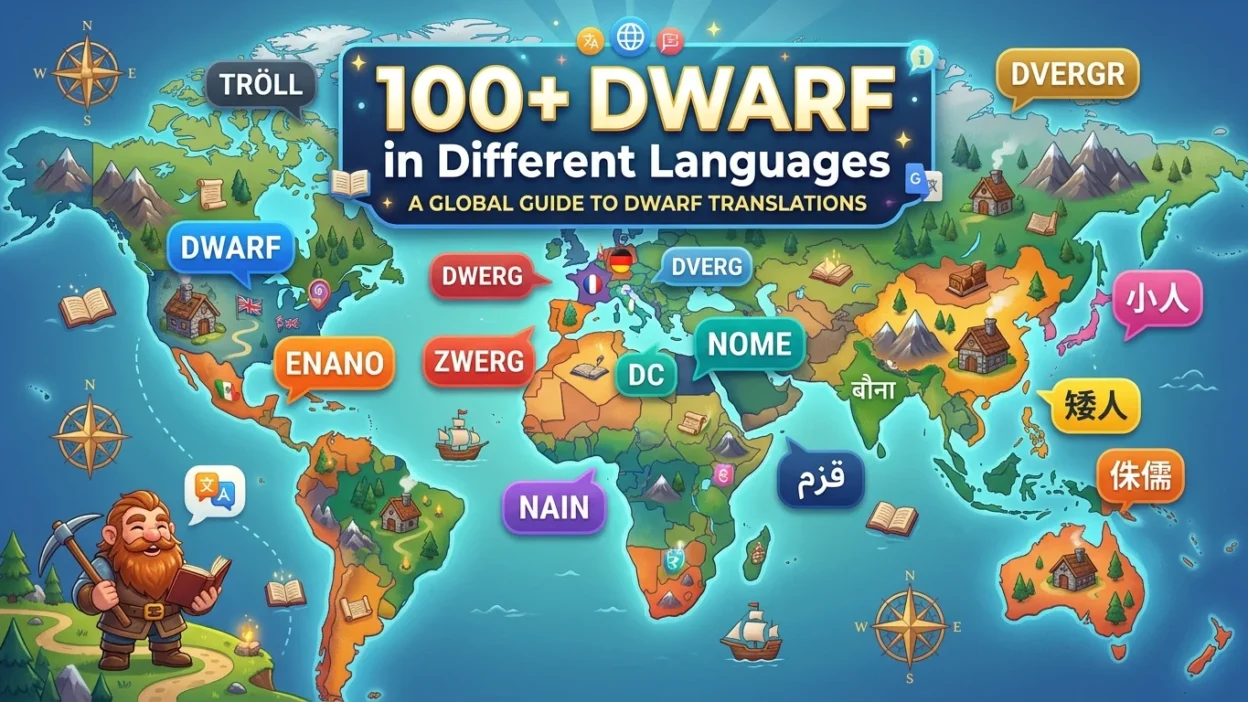
The word “dwarf” is used in many cultures and languages around the world. Whether you are learning languages, translating fantasy stories, studying folklore, or simply curious about global vocabulary, understanding how to say “dwarf” in different languages can be both educational and fascinating.
In this guide, you will discover translations of the word “dwarf” along with pronunciation help and simple real life examples. This article is designed for anyone searching for “dwarf in all languages,” “how to say dwarf in different languages,” and “dwarf translations around the world.”
Dwarf in Different Languages
| Language | Pronunciation | Example |
| English | dworf | The dwarf lives in the mountain village. (Meaning: A small mythical person lives in the mountain village.) |
| Spanish | enano | El enano trabaja en la mina. (Meaning: The dwarf works in the mine.) |
| French | nain | Le nain porte une grande hache. (Meaning: The dwarf carries a big axe.) |
| German | zwerg | Der Zwerg construit une maison. (Meaning: The dwarf builds a house.) |
| Italian | nano | Il nano racconta una storia. (Meaning: The dwarf tells a story.) |
| Portuguese | anão | O anão mora na floresta. (Meaning: The dwarf lives in the forest.) |
| Dutch | dwerg | De dwerg fait du métal. (Meaning: The dwarf makes metal tools.) |
| Russian | karlik | Карлик идёт по дороге. (Meaning: The dwarf walks on the road.) |
| Ukrainian | karlyk | Карлик живе в печері. (Meaning: The dwarf lives in a cave.) |
| Polish | krasnolud | Krasnolud trzyma młot. (Meaning: The dwarf holds a hammer.) |
| Czech | trpaslík | Trpaslík pracuje celý den. (Meaning: The dwarf works all day.) |
| Slovak | trpaslík | Trpaslík nosí zlato. (Meaning: The dwarf carries gold.) |
| Hungarian | törpe | A törpe egy erdőben él. (Meaning: The dwarf lives in a forest.) |
| Romanian | pitic | Piticul cântă frumos. (Meaning: The dwarf sings beautifully.) |
| Bulgarian | dzhudzhe | Джуджето копае камъни. (Meaning: The dwarf digs stones.) |
| Greek | nanos | Ο νάνος περπατά γρήγορα. (Meaning: The dwarf walks quickly.) |
| Turkish | cüce | Cüce büyük bir kapı açtı. (Meaning: The dwarf opened a big door.) |
| Arabic | qazam | القزم يحمل حقيبة. (Meaning: The dwarf carries a bag.) |
| Hebrew | gamad | הגמד עובד בשקט. (Meaning: The dwarf works quietly.) |
| Persian | kotoleh | کوتوله در خانه است. (Meaning: The dwarf is in the house.) |
| Hindi | bauna | बौना जंगल में रहता है। (Meaning: The dwarf lives in the jungle.) |
| Urdu | bona | بونا بازار گیا۔ (Meaning: The dwarf went to the market.) |
| Bengali | bamon | বামন বই পড়ছে। (Meaning: The dwarf is reading a book.) |
| Punjabi | bona | ਬੋਨਾ ਘਰ ਵਿੱਚ ਹੈ। (Meaning: The dwarf is in the house.) |
| Gujarati | vaman | વામન રસ્તા પર ચાલે છે। (Meaning: The dwarf walks on the road.) |
| Marathi | bona | बुटका माणूस गात आहे। (Meaning: The dwarf is singing.) |
| Tamil | kullan | குள்ளன் ஒரு கதை சொல்கிறான். (Meaning: The dwarf tells a story.) |
| Telugu | potti manishi | పొట్టి మనిషి నవ్వుతున్నాడు. (Meaning: The dwarf is laughing.) |
| Kannada | kubja | ಕುಬ್ಜನು ಮನೆ ಕಟ್ಟಿದನು. (Meaning: The dwarf built a house.) |
| Malayalam | kullan | കുള്ളൻ മീൻ പിടിക്കുന്നു. (Meaning: The dwarf catches fish.) |
| Sinhala | miti miniha | මිටි මිනිහා දුවනවා. (Meaning: The dwarf is running.) |
| Nepali | hocho manche | होचो मान्छे बोल्दैछ। (Meaning: The dwarf is speaking.) |
| Chinese | airen | 矮人住在山里。 (Meaning: The dwarf lives in the mountains.) |
| Japanese | kobito | 小人は森にいます。 (Meaning: The dwarf is in the forest.) |
| Korean | nanjang-i | 난쟁이가 노래해요. (Meaning: The dwarf sings.) |
| Vietnamese | nguoi lun | Người lùn đang làm việc. (Meaning: The dwarf is working.) |
| Thai | khon taen | คนแคระเดินเร็วมาก. (Meaning: The dwarf walks very fast.) |
| Indonesian | kurcaci | Kurcaci membuat pedang. (Meaning: The dwarf makes a sword.) |
| Malay | orang kerdil | Orang kerdil itu kuat. (Meaning: The dwarf is strong.) |
| Filipino | unano | Ang unano ay masaya. (Meaning: The dwarf is happy.) |
| Swahili | kibete | Kibete anakaa kijijini. (Meaning: The dwarf lives in the village.) |
| Afrikaans | dwerg | Die dwerg bou ‘n brug. (Meaning: The dwarf builds a bridge.) |
| Zulu | umfushane | Umfushane uyacula. (Meaning: The dwarf is singing.) |
| Xhosa | umfutshane | Umfutshane uyasebenza. (Meaning: The dwarf is working.) |
| Somali | gaaban | Ninka gaaban wuu socdaa. (Meaning: The dwarf is walking.) |
| Amharic | achir sew | አጭር ሰው በቤት ነው። (Meaning: The dwarf is at home.) |
| Hausa | gajere | Mutum gajere yana dariya. (Meaning: The dwarf is laughing.) |
| Yoruba | eniyan kukuru | Eniyan kukuru naa ṣiṣẹ. (Meaning: The dwarf worked.) |
| Igbo | onye mkpụmkpụ | Onye mkpụmkpụ gara ahịa. (Meaning: The dwarf went to the market.) |
| Danish | dværg | Dværgen laver smykker. (Meaning: The dwarf makes jewelry.) |
| Swedish | dvärg | Dvärgen bor nära floden. (Meaning: The dwarf lives near the river.) |
| Norwegian | dverg | Dvergen finner gull. (Meaning: The dwarf finds gold.) |
| Finnish | kääpiö | Kääpiö lukee kirjaa. (Meaning: The dwarf reads a book.) |
| Icelandic | dvergur | Dvergur gengur hægt. (Meaning: The dwarf walks slowly.) |
| Estonian | päkapikk | Päkapikk elab metsas. (Meaning: The dwarf lives in the forest.) |
| Latvian | punduris | Punduris skrien ātri. (Meaning: The dwarf runs fast.) |
| Lithuanian | nykštukas | Nykštukas stato namą. (Meaning: The dwarf builds a house.) |
| Serbian | patuljak | Patuljak nosi torbu. (Meaning: The dwarf carries a bag.) |
| Croatian | patuljak | Patuljak kuha večeru. (Meaning: The dwarf cooks dinner.) |
| Bosnian | patuljak | Patuljak otvara vrata. (Meaning: The dwarf opens the door.) |
| Slovenian | palček | Palček živi v jami. (Meaning: The dwarf lives in a cave.) |
| Albanian | xhuxh | Xhuxhi po këndon. (Meaning: The dwarf is singing.) |
| Georgian | kubja | კუბჯა მუშაობს მაღაროში. (Meaning: The dwarf works in the mine.) |
| Armenian | dwarf | Թզուկը քայլում է։ (Meaning: The dwarf is walking.) |
| Azerbaijani | cırtdan | Cırtdan kitab oxuyur. (Meaning: The dwarf reads a book.) |
| Kazakh | ergejeili | Ергежейлі үйде отыр. (Meaning: The dwarf sits at home.) |
| Uzbek | mitti odam | Mitti odam yugurmoqda. (Meaning: The dwarf is running.) |
| Mongolian | odoy hun | Одой хүн дуулж байна. (Meaning: The dwarf is singing.) |
| Lao | khon te | ຄົນເຕ້ຍກຳລັງເຮັດວຽກ. (Meaning: The dwarf is working.) |
| Khmer | mnus teab | មនុស្សទាបកំពុងដើរ។ (Meaning: The dwarf is walking.) |
| Burmese | putho | ပုတိုလူကရယ်နေသည်။ (Meaning: The dwarf is laughing.) |
| Irish | abhac | Tá an t-abhac sa teach. (Meaning: The dwarf is in the house.) |
| Welsh | corrach | Mae’r corrach yn dawnsio. (Meaning: The dwarf is dancing.) |
| Maltese | nanu | In-nanu qiegħed jaħdem. (Meaning: The dwarf is working.) |
How to Say Dwarf in Different Languages
The word “dwarf” changes significantly from one language to another. In European languages, many translations are linked to mythology and folklore. In Asian and African languages, the word often describes a very short person or a mythical small being.
People commonly search for dwarf translations when reading fantasy novels, translating stories, learning languages, or exploring global cultures.
Dwarf Translations Around the World
Different cultures use unique words for dwarf characters in legends, movies, and literature. For example:
- German folklore often uses the word “Zwerg”
- Scandinavian cultures use “Dværg” or “Dverg”
- Japanese uses “Kobito”
- Spanish uses “Enano”
These dwarf in all languages examples show how language reflects cultural traditions and storytelling history.
Why Learn Dwarf in Multiple Languages?
Learning how to say dwarf in different languages can help with:
- Language learning
- Travel communication
- Translation projects
- Fantasy writing
- Gaming and storytelling
- Cultural understanding
It also improves vocabulary knowledge and helps learners understand how words evolve across regions.
Common Uses of the Word Dwarf
The term “dwarf” may refer to:
- A mythical fantasy creature
- A person with short stature
- A small version of an object or plant
- Astronomical terms like dwarf planets
Because of these multiple meanings, dwarf translations can vary slightly depending on the context and country.
Conclusion
Understanding dwarf in different languages is useful for language learners, translators, writers, and curious readers. From Europe to Asia and Africa, every culture has its own unique way to express the idea of a dwarf. These translations and examples make it easier to learn and compare dwarf translations around the world.
FAQs
1. How do you say dwarf in different languages?
You can say dwarf as “Zwerg” in German, “Enano” in Spanish, “Kobito” in Japanese, “Nain” in French, and “Kurcaci” in Indonesian.
2. What is the most common translation of dwarf around the world?
Common translations include “Zwerg,” “Enano,” “Nain,” and “Dværg,” especially in European languages.
3. Why do people search for dwarf translations?
People search for dwarf translations for language learning, fantasy writing, gaming, literature, and cultural studies.
4. Is the word dwarf used differently in some languages?
Yes, some languages use the word mainly for mythology, while others use it to describe short stature or small objects.
5. Which language has the easiest word for dwarf?
Many learners find simple forms like “Nano” in Italian or “Nanu” in Maltese easy to remember and pronounce.

Marak Robort is a content writer and researcher with a strong interest in language, meanings, and digital information. His work focuses on presenting clear, easy-to-understand explanations that help readers quickly grasp complex ideas.