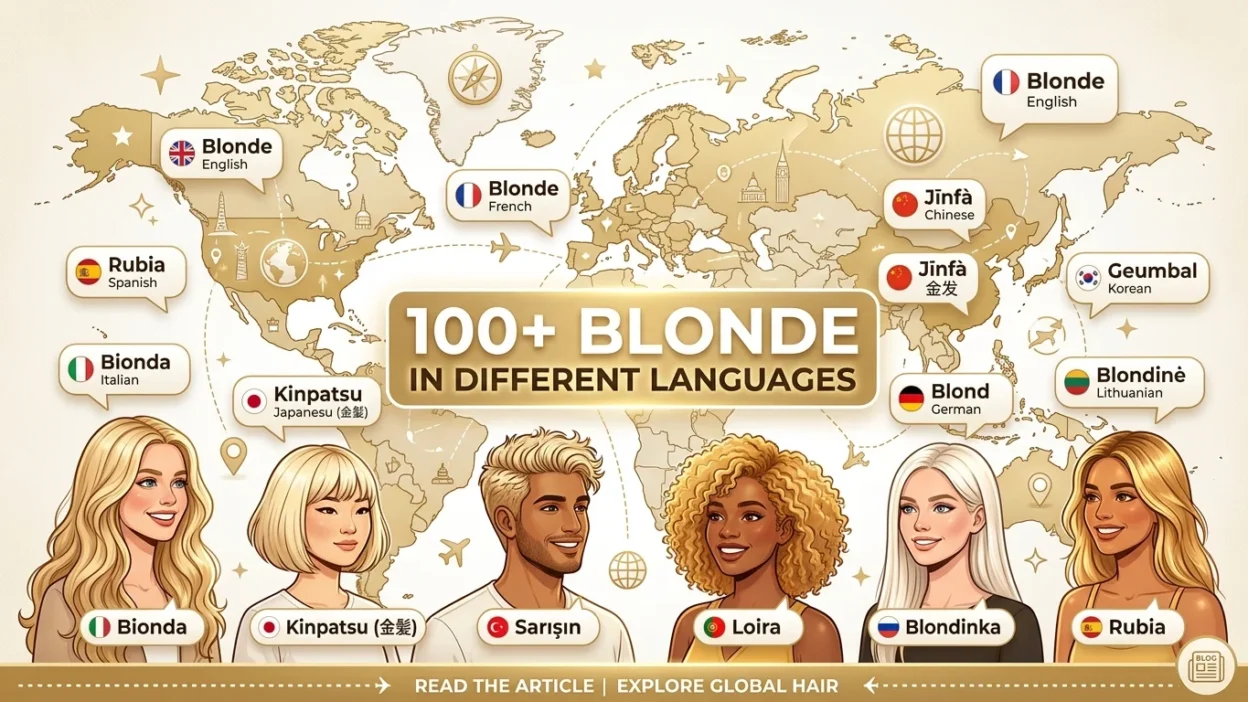
The word “blonde” is used in many cultures and languages to describe a person with light colored hair.
Whether you are learning languages, traveling internationally, writing multilingual content, or simply curious about blonde translations, this guide helps you discover how to say “blonde” in different languages around the world.
In this article, you will find languages with pronunciation guides and real life example sentences. This makes it easy to understand how native speakers use the word naturally in everyday conversation.
Blonde in Different Languages Table
| Language | Pronunciation | Example |
| English | Blond | She has blonde hair. (Meaning: Her hair color is blonde.) |
| Spanish | Rubia | Ella es rubia. (Meaning: She is blonde.) |
| French | Blonde | Elle est blonde. (Meaning: She is blonde.) |
| German | Blond | Sie hat blonde Haare. (Meaning: She has blonde hair.) |
| Italian | Bionda | Lei è bionda. (Meaning: She is blonde.) |
| Portuguese | Loira | Ela é loira. (Meaning: She is blonde.) |
| Dutch | Blond | Zij heeft blond haar. (Meaning: She has blonde hair.) |
| Russian | Blondinka | Ona blondinka. (Meaning: She is blonde.) |
| Ukrainian | Blondynka | Vona blondynka. (Meaning: She is blonde.) |
| Polish | Blondynka | Ona jest blondynką. (Meaning: She is blonde.) |
| Czech | Blondýna | Ona je blondýna. (Meaning: She is blonde.) |
| Slovak | Blondína | Ona je blondína. (Meaning: She is blonde.) |
| Hungarian | Szőke | Ő szőke. (Meaning: She is blonde.) |
| Romanian | Blondă | Ea este blondă. (Meaning: She is blonde.) |
| Bulgarian | Blondinka | Tya e blondinka. (Meaning: She is blonde.) |
| Greek | Xanthiá | Afti einai xanthiá. (Meaning: She is blonde.) |
| Turkish | Sarışın | O sarışın. (Meaning: She is blonde.) |
| Arabic | Shakra | Hiya shakra. (Meaning: She is blonde.) |
| Hebrew | Blondinit | Hi blondinit. (Meaning: She is blonde.) |
| Persian | Bolond | U bolond ast. (Meaning: She is blonde.) |
| Hindi | Sunahre Baal Wali | Vah sunahre baal wali hai. (Meaning: She has blonde hair.) |
| Urdu | Sunehri Baalon Wali | Woh sunehri baalon wali hai. (Meaning: She has blonde hair.) |
| Punjabi | Sunahri Waalan Wali | Oh sunahri waalan wali hai. (Meaning: She has blonde hair.) |
| Bengali | Swarnakeshi | Se swarnakeshi. (Meaning: She is blonde.) |
| Tamil | Ponnira Mudi | Avalukku ponnira mudi ulladhu. (Meaning: She has blonde hair.) |
| Telugu | Bangaru Rangu Juttu | Aameku bangaru rangu juttu undi. (Meaning: She has blonde hair.) |
| Kannada | Bili Koodalu | Avalige bili koodalu ide. (Meaning: She has blonde hair.) |
| Malayalam | Ponmudi | Avalkku ponmudi undu. (Meaning: She has blonde hair.) |
| Marathi | Soneri Kesanchi | Ti soneri kesanchi aahe. (Meaning: She has blonde hair.) |
| Gujarati | Soneri Vaalwali | Te soneri vaalwali chhe. (Meaning: She has blonde hair.) |
| Nepali | Sunaulo Kapaal | Uni sunaulo kapaal bhayeki chan. (Meaning: She has blonde hair.) |
| Sinhala | Ranwan Kesa | Eya ranwan kesa athi kenek. (Meaning: She has blonde hair.) |
| Chinese (Mandarin) | Jīnfà | Tā yǒu jīnfà. (Meaning: She has blonde hair.) |
| Japanese | Kinpatsu | Kanojo wa kinpatsu desu. (Meaning: She is blonde.) |
| Korean | Geum-bal | Geunyeoneun geum-bal-ieyo. (Meaning: She is blonde.) |
| Vietnamese | Tóc vàng | Cô ấy có tóc vàng. (Meaning: She has blonde hair.) |
| Thai | Phom Si Thong | Thoe mi phom si thong. (Meaning: She has blonde hair.) |
| Indonesian | Pirang | Dia berambut pirang. (Meaning: She has blonde hair.) |
| Malay | Perang | Dia berambut perang. (Meaning: She has blonde hair.) |
| Filipino | Kulay Ginto ang Buhok | Siya ay may kulay ginto na buhok. (Meaning: She has blonde hair.) |
| Swahili | Mwenye Nywele Za Dhahabu | Ana nywele za dhahabu. (Meaning: She has blonde hair.) |
| Afrikaans | Blond | Sy het blonde hare. (Meaning: She has blonde hair.) |
| Zulu | Onezinwele Ezimhlophe | Unezinwele ezimhlophe. (Meaning: She has blonde hair.) |
| Xhosa | Oneenwele Ezityheli | Uneenwele ezityheli. (Meaning: She has blonde hair.) |
| Somali | Timo Dahab Ah | Waxay leedahay timo dahab ah. (Meaning: She has blonde hair.) |
| Amharic | Bicha Segur | Esua bicha segur alebat. (Meaning: She has blonde hair.) |
| Hausa | Mai Gashin Zinariya | Tana da gashin zinariya. (Meaning: She has blonde hair.) |
| Yoruba | Olori Irun Ofeefee | O ni irun ofeefee. (Meaning: She has blonde hair.) |
| Igbo | Ntutu Edo Edo | O nwere ntutu edo edo. (Meaning: She has blonde hair.) |
| Finnish | Vaalea | Hän on vaalea. (Meaning: She is blonde.) |
| Swedish | Blond | Hon är blond. (Meaning: She is blonde.) |
| Norwegian | Blond | Hun er blond. (Meaning: She is blonde.) |
| Danish | Blond | Hun har blond hår. (Meaning: She has blonde hair.) |
| Icelandic | Ljóshærð | Hún er ljóshærð. (Meaning: She is blonde.) |
| Estonian | Blond | Ta on blond. (Meaning: She is blonde.) |
| Latvian | Blondīne | Viņa ir blondīne. (Meaning: She is blonde.) |
| Lithuanian | Blondinė | Ji yra blondinė. (Meaning: She is blonde.) |
| Albanian | Bjonde | Ajo është bjonde. (Meaning: She is blonde.) |
| Serbian | Plavuša | Ona je plavuša. (Meaning: She is blonde.) |
| Croatian | Plavuša | Ona je plavuša. (Meaning: She is blonde.) |
| Bosnian | Plavuša | Ona je plavuša. (Meaning: She is blonde.) |
| Slovenian | Blondinka | Ona je blondinka. (Meaning: She is blonde.) |
| Macedonian | Plavusha | Taa e plavusha. (Meaning: She is blonde.) |
| Georgian | Blondi | Is blondi-a. (Meaning: She is blonde.) |
| Armenian | Shikaher | Na shikaher e. (Meaning: She is blonde.) |
| Azerbaijani | Sarışın | O sarışındır. (Meaning: She is blonde.) |
| Kazakh | Sary Shas | Ol sary shas. (Meaning: She has blonde hair.) |
| Uzbek | Malla Sochli | U malla sochli. (Meaning: She has blonde hair.) |
| Mongolian | Shar Üst | Ter shar үстtei. (Meaning: She has blonde hair.) |
| Malayam Creole | Blond | Li ena seve blond. (Meaning: She has blonde hair.) |
| Haitian Creole | Blond | Li gen cheve blond. (Meaning: She has blonde hair.) |
| Irish | Fionn | Tá gruaig fhionn aici. (Meaning: She has blonde hair.) |
| Welsh | Melynwallt | Mae ganddi wallt melyn. (Meaning: She has blonde hair.) |
How to Say Blonde in Different Languages
The word “blonde” changes depending on grammar, gender, and local language structure. In many European languages, the translation is closely related to the English word. For example, French uses “blonde,” while German uses “blond.”
In Asian and African languages, the phrase often translates more directly to “golden hair” or “light-colored hair.” This shows how beauty descriptions differ across cultures and regions.
Blonde Translations Around the World
Blonde translations around the world reflect cultural diversity and language history. Some languages use a single word for blonde, while others describe the hair color using a complete phrase.
For example:
- Japanese uses “Kinpatsu”
- Arabic uses “Shakra”
- Turkish uses “Sarışın”
- Hindi commonly describes blonde hair as “golden hair”
These translations are commonly used in conversations, movies, fashion, and beauty discussions worldwide.
Why Learn Blonde in All Languages?
Learning “blonde” in all languages can help with:
- Language learning
- International travel
- Translation projects
- Global communication
- Cultural understanding
It is also useful for writers, students, tourists, and people interested in foreign languages and global expressions.
Common Uses of Blonde in Different Languages
People often use the word “blonde” when:
- Describing hair color
- Talking about fashion or beauty
- Introducing someone
- Learning vocabulary
- Translating conversations
Because hair color is a common physical description, knowing blonde translations can improve communication in many real-life situations.
Conclusion
Understanding how to say blonde in different languages is both educational and practical. From European languages to Asian and African dialects, the word changes in interesting ways across cultures. This guide provides 70 popular blonde translations, pronunciation examples, and sentence meanings to help you learn quickly and easily.
Whether you searched for “blonde in all languages,” “how to say blonde in different languages,” or “blonde around the world,” this article gives you a simple and complete resource in one place.
FAQs
1. How do you say blonde in different languages?
Blonde is translated differently in every language, such as “Rubia” in Spanish, “Bionda” in Italian, and “Kinpatsu” in Japanese.
2. What is the French word for blonde?
The French word for blonde is “Blonde” for females and “Blond” for males.
3. How do you say blonde hair in Asian languages?
Asian languages often describe blonde hair as golden or yellow hair. For example, Chinese uses “Jīnfà” and Japanese uses “Kinpatsu.”
4. Why are blonde translations different around the world?
Languages develop unique vocabulary based on culture, grammar, and historical influences, which is why blonde translations vary globally.
5. Is blonde the same word in every language?
No, the word changes significantly between languages. Some languages use one word, while others use descriptive phrases.