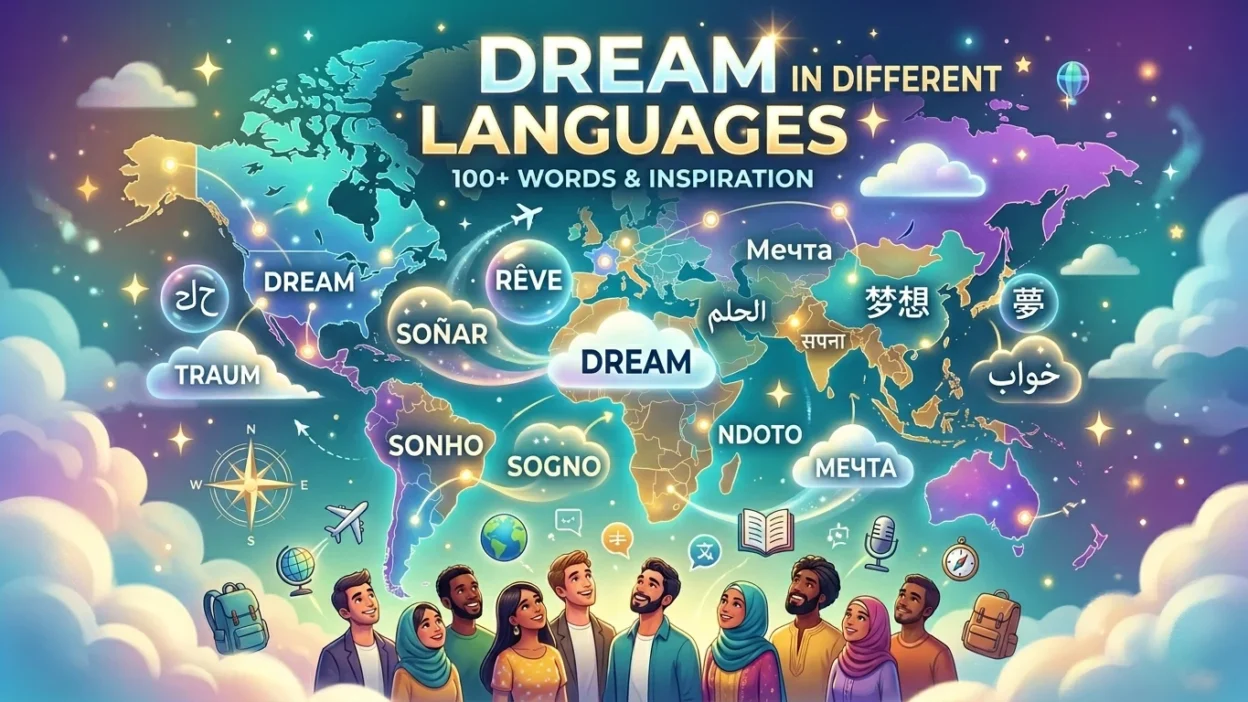
Dreams are a universal part of human life. Every culture has its own word for “dream,” and learning these translations can help you explore new languages, improve vocabulary, and understand global cultures better. If you are searching for “dream in different languages,” this guide gives you a simple and easy to read collection of translations from around the world.
In this article, you will discover how to say dream in different languages, learn pronunciation, and see real life example sentences with English meanings.
Whether you are a student, traveler, language lover, or content creator, this list will help you understand dream translations in all languages more easily.
Dream in Different Languages
| Language | Pronunciation | Example |
| English | Dreem | I have a beautiful dream. (Meaning: I have a beautiful dream.) |
| Spanish | Sue-nyo | Tengo un sueño grande. (Meaning: I have a big dream.) |
| French | Rev | J’ai un rêve heureux. (Meaning: I have a happy dream.) |
| German | Trowm | Ich habe einen Traum. (Meaning: I have a dream.) |
| Italian | Sog-no | Ho un sogno speciale. (Meaning: I have a special dream.) |
| Portuguese | So-nyo | Eu tive um sonho estranho. (Meaning: I had a strange dream.) |
| Russian | Son | U menya est mechta. (Meaning: I have a dream.) |
| Chinese (Mandarin) | Meng | Wo zuo le yi ge meng. (Meaning: I had a dream.) |
| Japanese | Yu-me | Watashi wa yume o mita. (Meaning: I saw a dream.) |
| Korean | Kkum | Naneun kkum-eul kkuda. (Meaning: I dream.) |
| Arabic | Hulm | Ra’aytu hulman jamilan. (Meaning: I saw a beautiful dream.) |
| Hindi | Swapna | Mujhe ek sapna aya. (Meaning: I had a dream.) |
| Urdu | Khawab | Maine ek khawab dekha. (Meaning: I saw a dream.) |
| Turkish | Ruya | Guzel bir ruya gordum. (Meaning: I saw a beautiful dream.) |
| Persian | Roya | Man yek roya daram. (Meaning: I have a dream.) |
| Greek | Oniro | Eida ena oniro. (Meaning: I saw a dream.) |
| Dutch | Droom | Ik had een droom. (Meaning: I had a dream.) |
| Swedish | Drom | Jag hade en drom. (Meaning: I had a dream.) |
| Norwegian | Drom | Jeg hadde en drom. (Meaning: I had a dream.) |
| Danish | Drom | Jeg havde en drom. (Meaning: I had a dream.) |
| Finnish | Uni | Nain kauniin unen. (Meaning: I saw a beautiful dream.) |
| Polish | Sen | Mialem dziwny sen. (Meaning: I had a strange dream.) |
| Czech | Sen | Mel jsem sen. (Meaning: I had a dream.) |
| Slovak | Sen | Mal som sen. (Meaning: I had a dream.) |
| Hungarian | Alom | Volt egy alomom. (Meaning: I had a dream.) |
| Romanian | Vis | Am avut un vis. (Meaning: I had a dream.) |
| Bulgarian | San | Imah san. (Meaning: I had a dream.) |
| Serbian | San | Imao sam san. (Meaning: I had a dream.) |
| Croatian | San | Sanjao sam san. (Meaning: I dreamed a dream.) |
| Slovenian | Sanje | Imel sem sanje. (Meaning: I had dreams.) |
| Ukrainian | Son | Ya bachyv son. (Meaning: I saw a dream.) |
| Belarusian | Son | Ya mew son. (Meaning: I had a dream.) |
| Lithuanian | Sapnas | As turejau sapna. (Meaning: I had a dream.) |
| Latvian | Sapnis | Man bija sapnis. (Meaning: I had a dream.) |
| Estonian | Uni | Mul oli uni. (Meaning: I had a dream.) |
| Hebrew | Khalom | Halamti khalom. (Meaning: I dreamed a dream.) |
| Thai | Fan | Chan mee khwam fan. (Meaning: I have a dream.) |
| Vietnamese | Giac mo | Toi co mot giac mo. (Meaning: I have a dream.) |
| Indonesian | Mimpi | Saya punya mimpi. (Meaning: I have a dream.) |
| Malay | Mimpi | Saya ada mimpi. (Meaning: I have a dream.) |
| Filipino | Panaginip | Nagkaroon ako ng panaginip. (Meaning: I had a dream.) |
| Swahili | Ndoto | Nina ndoto kubwa. (Meaning: I have a big dream.) |
| Zulu | Iphupho | Nginephupho. (Meaning: I have a dream.) |
| Afrikaans | Droom | Ek het ‘n droom. (Meaning: I have a dream.) |
| Icelandic | Draumur | Mig dreymdi draum. (Meaning: I dreamed a dream.) |
| Irish | Aisling | Bhi aisling agam. (Meaning: I had a dream.) |
| Welsh | Breuddwyd | Cefais freuddwyd. (Meaning: I had a dream.) |
| Scottish Gaelic | Bruadar | Bha bruadar agam. (Meaning: I had a dream.) |
| Albanian | Enderr | Une pashe nje enderr. (Meaning: I saw a dream.) |
| Macedonian | Son | Imav son. (Meaning: I had a dream.) |
| Bosnian | San | Imao sam san. (Meaning: I had a dream.) |
| Georgian | Sizmari | Me vnaxe sizmari. (Meaning: I saw a dream.) |
| Armenian | Yeraz | Yes yeraz tesel em. (Meaning: I saw a dream.) |
| Azerbaijani | Yuxu | Men yuxu gordum. (Meaning: I saw a dream.) |
| Kazakh | Tus | Men tus kordim. (Meaning: I saw a dream.) |
| Uzbek | Tush | Men tush kordim. (Meaning: I saw a dream.) |
| Mongolian | Moroodol | Bi moroodol harsan. (Meaning: I saw a dream.) |
| Nepali | Sapana | Maile sapana dekhe. (Meaning: I saw a dream.) |
| Bengali | Swapno | Ami ekta swapno dekhechi. (Meaning: I saw a dream.) |
| Punjabi | Supna | Main ik supna vekheya. (Meaning: I saw a dream.) |
| Tamil | Kanavu | Naan oru kanavu kanden. (Meaning: I saw a dream.) |
| Telugu | Kala | Nenu oka kala chusanu. (Meaning: I saw a dream.) |
| Kannada | Kanasu | Nanu ondu kanasu kande. (Meaning: I saw a dream.) |
| Malayalam | Swapnam | Njan oru swapnam kandu. (Meaning: I saw a dream.) |
| Marathi | Swapna | Mala ek swapna padla. (Meaning: I had a dream.) |
| Gujarati | Sapnu | Mane ek sapnu aavyu. (Meaning: I had a dream.) |
| Sinhala | Sihina | Mama sihinayak dakka. (Meaning: I saw a dream.) |
| Burmese | Ein Mat | Kyunote ein mat met de. (Meaning: I had a dream.) |
| Khmer | Sok Sap | Khnhom mean sok sap. (Meaning: I have a dream.) |
| Lao | Fan | Khoi mi fan. (Meaning: I have a dream.) |
| Haitian Creole | Rev | Mwen te fè yon rev. (Meaning: I had a dream.) |
| Esperanto | Songho | Mi havis songhon. (Meaning: I had a dream.) |
| Latin | Somnium | Somnium vidi. (Meaning: I saw a dream.) |
How to Say Dream in Different Languages
The word “dream” changes across cultures and languages, but its meaning often connects to hope, imagination, sleep, and future goals. Many people search for dream in all languages to learn pronunciation, improve communication skills, or create multilingual content.
Some languages use completely unique words, while others share similar roots. For example:
- Spanish: Sueño
- Italian: Sogno
- French: Rêve
- Portuguese: Sonho
These words come from related language families and sound somewhat similar.
Why Learning Dream Translations Is Useful
Learning dream translations around the world can help you:
- Improve multilingual vocabulary
- Understand global cultures
- Create international content
- Communicate with travelers and friends
- Learn language pronunciation more naturally
It is also useful for students, writers, bloggers, and social media creators who want to use emotional or inspirational words in different languages.
Dream Around the World
The idea of dreams exists in every culture. In some countries, dreams represent future goals and ambitions, while in others they are connected to sleep, spirituality, or imagination. Because of this, the word dream carries emotional meaning in nearly every language.
When people search for how to say dream in different languages, they often want meaningful translations for tattoos, art, motivational quotes, travel projects, or language learning.
Conclusion
Now you know how to say dream in different languages with pronunciation and example sentences. These dream translations help you understand how cultures around the world express hopes, imagination, and nighttime visions. Learning simple words like dream is a great way to start exploring new languages and global communication.
FAQs
1. How do you say dream in different languages?
Dream is translated differently worldwide, such as Sueño in Spanish, Rêve in French, Yume in Japanese, and Khawab in Urdu.
2. What is the most common translation of dream?
Common translations include Dream (English), Sueño (Spanish), Sogno (Italian), and Rêve (French).
3. Why do people search for dream in all languages?
People search for dream translations for education, travel, tattoos, quotes, art, and multilingual communication.
4. How can I learn dream pronunciation in different languages?
You can learn pronunciation by reading phonetic spellings and practicing short example sentences daily.
5. Is the word dream similar across languages?
Some languages share similar words because of common language roots, while others use completely unique terms.

Ely Joseph is a language researcher, writer, and contributor who specializes in words, meanings, and multilingual communication. With a strong interest in how language shapes understanding across cultures, Ely focuses on creating clear, accurate, and reader-friendly content for a global audience.