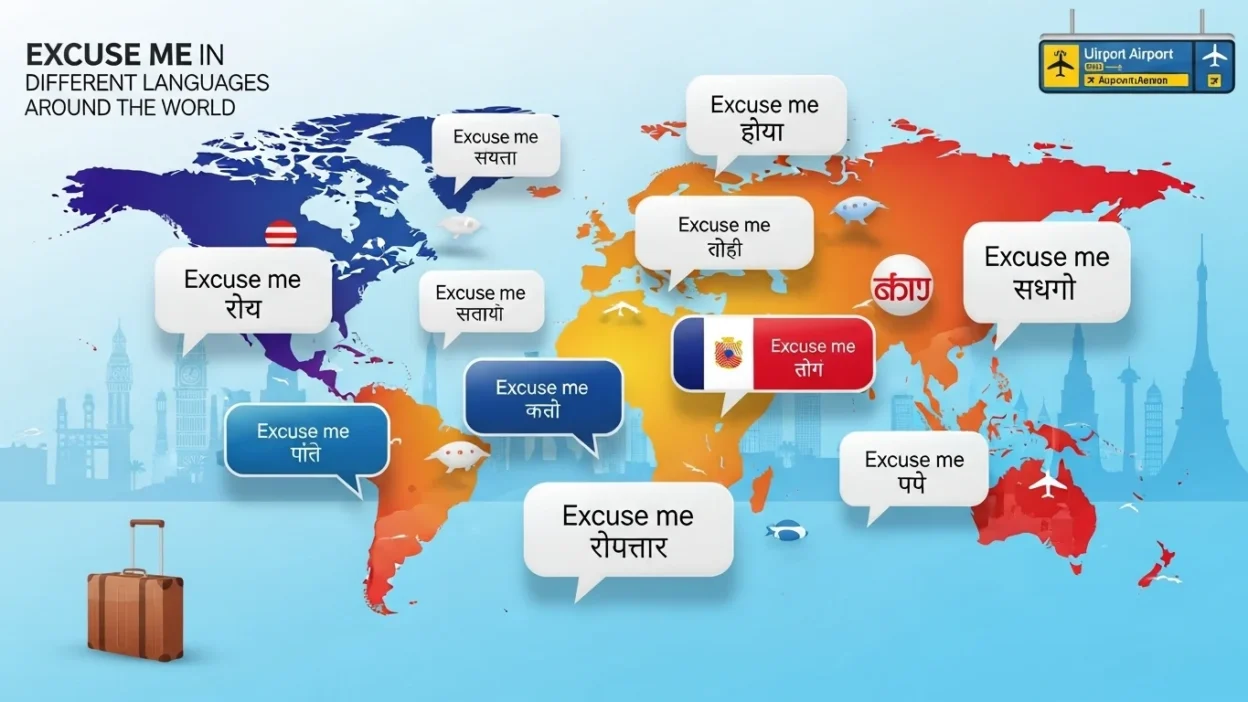
Learning how to say excuse me in different languages is one of the most useful communication skills for travelers, students, and global learners.
Whether you are asking for attention, passing through a crowd, or politely interrupting someone, knowing how to say this simple phrase can help you sound respectful and culturally aware.
In this guide, you will discover excuse me translations in all languages, how to say excuse me in different languages, and how this polite expression is used around the world in real life situations.
How to Say Excuse Me in Different Languages Around the World
| Language | Pronunciation | Example (with English meaning) |
| English | ik-SKYOOS mee | Excuse me, can I pass? (Polite request to move through) |
| Spanish | dees-KOOL-peh | Disculpe, ¿puedo pasar? (Excuse me, can I pass?) |
| French | ex-kü-zeh-mwa | Excusez-moi, je peux passer? (Excuse me, can I pass?) |
| German | ent-SHOOL-di-gung | Entschuldigung, darf ich durch? (Excuse me, may I pass?) |
| Italian | SKOO-zee | Scusi, posso passare? (Excuse me, can I pass?) |
| Portuguese | kom lee-SEN-sa | Com licença, posso passar? (Excuse me, may I pass?) |
| Russian | iz-vee-NEE-tye | Извините, можно пройти? (Excuse me, may I pass?) |
| Chinese (Mandarin) | ching when | 请问,我可以过去吗?(Excuse me, can I go through?) |
| Japanese | su-mee-ma-sen | すみません、通ってもいいですか?(Excuse me, can I pass?) |
| Korean | sil-lye-ham-ni-da | 실례합니다, 지나가도 될까요? (Excuse me, may I pass?) |
| Arabic | af-wan | عفواً، هل يمكنني المرور؟ (Excuse me, may I pass?) |
| Hindi | maaf kee-jee-ye | माफ़ कीजिए, क्या मैं जा सकता हूँ? (Excuse me, can I pass?) |
| Urdu | maaf kee-jee-ye | معاف کیجئے، کیا میں گزر سکتا ہوں؟ (Excuse me, can I pass?) |
| Bengali | maaf kor-ben | মাফ করবেন, আমি যেতে পারি? (Excuse me, can I pass?) |
| Punjabi | maaf kar-na | ਮਾਫ਼ ਕਰਨਾ, ਮੈਂ ਲੰਘ ਸਕਦਾ ਹਾਂ? (Excuse me, can I pass?) |
| Turkish | af-e-der-si-niz | Afedersiniz, geçebilir miyim? (Excuse me, can I pass?) |
| Persian | be-bakh-shid | ببخشید، میتوانم عبور کنم؟ (Excuse me, can I pass?) |
| Dutch | par-DON | Pardon, mag ik erlangs? (Excuse me, can I pass?) |
| Greek | sig-NO-mi | Συγγνώμη, μπορώ να περάσω; (Excuse me, can I pass?) |
| Polish | psheh-PRA-sham | Przepraszam, mogę przejść? (Excuse me, can I pass?) |
| Czech | pro-MIN-tye | Promiňte, mohu projít? (Excuse me, can I pass?) |
| Slovak | pre-PAH-chte | Prepáčte, môžem prejsť? (Excuse me, can I pass?) |
| Hungarian | el-NEH-zesht | Elnézést, átmehetek? (Excuse me, can I pass?) |
| Romanian | SKOO-ză-mă | Scuză-mă, pot trece? (Excuse me, can I pass?) |
| Bulgarian | iz-vee-NEH-te | Извинете, може ли да мина? (Excuse me, can I pass?) |
| Serbian | iz-vee-NEE-te | Извините, могу ли да прођем? (Excuse me, can I pass?) |
| Croatian | o-pro-STI-te | Oprostite, mogu li proći? (Excuse me, can I pass?) |
| Bosnian | iz-vee-NEE-te | Izvinite, mogu li proći? (Excuse me, can I pass?) |
| Ukrainian | vy-BACH-tye | Вибачте, чи можу пройти? (Excuse me, can I pass?) |
| Hebrew | SLEE-kha | סליחה, אפשר לעבור? (Excuse me, can I pass?) |
| Thai | khor thot | ขอโทษ, ขอผ่านได้ไหม? (Excuse me, can I pass?) |
| Vietnamese | sin loi | Xin lỗi, cho tôi đi qua? (Excuse me, can I pass?) |
| Indonesian | per-MEE-see | Permisi, boleh lewat? (Excuse me, can I pass?) |
| Malay | per-MEE-see | Permisi, boleh saya lalu? (Excuse me, can I pass?) |
| Filipino | pa-u-MAN-hin | Paumanhin, pwede ba akong dumaan? (Excuse me, can I pass?) |
| Swahili | sa-ma-HA-ni | Samahani, naweza kupita? (Excuse me, can I pass?) |
| Yoruba | e jo-wo | Ẹ jọwọ, ṣe mo le kọja? (Excuse me, can I pass?) |
| Zulu | ngi-ya-xo-li-sa | Ngiyaxolisa, ngingadlula? (Excuse me, can I pass?) |
| Amharic | yi-kihr-ta | ይቅርታ, ልሄድ እችላለሁ? (Excuse me, can I pass?) |
| Somali | raal-li a-how | Raalli ahow, ma gudbi karaa? (Excuse me, can I pass?) |
| Tamil | man-ni-kka-vum | மன்னிக்கவும், நான் செல்லலாமா? (Excuse me, can I pass?) |
| Telugu | ksha-mi-nchan-di | క్షమించండి, నేను వెళ్లవచ్చా? (Excuse me, can I pass?) |
| Marathi | maaf ka-ra | माफ करा, मला जाऊ द्या? (Excuse me, can I pass?) |
| Gujarati | maaf kar-sho | માફ કરશો, હું જઈ શકું? (Excuse me, can I pass?) |
| Kannada | ksha-mi-si | ಕ್ಷಮಿಸಿ, ನಾನು ಹೋಗಬಹುದೇ? (Excuse me, can I pass?) |
| Malayalam | ksha-mi-kka-nam | ക്ഷമിക്കണം, ഞാൻ പോകാമോ? (Excuse me, can I pass?) |
| Sinhala | sa-ma-we-nna | සමාවෙන්න, මට යා හැකිද? (Excuse me, can I pass?) |
| Nepali | maaf gar-nu-hos | माफ गर्नुहोस्, म जान सक्छु? (Excuse me, can I pass?) |
| Tibetan | gong-dag | དགོངས་དག, ང་འགྲོ་ཆོག་ག? (Excuse me, can I pass?) |
| Lao | khor thot | ຂໍໂທດ, ຂ້ອຍຜ່ານໄດ້ບໍ? (Excuse me, can I pass?) |
| Khmer | som tos | សូមទោស, ខ្ញុំអាចទៅបានទេ? (Excuse me, can I pass?) |
| Burmese | khwin pyu par | ခွင့်ပြုပါ, ကျွန်တော်သွားလို့ရမလား? (Excuse me, can I pass?) |
| Mongolian | uu-cha-laa-rai | Уучлаарай, би өнгөрч болох уу? (Excuse me, can I pass?) |
| Kazakh | ke-shi-ri-niz | Кешіріңіз, өтуге бола ма? (Excuse me, can I pass?) |
| Uzbek | uzr | Uzr, men o’ta olamanmi? (Excuse me, can I pass?) |
| Azerbaijani | ba-ghish-la-yin | Bağışlayın, keçə bilərəm? (Excuse me, can I pass?) |
| Armenian | ne-ro-ghu-tyun | Ներողություն, կարո՞ղ եմ անցնել? (Excuse me, can I pass?) |
| Georgian | bo-di-shi | ბოდიში, შემიძლია გავიარო? (Excuse me, can I pass?) |
| Finnish | an-tek-si | Anteeksi, saanko mennä? (Excuse me, can I pass?) |
| Swedish | ur-SÄK-ta | Ursäkta, får jag passera? (Excuse me, can I pass?) |
| Norwegian | UNN-skyld | Unnskyld, kan jeg gå forbi? (Excuse me, can I pass?) |
| Danish | UNN-skyld | Undskyld, må jeg komme forbi? (Excuse me, can I pass?) |
| Icelandic | fi-ri-r-ge-fthu | Fyrirgefðu, má ég fara framhjá? (Excuse me, can I pass?) |
| Irish | gabh mo LEITH-skeal | Gabh mo leithscéal, an féidir liom dul? (Excuse me, can I pass?) |
| Scottish Gaelic | gabh mo LEIS-geul | Gabh mo leisgeul, an urrainn dhomh dol seachad? (Excuse me, can I pass?) |
| Welsh | es-gus-OD-woch | Esgusodwch, a gaf i basio? (Excuse me, can I pass?) |
| Albanian | me fal-ni | Më falni, a mund të kaloj? (Excuse me, can I pass?) |
| Lithuanian | at-si-PRA-shau | Atsiprašau, ar galiu praeiti? (Excuse me, can I pass?) |
| Latvian | at-vai-ni-yo-et | Atvainojiet, vai varu paiet? (Excuse me, can I pass?) |
| Estonian | va-ban-dust | Vabandust, kas ma võin läbi minna? (Excuse me, can I pass?) |
Why Learning “Excuse Me” in Different Languages Matters
Knowing how to say excuse me around the world helps you communicate politely in any country. It improves your travel experience, avoids misunderstandings, and shows respect for local culture. This simple phrase is one of the most powerful social tools in global communication.
Common Situations to Use “Excuse Me”
You can use this phrase when:
- Passing through a crowd
- Asking for directions
- Getting someone’s attention
- Interrupting politely
- Apologizing for small mistakes
Conclusion
Learning excuse me in all languages is a small step that creates a big impact in communication. It helps you stay polite, respectful, and confident while interacting with people worldwide.
FAQs
1. What is excuse me in different languages used for?
It is used to politely get attention, pass through, or interrupt someone.
2. How do you say excuse me in most languages?
Most languages have a polite single-word or short phrase equivalent.
3. Why should I learn excuse me in different languages?
It improves travel communication and shows respect for other cultures.
4. Is excuse me the same as sorry in all languages?
No, some languages use different words for apology and attention.
5. What is the easiest way to learn excuse me in all languages?
Practice common travel phrases and repeat them regularly.

Ely Joseph is a language researcher, writer, and contributor who specializes in words, meanings, and multilingual communication. With a strong interest in how language shapes understanding across cultures, Ely focuses on creating clear, accurate, and reader-friendly content for a global audience.