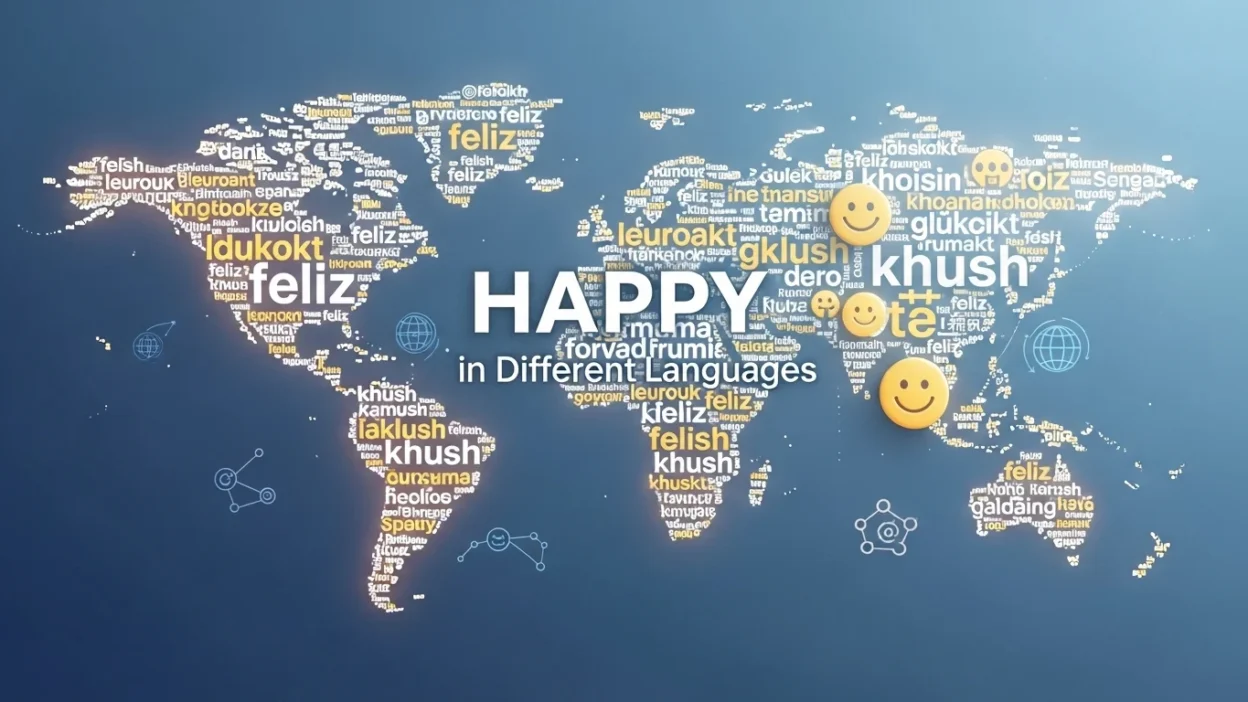
Happiness is a universal emotion, but every language expresses it in its own beautiful way. Learning how to say happy in different languages helps you connect with people across cultures, improve communication, and understand global expressions of joy.
Whether you are searching for “happy in all languages”, “how to say happy in different languages”, or “happy translations around the world”, this guide gives you exactly what you need in a simple and structured format.
Happy in Different Languages Around the World
| Language | Pronunciation | Example |
| English | hap-ee | I feel happy today. (I am feeling joyful today.) |
| Spanish | feh-lees | Estoy feliz hoy. (I am happy today.) |
| French | uh-roo / uh-rooz | Je suis heureux aujourd’hui. (I am happy today.) |
| German | glueck-lich | Ich bin glücklich. (I am happy.) |
| Italian | feh-lee-che | Sono felice oggi. (I am happy today.) |
| Portuguese | feh-leez | Estou feliz. (I am happy.) |
| Dutch | ghe-lukh-ikh | Ik ben gelukkig. (I am happy.) |
| Swedish | glad | Jag är glad. (I am happy.) |
| Norwegian | glad | Jeg er glad. (I am happy.) |
| Danish | glad | Jeg er glad i dag. (I am happy today.) |
| Finnish | on-neh-li-nen | Olen onnellinen. (I am happy.) |
| Icelandic | ha-ming-yu-sa-mur | Ég er hamingjusamur. (I am happy.) |
| Russian | schas-lee-viy | Я счастливый. (I am happy.) |
| Ukrainian | shchas-ly-vyy | Я щасливий. (I am happy.) |
| Polish | shchen-shli-vy | Jestem szczęśliwy. (I am happy.) |
| Czech | shta-sht-ny | Jsem šťastný. (I am happy.) |
| Slovak | shta-sht-ny | Som šťastný. (I am happy.) |
| Hungarian | bol-dog | Boldog vagyok. (I am happy.) |
| Romanian | feh-ree-chit | Sunt fericit. (I am happy.) |
| Turkish | mut-lu | Mutluyum. (I am happy.) |
| Greek | kha-roo-me-nos | Είμαι χαρούμενος. (I am happy.) |
| Arabic | sa-eed | أنا سعيد. (I am happy.) |
| Hebrew | sa-me-ach | אני שמח. (I am happy.) |
| Persian | khosh-hahl | من خوشحال هستم. (I am happy.) |
| Urdu | khush | میں خوش ہوں۔ (I am happy.) |
| Hindi | khush | मैं खुश हूँ। (I am happy.) |
| Bengali | khu-shi | আমি খুশি। (I am happy.) |
| Punjabi | khush | ਮੈਂ ਖੁਸ਼ ਹਾਂ। (I am happy.) |
| Tamil | magizhchi | நான் மகிழ்ச்சி அடைகிறேன். (I am happy.) |
| Telugu | san-to-sham-ga | నేను సంతోషంగా ఉన్నాను. (I am happy.) |
| Malayalam | san-to-sham | ഞാൻ സന്തോഷം. (I am happy.) |
| Kannada | san-to-sha | ನಾನು ಸಂತೋಷವಾಗಿದ್ದೇನೆ. (I am happy.) |
| Gujarati | khush | હું ખુશ છું. (I am happy.) |
| Marathi | anan-di | मी आनंदी आहे. (I am happy.) |
| Sinhala | sa-tu-tu | මම සතුටුයි. (I am happy.) |
| Thai | mee khwam suk | ฉันมีความสุข (I am happy.) |
| Vietnamese | hanh phuc | Tôi hạnh phúc. (I am happy.) |
| Indonesian | ba-ha-gia | Saya bahagia. (I am happy.) |
| Malay | ba-ha-gia | Saya gembira. (I am happy.) |
| Filipino | ma-sa-ya | Ako ay masaya. (I am happy.) |
| Chinese (Simplified) | kuai-le | 我很快乐。 (I am happy.) |
| Chinese (Traditional) | kuai-le | 我很快樂。 (I am happy.) |
| Japanese | shi-a-wa-se | 私は幸せです。 (I am happy.) |
| Korean | haeng-bo-kan | 나는 행복하다. (I am happy.) |
| Mongolian | az jar-gal-tai | Би аз жаргалтай. (I am happy.) |
| Khmer | mean so-pi-mong-kol | ខ្ញុំមានសុភមង្គល។ (I am happy.) |
| Lao | mii khwam suk | ຂ້ອຍມີຄວາມສຸກ. (I am happy.) |
| Burmese | pyaw shwin | ကျွန်တော်ပျော်ရွှင်တယ်။ (I am happy.) |
| Nepali | khusi | म खुसी छु। (I am happy.) |
| Tibetan | skyid po | ང་སྐྱིད་པོ་ཡིན། (I am happy.) |
| Swahili | fu-ra-ha | Nina furaha. (I am happy.) |
| Zulu | u-ja-bu-le | Ngijabule. (I am happy.) |
| Afrikaans | ge-luk-kig | Ek is gelukkig. (I am happy.) |
| Amharic | des-teg-na | ደስተኛ ነኝ። (I am happy.) |
| Somali | fa-rax-san | Waan faraxsanahay. (I am happy.) |
| Yoruba | a-yo | Inú mi dùn. (I am happy.) |
| Igbo | o-bi uto | Obi dị m ụtọ. (I am happy.) |
| Hausa | mai fa-rin ci-ki | Ina farin ciki. (I am happy.) |
| Albanian | i lu-mtur | Jam i lumtur. (I am happy.) |
| Bosnian | sre-tan | Ja sam sretan. (I am happy.) |
| Serbian | sre-chan | Ја сам срећан. (I am happy.) |
| Croatian | sre-tan | Ja sam sretan. (I am happy.) |
| Slovenian | sre-ch-en | Sem srečen. (I am happy.) |
| Lithuanian | lai-min-gas | Aš laimingas. (I am happy.) |
| Latvian | lai-migs | Es esmu laimīgs. (I am happy.) |
| Estonian | on-ne-lik | Ma olen õnnelik. (I am happy.) |
| Welsh | ha-pus | Rwy’n hapus. (I am happy.) |
| Irish | saw-sta | Tá mé sásta. (I am happy.) |
| Scottish Gaelic | to-lik-te | Tha mi toilichte. (I am happy.) |
| Basque | zo-ri-on-tsu | Ni zoriontsu naiz. (I am happy.) |
Why Learning “Happy” in Different Languages Matters
Understanding happy translations in different languages helps you:
- Connect emotionally with people worldwide
- Improve cultural awareness
- Strengthen language learning skills
- Travel and communicate more confidently
How to Say Happy in Different Languages Effectively
To master happy in all languages, focus on:
- Repetition and pronunciation practice
- Listening to native speakers
- Using simple daily sentences
- Practicing with real life conversations
Happy Around the World: Cultural Insight
Different cultures express happiness differently. Some use emotional words, while others connect happiness with peace, luck, or satisfaction. This shows that happiness is not just a word it is a shared human feeling.
Conclusion
Learning how to say happy in different languages opens the door to global communication and cultural understanding. With 70 languages covered above, you now have a powerful reference to express joy anywhere in the world. Whether for travel, study, or curiosity, these translations help you connect more deeply with people everywhere.
FAQs
1. How do you say happy in different languages easily?
You can learn simple translations like “feliz,” “heureux,” or “khush” depending on the language.
2. What is happy in all languages most commonly used?
Common forms include “happy,” “feliz,” “felice,” and “glücklich.”
3. Why is learning happy in different languages useful?
It helps improve communication, travel experience, and cultural understanding.
4. Is happy the same in all languages?
No, each language has its own unique word and pronunciation.
5. How many ways can you say happy in different languages?
There are hundreds, but this guide covers 70 commonly used global languages.