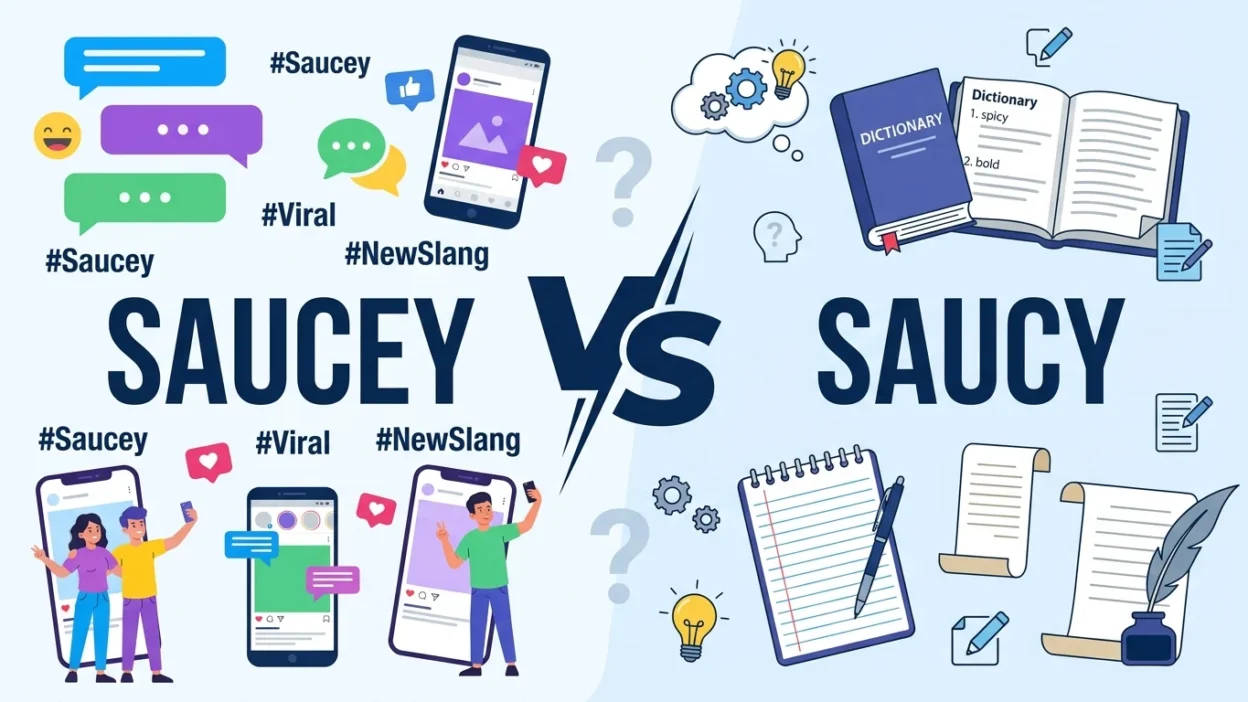
When I first noticed the confusion between Saucy and Saucey, it reminded me how small spelling issues can change the whole sense of English writing. The correct form is Saucy, which is the standard adjective in dictionary recognition, while Saucey is a nonstandard variation often seen in informal writing, social media, or branding. This small spelling mistake usually comes from a simple typing error, where learners follow a wrong logic assumption instead of the real grammar rule.
From my experience helping ESL students, this confusion often starts with the idea of sauce + -y suffix, which seems like normal adjective formation, but English has a special spelling rule where we drop e. This creates saucy, not saucey, following a clear linguistic rule that dates back to Middle English and even 14th century historical language change.
Over time, the evolution of meaning added a meaning shift, where Saucy became linked with bold, cheeky, playful, even flirtatious personality, often used in humor, teasing, or a light tone in daily conversation, captions, and jokes. Meanwhile, Saucey appears more in modern usage, especially internet culture, where swagger, style, flair, and aesthetic matter more than correctness, even in brand names or creative identity.
Quick Answer
- Saucy is the standard and correct dictionary spelling.
- Saucy usually means bold, playful, cheeky, confident, or slightly rude in a fun way.
- Saucey is a modern alternative spelling often seen online and in slang.
- In formal writing, school assignments, emails, and professional communication, use saucy.
- In casual social media posts, some people use saucey for style or personal preference.
- If you are unsure, saucy is usually the safest choice.
Origin and Background
Where Did “Saucy” Come From?
The word saucy has been part of English for hundreds of years.
Long ago, it was linked to the idea of adding sauce to food. Over time, people started using the word to describe someone who had extra boldness, confidence, or attitude.
For example:
- A child talking back to a parent might be called saucy.
- A person making playful jokes could be described as saucy.
- A confident comment might sound saucy.
Today, the word is commonly used to describe behavior that is slightly bold or cheeky.
Where Did “Saucey” Come From?
Saucey is mostly a modern spelling variation.
It became more common through:
- Social media
- Text messages
- Internet slang
- Informal online conversations
Many people use saucey simply because they like the way it looks. It often carries the same meaning as saucy, but it is not usually the preferred spelling in standard English.
The Difference Between Saucey and Saucy
The main difference is not the meaning. The main difference is the spelling and level of formality.
Saucy
Saucy is the traditional and accepted English spelling.
Examples:
- She gave a saucy reply.
- That was a saucy joke.
- The actor made a saucy comment.
This spelling is accepted in dictionaries and standard English writing.
Saucey
Saucey is a non standard spelling that appears mainly online.
Examples:
- That outfit looks saucey.
- His social media post was saucey.
- The new song has a saucey vibe.
Many people use it to sound modern, stylish, or trendy.
Simple Rule
If you are writing for:
- School
- Work
- Exams
- Articles
- Professional emails
Use saucy.
If you are chatting with friends online, you may see or use saucey.
Comparison Table
| Feature | Saucy | Saucey |
| Standard English spelling | Yes | No |
| Found in dictionaries | Yes | Sometimes not |
| Suitable for school writing | Yes | Usually no |
| Suitable for business writing | Yes | No |
| Common on social media | Yes | Yes |
| Modern slang feeling | Sometimes | Yes |
| Recommended for learners | Yes | Usually no |
| Safest choice | Yes | No |
Which One Should You Use and When?
Use “Saucy” When:
Choose saucy for:
- School assignments
- Essays
- Reports
- Professional emails
- Books
- News articles
- Formal communication
Examples:
- The character made a saucy remark.
- She has a saucy sense of humor.
- The advertisement used a saucy tone.
Use “Saucey” When:
You might use saucey in:
- Text messages
- Casual chats
- Social media captions
- Informal online content
Examples:
- That outfit is saucey.
- This playlist is saucey.
- Your new look is saucey.
Remember that some readers may think the spelling is incorrect because it is not the traditional form.
Best Advice
For most situations, use saucy.
It is correct, widely accepted, and understood by everyone.
Common Mistakes People Make
Mistake 1: Thinking They Have Different Meanings
Many people believe saucey and saucy have completely different meanings.
In reality, they usually express the same idea of confidence, style, boldness, or attitude.
Mistake 2: Using “Saucey” in Formal Writing
Some learners use saucey in:
- School papers
- Work emails
- Academic writing
This can make the writing look less professional.
Mistake 3: Assuming “Saucey” Is the Official Spelling
The official and standard spelling is saucy.
Saucey is mainly a modern variation.
Mistake 4: Avoiding “Saucy” Because It Looks Old
Some people think saucy sounds outdated.
Actually, it is still widely used and understood today.
Everyday Real Life Examples
Emails
Professional email:
- Thank you for your thoughtful message.
Not recommended:
- Thank you for your saucey message.
Possible casual use:
- Your saucy sense of humor made me laugh.
News
News writers are more likely to use:
- The celebrity made a saucy comment during the interview.
They would rarely use:
- The celebrity made a saucey comment during the interview.
Social Media
Common examples include:
- That outfit is saucey.
- Feeling saucey today.
- This look is saucey.
You may also see:
- Looking saucy tonight.
- A saucy new fashion trend.
Daily Conversations
Examples:
- That was a saucy joke.
- He gave a saucy answer.
- She has a saucy personality.
- Your new style looks saucey.
Learning Section for Students and Beginners
Easy Memory Trick
Think of it this way:
Saucy = Standard
Both words start with the letter S.
This can help you remember that saucy is the standard spelling.
Quick Practice
Which sentence is best for formal writing?
- The article had a saucey tone.
- The article had a saucy tone.
Correct answer:
The article had a saucy tone.
Fill in the Blank
Choose the best word:
- The student gave a ______ reply during class.
Answer:
saucy
Beginner Rule
When in doubt:
Always choose “saucy.”
You will almost never be wrong.
Frequently Asked Questions (FAQ)
Is saucey a real word?
Yes, many people use it online and in casual communication. However, it is not the standard spelling in traditional English.
Is saucy the correct spelling?
Yes. Saucy is the accepted and standard English spelling.
Do saucey and saucy mean the same thing?
Most of the time, yes. Both usually describe something bold, stylish, cheeky, confident, or playful.
Which spelling should students use?
Students should generally use saucy because it is the standard form.
Can I use saucey on social media?
Yes. Many people use saucey in captions, posts, and online conversations.
Is saucey wrong?
Not necessarily. It is simply less formal and less standard than saucy.
Which spelling appears in dictionaries?
Saucy is the spelling most commonly found in dictionaries.
Which spelling is better for professional writing?
Saucy is the better choice for professional and formal writing.
Conclusion
The difference between saucey and saucy is mainly about spelling and usage rather than meaning.
Saucy is the traditional, correct, and widely accepted English spelling. It works well in school, work, professional writing, and everyday communication.
Saucey is a modern spelling variation often seen on social media, in text messages, and in casual online conversations. While many people understand it, it is generally not the best choice for formal writing.
If you ever feel unsure, remember one simple rule: choose “saucy.” It is the standard spelling, easy to understand, and appropriate in almost every situation.

Marak Robort is a content writer and researcher with a strong interest in language, meanings, and digital information. His work focuses on presenting clear, easy-to-understand explanations that help readers quickly grasp complex ideas.