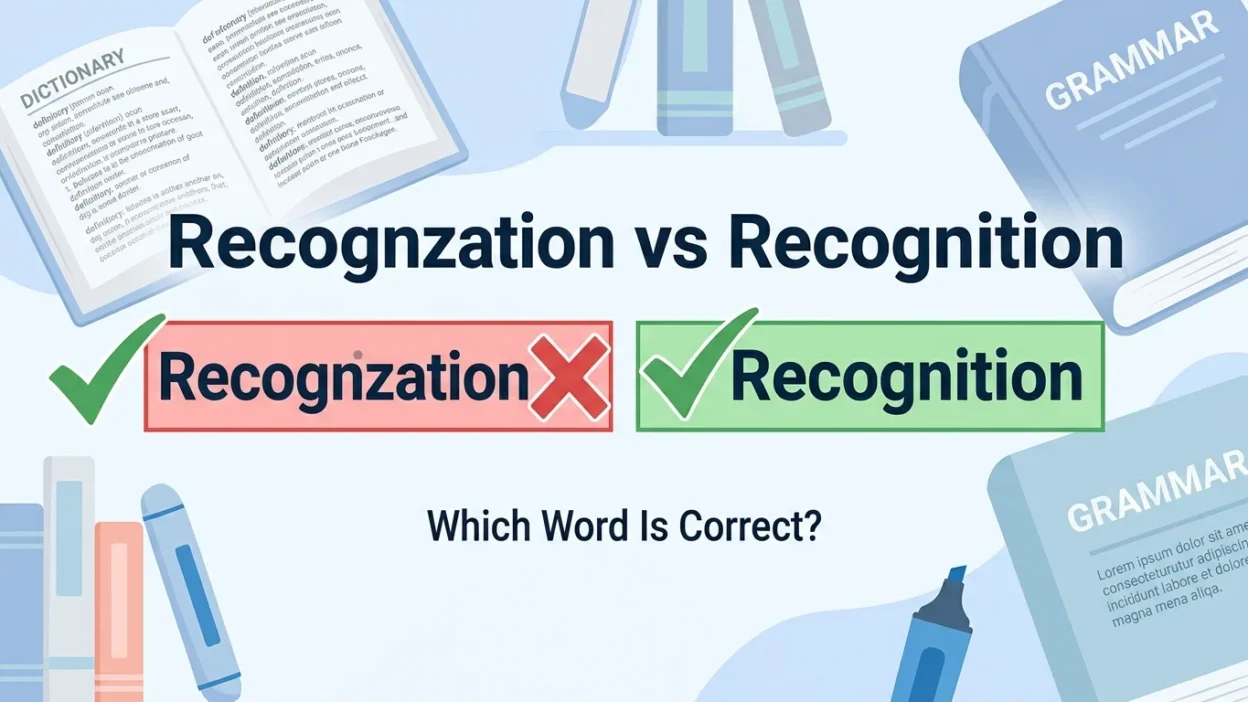
Many English learners and even native speakers get stuck in the confusion between recognization and recognition, especially when they assume every -ize verb pattern should follow a neat -ization pattern. From my experience working with academic writing, business writing, and professional writing, this mistake often appears in emails, CMS content, and even HR documents where people aim for clarity but accidentally introduce a spelling mistake or grammar error.
In modern English, the standard and widely accepted noun form of recognize is recognition, which follows an irregular word formation and ends in -ition ending, not -ization pattern. While recognization exists in historical context and some technical contexts, it is considered nonstandard, rarely used, and often marked as incorrect in dictionaries and style guides used for professional writing, academic writing, and everyday communication.
This is why usage preference strongly supports recognition in both American English and British English, with no variation in modern spelling rules. The difference is not just spelling it affects credibility, readability, and overall communication quality in technology, education, government, and AI systems, including facial recognition systems and biometric systems used in security systems and recognition technology.
The key difference becomes clearer when we look at noun form, verb recognition, and how recognize → recognition follows a stable word structure instead of forcing a verb noun transformation like -ization pattern words such as organization, modernization, or specialization. Many people fall into overgeneralization because of similar language patterns, but English often uses an irregular word formation like decision, revision, or realization, which shows why recognition meaning must be learned as a fixed noun definition.
In real usage examples, we see employee recognition, public recognition, official recognition, brand recognition, and recognition program, all reflecting acknowledgment, appreciation, identification, and acceptance in workplace, school, and college settings. However, recognization appears mainly as a spelling error, leading to incorrect usage, language confusion, and reduced writing quality in formal writing, informal writing, emails, and social media.
Tools like Google, search engines, and corpus analysis such as COCA show a strong frequency ratio 50,000:1 in favor of recognition, proving its dominance in keyword intent, ranking, and content writing optimization. A simple memory trick, or spelling tip, is to remember: recognize → recognition, often taught in English grammar guide, learning guide, and classroom practice sentences using fill in the blank exercises. This also improves writing improvement, communication skills, and overall word choice accuracy across HR platforms, legal English, international law, and trademark branding, where precision is essential.
Quick Answer
- ✅ Recognition is the correct word in modern English.
- ✅ It is used in schools, workplaces, books, newspapers, and everyday conversations.
- ❌ Recognization is not normally used by native English speakers.
- ❌ Most dictionaries and style guides do not recommend using it.
- ✅ If you are writing or speaking English, choose recognition.
Simple Example
Correct:
- She received recognition for her hard work.
Incorrect or uncommon:
- She received recognization for her hard work.
Simple Origin or Background Explanation
To understand the difference, it helps to look at where the words come from.
The verb recognize means:
- To know someone or something because you have seen it before
- To accept or acknowledge something
- To give credit to someone
Examples:
- I recognized my teacher in the crowd.
- The company recognized her efforts.
- He recognized the importance of education.
Over time, English developed the noun recognition to describe the act of recognizing someone or something.
Examples:
- facial recognition
- public recognition
- recognition of achievement
Although some people created the form recognization, it never became common in standard English. As a result, recognition became the accepted word and remains the preferred choice today.
Clear Explanation of the Difference
The main difference is very simple:
Recognition
Recognition is the standard English noun.
It means:
- Identifying someone or something
- Accepting something as true or important
- Giving praise or credit
Examples:
- The student received recognition for excellent grades.
- Facial recognition technology is becoming more common.
- Her work gained national recognition.
Recognization
Recognization is a rare and generally nonstandard form.
Most native speakers do not use it. Many readers may think it is a mistake.
Examples:
- The recognization of his efforts helped motivate him.
Even though the sentence can be understood, most people would replace recognization with recognition.
Correct version:
- The recognition of his efforts helped motivate him.
The Key Rule
Whenever you want the noun form of recognize, use recognition.
Comparison Table
| Feature | Recognition | Recognization |
| Is it correct modern English? | Yes | Usually no |
| Commonly used? | Very common | Very rare |
| Found in dictionaries? | Yes | Sometimes listed as uncommon |
| Used by native speakers? | Yes | Almost never |
| Suitable for school writing? | Yes | No |
| Suitable for business writing? | Yes | No |
| Recommended for learners? | Yes | No |
Which One to Use and When
The answer is straightforward: use recognition in nearly every situation.
In School Assignments
Use:
- recognition of talent
- recognition of achievement
- recognition of effort
Example:
- The athlete received recognition for winning the competition.
In Professional Writing
Use:
- employee recognition
- industry recognition
- public recognition
Example:
- The company earned recognition for excellent customer service.
In Technology
Use:
- speech recognition
- facial recognition
- pattern recognition
Example:
- Facial recognition helps identify people in photos.
In Daily Conversation
Use:
- recognition from friends
- recognition from teachers
- recognition from the community
Example:
- She finally got the recognition she deserved.
Rule to Remember
If you are choosing between the two words, pick recognition every time.
Common Mistakes People Make
Many learners make similar mistakes when using these words.
Adding “-ization” Automatically
Some learners assume every verb ending in -ize changes to -ization.
Examples:
- organize → organization
- realize → realization
Because of this pattern, they create:
- recognize → recognization
However, English uses recognition instead.
Copying Rare Online Usage
Sometimes people see recognization on forums, comments, or social media posts.
Just because a word appears online does not mean it is standard English.
Using It in Formal Writing
A student may write:
- The recognization of scientific discoveries is important.
A better sentence is:
- The recognition of scientific discoveries is important.
Confusing Verb and Noun Forms
Remember:
| Verb | Noun |
| Recognize | Recognition |
Example:
- I recognize her. (verb)
- I have recognition of her achievements. (noun)
Everyday Real Life Examples
Emails
Correct:
- Thank you for the recognition of my work.
- I appreciate the recognition from the team.
Incorrect:
- Thank you for the recognization of my work.
News
Correct:
- The artist received international recognition.
- The award brought recognition to the organization.
Incorrect:
- The artist received international recognization.
Social Media
Correct:
- After years of effort, she finally got the recognition she deserved.
- The project is gaining recognition online.
Incorrect:
- The project is gaining recognization online.
Daily Conversations
Correct:
- He wants recognition for his contributions.
- The teacher gave recognition to the best students.
Incorrect:
- He wants recognization for his contributions.
Short Learning Section for Students and Beginners
Here is an easy way to remember the correct word.
Memory Trick
Think of this pattern:
- recognize → recognition
Do not add -ization.
Practice Sentences
Choose the correct word.
- She earned ______ for her hard work.
- Recognition ✅
- The company gained ______ in the market.
- Recognition ✅
- Speech ______ software is improving.
- Recognition ✅
Quick Test
Which sentence sounds correct?
A. The recognization of his talent was important.
B. The recognition of his talent was important.
Correct answer:
✅ B. The recognition of his talent was important.
FAQ
Is recognization a real word?
It has appeared in some places, but it is very rare and not commonly accepted in standard English. Most writers should avoid it.
Which word should students use?
Students should use recognition in assignments, essays, and exams.
Why do people say recognization?
Many people assume it follows the same pattern as words like organization and realization. However, English uses recognition instead.
Is recognization grammatically wrong?
Many readers and teachers consider it incorrect or nonstandard. Using recognition is the safer choice.
What is the noun form of recognize?
The standard noun form is recognition.
Can I use recognization in formal writing?
It is not recommended. Use recognition instead.
Which word do native English speakers use?
Native speakers almost always use recognition.
What does recognition mean?
Recognition means identifying, acknowledging, accepting, or giving credit to someone or something.
Conclusion
The confusion between recognization and recognition is common, especially for English learners. Both words may look possible, but modern English strongly favors one form.
Recognition is the correct, standard, and widely accepted word. It is used in schools, workplaces, books, news reports, technology, and everyday conversation.
Recognization is extremely uncommon and is generally not recommended for normal writing or speaking.
If you ever have to choose between the two, remember this simple rule:
Recognize → Recognition
Using recognition will help your English sound natural, correct, and clear.

David William is a language enthusiast, researcher, and content creator at Lingoveb. With a deep passion for words, meanings, and global communication, he focuses on making language simple, clear, and accessible for readers around the world.