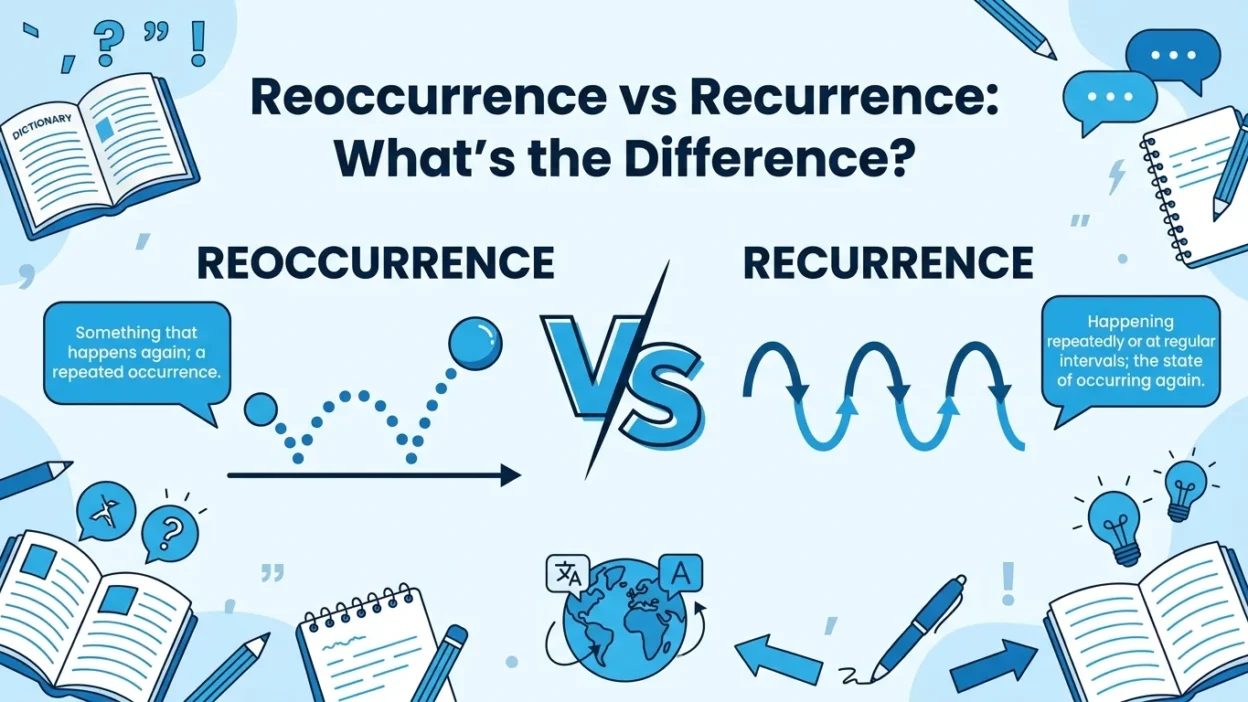
Many English learners and even native speakers get confused between reoccurrence and recurrence because both words seem to mean the same thing.
When you look at them, they appear very similar:
- Reoccurrence
- Recurrence
Both words talk about something happening again. Because of this, people often wonder:
- Are they interchangeable?
- Is one more correct than the other?
- Which word should I use in writing?
The good news is that the difference is not difficult. Once you understand how these words are used, the confusion disappears.
This guide explains everything in simple English so you can use the correct word with confidence.
Quick Answer
- Recurrence is the more common and preferred word.
- Reoccurrence also means something happens again.
- In most situations, recurrence sounds more natural.
- Many dictionaries accept both words.
- Professional, academic, and everyday writing usually prefer recurrence.
- If you are unsure, choose recurrence.
Example:
✅ The recurrence of the problem worried the team.
✅ The reoccurrence of the problem worried the team.
Both are correct, but recurrence is more common.
Simple Origin or Background Explanation
To understand the difference, it helps to know where the words come from.
The Word “Recurrence”
The word recurrence comes from the idea of something returning or happening again.
It has been widely used in English for a long time and became the standard word for repeated events.
Examples:
- recurrence of a disease
- recurrence of a mistake
- recurrence of bad weather
The Word “Reoccurrence”
The word reoccurrence comes from:
- re- = again
- occurrence = an event or something that happens
Together, it literally means:
“an occurrence that happens again.”
Because of this meaning, many people naturally create or use the word reoccurrence.
Although it is accepted in English, it is less common than recurrence.
Clear Explanation of the Difference
The main difference is not really about meaning.
The difference is mostly about usage and preference.
Recurrence
Recurrence means:
Something happens again after happening before.
Examples:
- The recurrence of headaches concerned her.
- There was a recurrence of flooding in the town.
- The recurrence of technical issues delayed the project.
This is the word most writers choose.
Reoccurrence
Reoccurrence also means:
Something occurs again.
Examples:
- The reoccurrence of the error frustrated users.
- Scientists studied the reoccurrence of the event.
- The reoccurrence of the symptoms was unexpected.
The meaning is almost identical.
The Key Point
In modern English:
- Recurrence = preferred and more common
- Reoccurrence = correct but less common
That is the easiest way to remember it.
Comparison Table
| Feature | Recurrence | Reoccurrence |
| Meaning | Something happens again | Something happens again |
| Correct English word? | Yes | Yes |
| More common? | Yes | No |
| Preferred in writing? | Yes | Usually not |
| Used in professional writing? | Very often | Less often |
| Easy choice when unsure? | Yes | Not usually |
| Sounds more natural to most readers? | Yes | No |
Which One to Use and When
Use “Recurrence” Most of the Time
This is the safest choice.
Examples:
- recurrence of a disease
- recurrence of a problem
- recurrence of a conflict
- recurrence of symptoms
- recurrence of an error
Most readers expect this word.
Use “Reoccurrence” If You Prefer It
The word is not wrong.
Some writers choose it because it clearly connects to the word occurrence.
Example:
- The reoccurrence of the event surprised everyone.
People will understand what you mean.
Easy Rule
If you are writing:
- homework
- essays
- reports
- articles
- emails
- business documents
Choose recurrence.
It is the more widely accepted option.
Common Mistakes People Make
Mistake 1: Thinking One Word Is Completely Wrong
Many people believe reoccurrence is incorrect.
This is not true.
Both words exist in English.
Mistake 2: Using Both Words in the Same Piece of Writing
For example:
❌ The recurrence of the issue caused concern. The reoccurrence of the issue continued later.
Using both can look inconsistent.
Instead, choose one and stay consistent.
Mistake 3: Assuming They Have Very Different Meanings
Some learners spend a lot of time searching for a major difference.
In reality, the meanings are extremely close.
Mistake 4: Choosing the Longer Word Automatically
Some people think longer words sound smarter.
However, recurrence is usually the better choice because it is more common and easier for readers to recognize.
Everyday Real Life Examples
Emails
Recurrence
- We are monitoring the recurrence of the issue.
- The recurrence of system errors has decreased.
Reoccurrence
- We are investigating the reoccurrence of the problem.
- The reoccurrence of network failures is being reviewed.
News
Recurrence
- Officials fear a recurrence of flooding.
- Experts are studying the recurrence of the disease.
Reoccurrence
- Authorities reported the reoccurrence of the event.
- Researchers observed the reoccurrence of the phenomenon.
Social Media
Recurrence
- Hopefully there is no recurrence of this bug.
- The recurrence of these rumors is annoying.
Reoccurrence
- The reoccurrence of the glitch is frustrating.
- Many users noticed the reoccurrence of the issue.
Daily Conversations
You may hear:
- There was a recurrence of the problem.
- The symptoms showed a recurrence.
You will hear recurrence much more often than reoccurrence.
Short Learning Section for Students and Beginners
Memory Trick
Think of it this way:
Recurrence = the normal choice
When something happens again, most English speakers use recurrence.
Simple Formula
- Happens again → Recurrence ✅
- Happens again → Reoccurrence ✅
But:
- Preferred word → Recurrence ⭐
Quick Practice
Choose the better word.
- The ______ of the disease worried doctors.
- The ______ of the error caused delays.
- The ______ of flooding damaged roads.
Answers:
- recurrence
- recurrence
- recurrence
All three could technically use reoccurrence, but recurrence sounds more natural.
One Sentence Summary
Recurrence and reoccurrence both mean something happens again, but recurrence is the word most people prefer and use.
FAQ
Is reoccurrence a real word?
Yes. Reoccurrence is a real English word and is accepted by dictionaries.
Is recurrence more correct than reoccurrence?
Not exactly. Both are correct, but recurrence is much more common and preferred in most writing.
Can I use the words interchangeably?
In many situations, yes. Their meanings are very similar.
Which word is used more often?
Recurrence is used much more often than reoccurrence.
Which word should students use?
Students should usually use recurrence because it is the standard and more familiar choice.
Is reoccurrence old fashioned?
Not necessarily. It is simply less common than recurrence.
Do dictionaries accept both words?
Yes. Most major dictionaries recognize both words.
Which word sounds more natural?
For most readers and writers, recurrence sounds more natural.
Conclusion
The confusion between reoccurrence and recurrence comes from the fact that both words describe the same basic idea: something happening again.
The important thing to remember is that both words are correct. However, recurrence is the more common, preferred, and widely used term in everyday English, professional writing, education, and formal communication.
If you ever feel unsure, choose recurrence. It is the option most readers expect, and it will sound natural in almost every situation.
A simple rule to remember is:
Recurrence = preferred choice
Reoccurrence = acceptable but less common choice
Once you know this rule, choosing between the two words becomes easy.

Ely Joseph is a language researcher, writer, and contributor who specializes in words, meanings, and multilingual communication. With a strong interest in how language shapes understanding across cultures, Ely focuses on creating clear, accurate, and reader-friendly content for a global audience.