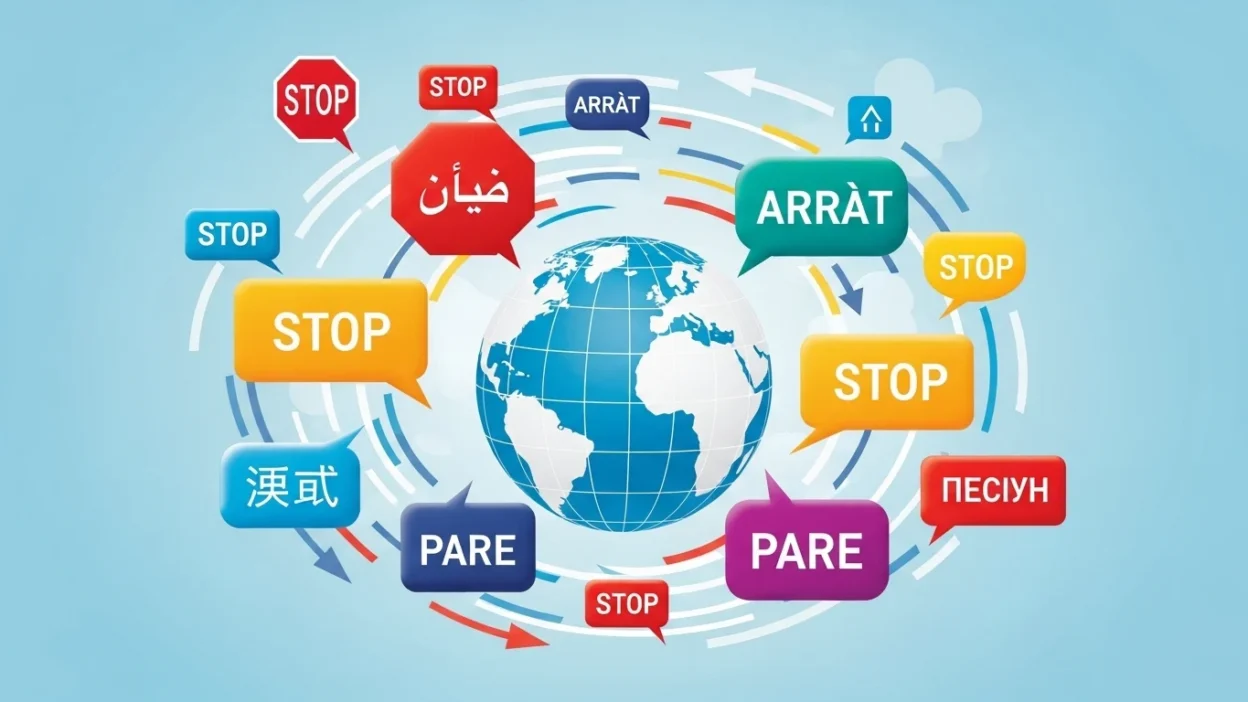
Understanding how to say stop in different languages is not only fascinating but also incredibly useful in everyday life, travel, and cultural learning.
Whether you’re driving abroad, navigating international road signs, or simply curious about languages, knowing how to express “stop” can make communication clearer and safer. In this guide, we’ll explore stop translations in 70 different languages, complete with pronunciation and real-life examples, making it easy to learn and use.
70 Ways to Say “Stop” in Different Languages
| Language | Pronunciation | Example | English Meaning |
| Arabic | waqf | waqf min fadlak | Stop, please |
| Spanish | alto | Alto, por favor | Stop, please |
| French | arrêt | Arrêt ici | Stop here |
| German | stopp | Stopp hier | Stop here |
| Italian | fermare | Fermare subito | Stop immediately |
| Portuguese | parar | Pare agora | Stop now |
| Russian | стоп | Stop! Stoy! | Stop! Stand! |
| Chinese (Mandarin) | tíng | 请停 | Please stop |
| Japanese | 止まれ | Tomare | Stop |
| Korean | 멈춰 | Meomchwo | Stop |
| Hindi | रुक | Ruk | Stop |
| Bengali | থাম | Tham | Stop |
| Punjabi | ਰੋਕ | Rok | Stop |
| Urdu | رکو | Ruko | Stop |
| Turkish | dur | Dur lütfen | Stop, please |
| Persian | توقف | Tavaghof | Stop |
| Vietnamese | dừng | Dừng lại | Stop |
| Thai | หยุด | Yut | Stop |
| Indonesian | berhenti | Berhenti di sini | Stop here |
| Malay | berhenti | Berhenti sekarang | Stop now |
| Greek | σταμάτα | Stamata | Stop |
| Hebrew | עצור | Atzor | Stop |
| Swahili | simama | Simama hapa | Stop here |
| Somali | joogsada | Joogsada hadda | Stop now |
| Zulu | yima | Yima lapha | Stop here |
| Xhosa | yima | Yima apha | Stop here |
| Afrikaans | stop | Stop hier | Stop here |
| Czech | zastav | Zastavte auto | Stop the car |
| Slovak | zastav | Zastav tu | Stop here |
| Polish | zatrzymaj | Zatrzymaj się | Stop |
| Ukrainian | зупинитися | Zupynysya | Stop |
| Romanian | opri | Opriți aici | Stop here |
| Hungarian | állj | Állj meg | Stop |
| Bulgarian | спри | Спрете тук | Stop here |
| Serbian | заустави | Zaustavi | Stop |
| Croatian | stani | Stani ovdje | Stop here |
| Bosnian | stani | Stani sada | Stop now |
| Slovenian | ustavi | Ustavi tukaj | Stop here |
| Lithuanian | sustoti | Sustok čia | Stop here |
| Latvian | apstājies | Apstājies tagad | Stop now |
| Estonian | peatu | Peatu siin | Stop here |
| Finnish | pysähdy | Pysähdy heti | Stop immediately |
| Norwegian | stopp | Stopp her | Stop here |
| Swedish | stopp | Stopp här | Stop here |
| Danish | stop | Stop her | Stop here |
| Icelandic | stopp | Stopp hér | Stop here |
| Maltese | waqqaf | Waqqaf hawn | Stop here |
| Georgian | გაჩერდი | Gach’erdi | Stop |
| Armenian | կանգ առ | Kank ar | Stop |
| Azerbaijani | dayan | Dayan burada | Stop here |
| Kazakh | тоқта | Toqta | Stop |
| Uzbek | to‘xtash | To‘xtash | Stop |
| Kyrgyz | токтогула | Toktogula | Stop |
| Tajik | ист | Ist | Stop |
| Mongolian | зогс | Zogs | Stop |
| Nepali | रोक | Rok | Stop |
| Sinhala | නවත්වන්න | Navathvanna | Stop |
| Burmese | ရပ် | Yat | Stop |
| Khmer | បញ្ឈប់ | Banhchhob | Stop |
| Lao | ຢຸດ | Yud | Stop |
| Malay (Brunei) | berhenti | Berhenti sekarang | Stop now |
| Filipino | huminto | Huminto ka | Stop |
| Maori | tū | Tū i konei | Stop here |
| Samoan | taofi | Taofi iinei | Stop here |
| Tahitian | faahou | Faahou i teie | Stop here |
| Hawaiian | hoʻopaʻa | Hoʻopaʻa i ʻaneʻi | Stop here |
| Maltese | waqqaf | Waqqaf issa | Stop now |
| Albanian | ndal | Ndal këtu | Stop here |
| Serbian (Latin) | zaustavi | Zaustavi ovde | Stop here |
| Montenegrin | zaustavi | Zaustavi sada | Stop now |
| Bosnian | stani | Stani ovdje | Stop here |
| Luxembourgish | ophalen | Stop elo | Stop now |
Why Learning “Stop in All Languages” Matters
Knowing stop translations helps in travel, emergencies, and cross-cultural communication. Whether you’re navigating a foreign city, helping someone, or simply curious about how to say stop in different languages, these phrases make it easier to be understood globally.
Tips for Remembering “Stop Around the World”
- Focus on phonetics – Learning pronunciation helps even if you can’t read the script.
- Practice with real sentences – Using the example sentences above makes it easier to recall.
- Use visual cues – Associating words with road signs or gestures reinforces memory.
Conclusion
Mastering stop in different languages equips you with a practical skill for travel, safety, and cultural understanding. With this comprehensive guide of 70 languages, you now have a ready reference for stop translations, pronunciation, and examples to confidently use around the world.
FAQs
1. What is the easiest way to remember “stop” in other languages?
Focus on the pronunciation and pair it with a gesture like holding up your hand.
2. Can I use these phrases for driving in foreign countries?
Yes, knowing the local word for “stop” can help in emergencies and daily navigation.
3. Are there different forms of “stop” in formal and informal contexts?
Some languages like French and Italian have polite forms, so context matters.
4. Why are there multiple entries for some languages?
Certain languages have regional dialects or scripts, such as Maltese and Serbian.
5. How do I practice saying “stop” in all languages efficiently?
Use flashcards, repeat the examples aloud, and associate them with real life situations.

Ely Joseph is a language researcher, writer, and contributor who specializes in words, meanings, and multilingual communication. With a strong interest in how language shapes understanding across cultures, Ely focuses on creating clear, accurate, and reader-friendly content for a global audience.