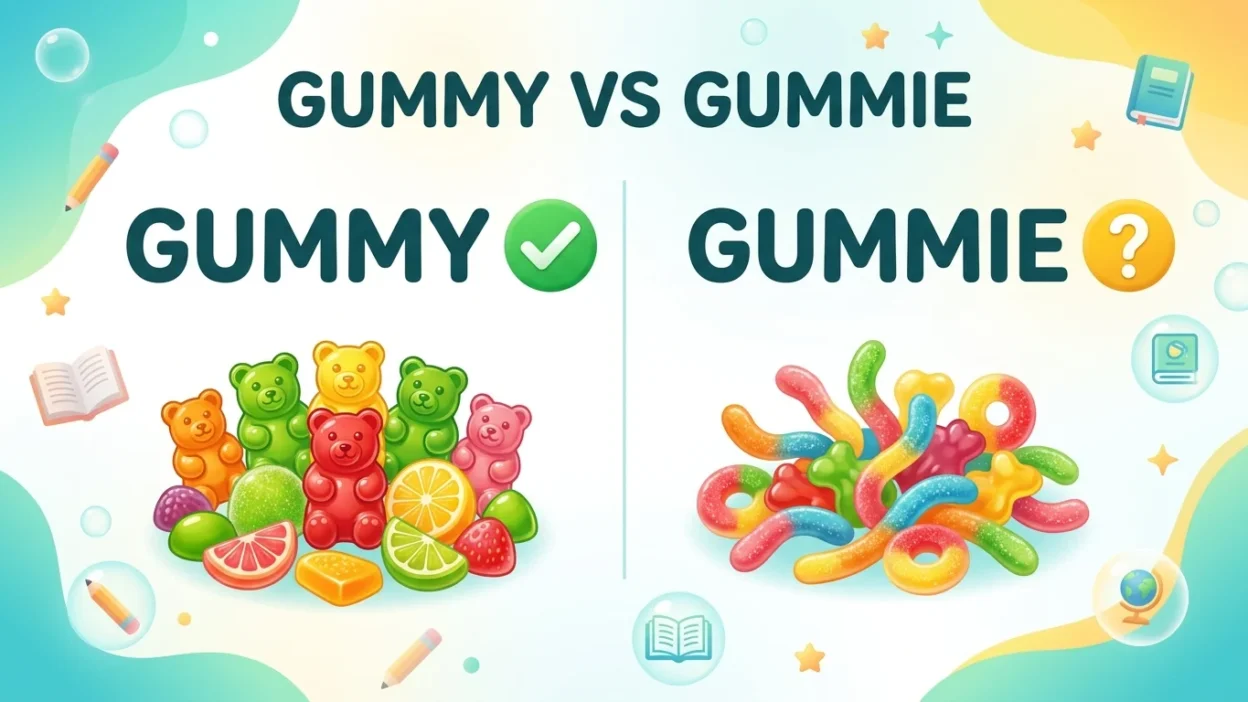
Many English learners and even native speakers get confused by gummy and gummie because the two words look very similar. They have almost the same spelling, and both can appear online, in social media posts, product names, and casual writing.
When people see two versions of a word, they often wonder:
- Which spelling is correct?
- Are they different words?
- Can both be used in writing?
- Which one should I use in school, work, or daily communication?
The good news is that the difference is very simple. Once you understand it, you will probably never be confused again.
Quick Answer
- Gummy is the standard and widely accepted spelling.
- Gummie is usually a less common alternative spelling.
- In most situations, gummy is the spelling you should use.
- Dictionaries, schools, and formal writing generally prefer gummy.
- You may see gummie in brand names, usernames, or informal writing.
If you are unsure, choose gummy.
Origin and Background
The word gummy comes from the word gum.
In English, adding -y to a noun often creates an adjective. For example:
- Cloud → Cloudy
- Dirt → Dirty
- Wind → Windy
- Gum → Gummy
The word gummy was first used to describe something that has the texture of gum. It can mean:
- Sticky
- Soft
- Chewy
- Covered with a gum like substance
Over time, the word became popular because of gummy candies, which are soft and chewy sweets.
The spelling gummie developed later as a variation. It is much less common and is not usually the preferred spelling in standard English.
Clear Explanation of the Difference
The main difference is not meaning. The difference is mostly spelling.
Gummy
Gummy is the standard English spelling.
It is commonly used in:
- Dictionaries
- Schools
- Books
- Newspapers
- Business writing
- Product descriptions
Examples:
- I bought some gummy bears.
- The candy has a gummy texture.
- The medicine comes in a gummy form.
Gummie
Gummie is an alternative spelling.
You might see it:
- In informal writing
- In usernames
- In brand names
- On social media
Examples:
- My username is SweetGummie.
- The company sells Gummie treats.
In standard English, most writers would still choose gummy.
Do They Mean Different Things?
Usually, no.
Most of the time, gummy and gummie refer to the same idea. The difference is simply that one spelling is standard and the other is less common.
Comparison
| Feature | Gummy | Gummie |
| Standard English spelling | Yes | No |
| Commonly used | Yes | Less common |
| Found in dictionaries | Yes | Rarely |
| Good for school writing | Yes | Usually not |
| Good for formal writing | Yes | Usually not |
| Seen in brand names | Sometimes | Sometimes |
| Meaning | Soft, chewy, sticky | Usually the same meaning |
| Recommended spelling | Yes | No |
Which One to Use and When
Use “Gummy” for Most Situations
Choose gummy when writing:
- School assignments
- Essays
- Reports
- Emails
- Articles
- Professional documents
Examples:
- The child ate a gummy bear.
- These vitamins are gummy and easy to chew.
- The surface felt gummy after drying.
When Might You See “Gummie”?
You may notice gummie in:
- Brand names
- Social media accounts
- Online nicknames
- Creative spellings
Examples:
- HappyGummie123
- Gummie World
- Gummie Treats
These are often style choices rather than standard spelling choices.
Safe Rule
If you are writing for school, work, or everyday communication, use gummy.
Common Mistakes People Make
Mistake 1: Thinking Both Are Equally Standard
Many people believe both spellings are equally accepted.
This is not usually true.
Gummy is the standard spelling used by most writers.
Mistake 2: Using “Gummie” in Formal Writing
Some learners use gummie in reports or assignments.
Example:
❌ The store sells gummie vitamins.
Better:
✅ The store sells gummy vitamins.
Mistake 3: Assuming the Meanings Are Different
People sometimes think:
- Gummy means candy.
- Gummie means something else.
In most cases, the meanings are the same.
Mistake 4: Copying Informal Spellings
Social media often contains creative spellings.
Just because a spelling appears online does not mean it is the standard form.
Everyday Real Life Examples
Emails
Correct:
- We have added new gummy vitamins to our product line.
- The package contains gummy supplements.
Less common:
- We have added new gummie vitamins to our product line.
News
More likely:
- The company released a new gummy candy product.
- Health experts discussed gummy supplements.
Less likely:
- The company released a new gummie candy product.
Social Media
Common examples:
- I love gummy bears!
- These gummy vitamins taste great.
Creative examples:
- GummieQueen
- SweetGummieLife
Social media often allows more creative spelling choices.
Daily Conversations
Examples:
- Do you want a gummy bear?
- These gummy candies are delicious.
- The mixture became gummy after cooling.
Most people naturally use gummy.
Short Learning Section for Students and Beginners
A simple way to remember the correct spelling is:
Remember the Base Word
The base word is:
gum
Add -y:
gum + y = gummy
This follows a common English pattern.
Examples:
| Base Word | New Word |
| Sun | Sunny |
| Fun | Funny |
| Mud | Muddy |
| Gum | Gummy |
Quick Memory Trick
Think:
“Gummy is the dictionary spelling.”
Whenever you are unsure, write gummy.
Practice Sentences
Fill in the blank:
- I ate a _____ bear.
- The candy felt _____.
- She bought _____ vitamins.
Answers:
- gummy
- gummy
- gummy
FAQ
Is gummy the correct spelling?
Yes. Gummy is the standard and most widely accepted spelling.
Is gummie a real word?
It may appear as an alternative spelling, but it is much less common than gummy.
Which spelling should students use?
Students should use gummy in assignments, homework, and exams.
Do gummy and gummie have different meanings?
Usually no. They generally refer to the same thing.
Which spelling is more common?
Gummy is far more common in everyday English.
Can I use gummie in a username?
Yes. Many people use creative spellings in usernames and online profiles.
Which spelling appears more often on products?
Most products use gummy, especially when describing candy or supplements.
What should ESL learners remember?
The safest choice is always gummy because it is the standard English spelling.
Conclusion
The difference between gummy and gummie is mainly a matter of spelling. Gummy is the standard, accepted, and commonly used form in English. It appears in dictionaries, schools, books, and everyday writing. Gummie is a less common alternative that is usually seen in informal settings, usernames, or brand names.
For students, ESL learners, and anyone who wants to write correctly, the best choice is simple: use gummy. It is the spelling most readers expect to see, and it works well in almost every situation.

Marak Robort is a content writer and researcher with a strong interest in language, meanings, and digital information. His work focuses on presenting clear, easy-to-understand explanations that help readers quickly grasp complex ideas.