Many English learners and even native speakers sometimes get confused between hazard and hazzard. The reason is simple: both words look very similar when written.
When people hear the word spoken, they may not notice the spelling difference. As a result, they often wonder whether both words are correct or if one is just a spelling mistake.
The good news is that the difference is very easy to understand. Once you learn it, you will probably never confuse these words again.
In this guide, you will learn exactly what each word means, when to use it, and how to avoid common mistakes.
Quick Answer
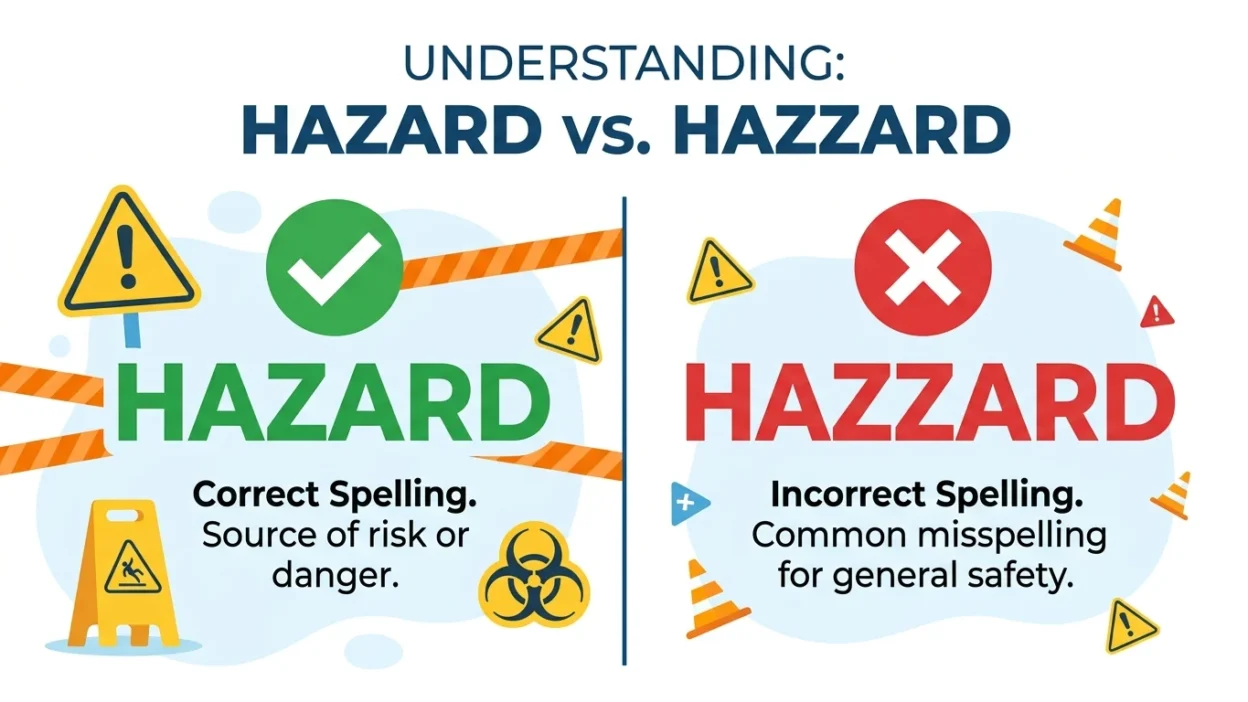
- Hazard is a correct English word.
- Hazard means a danger, risk, or something that can cause harm.
- Hazzard is usually a misspelling of hazard.
- The only time Hazzard is correct is when it is part of a person’s name, place name, or title.
- In normal writing, you should almost always use hazard.
Simple Rule
✅ Hazard = danger or risk
❌ Hazzard = usually incorrect spelling
Simple Origin or Background Explanation
The word hazard has been used in English for many centuries. It came from older languages and gradually became the English word we use today for danger, risk, or something unsafe.
Over time, hazard became common in many areas such as:
- Safety training
- Construction
- Health care
- Schools
- Workplaces
- News reports
The spelling hazzard did not become a standard English word. Most often, it appears because someone accidentally adds an extra “z” while typing.
However, Hazzard can be a surname. Some people have Hazzard as their family name.
Because of this, both spellings can sometimes be seen, which creates confusion.
Clear Explanation of the Difference
The main difference is very simple.
Hazard
Hazard is a common English noun.
It refers to:
- A danger
- A risk
- Something that may cause injury or damage
Examples:
- Wet floors are a hazard.
- Smoking is a health hazard.
- Broken glass can be a hazard.
- Driving in heavy fog is a hazard.
In all these examples, hazard means something dangerous.
Hazzard
Hazzard is generally not the standard English word for danger.
Most of the time, it is:
- A spelling mistake of hazard
- A family name
- A place name
Example:
- Mr. Hazzard works at the school.
Here, Hazzard is someone’s name, not a word meaning danger.
Easy Way to Remember
If you are talking about:
- Danger
- Safety
- Risk
- Harm
Use hazard.
If you are writing a person’s surname, then Hazzard may be correct.
Comparison
| Feature | Hazard | Hazzard |
| Correct English word? | Yes | Usually no |
| Meaning | Danger or risk | Usually a name or misspelling |
| Commonly used in daily English? | Yes | No |
| Used in safety warnings? | Yes | No |
| Found in dictionaries? | Yes | Usually only as a surname |
| Example | Fire is a hazard. | Sarah Hazzard is a teacher. |
Which One to Use and When
Use Hazard When Talking About Danger
Choose hazard when discussing:
- Safety
- Risks
- Accidents
- Health concerns
- Dangerous situations
Examples:
- Electrical wires are a hazard.
- Ice on the road is a hazard.
- Chemical spills create a hazard.
- Loud noise can be a hearing hazard.
Use Hazzard Only as a Name
Use Hazzard only when it is part of:
- A person’s name
- A family name
- A place name
- A title
Examples:
- John Hazzard attended the meeting.
- The Hazzard family moved last year.
In ordinary writing about danger, never replace hazard with hazzard.
Common Mistakes People Make
Many learners make similar mistakes with these words.
Adding an Extra Z
Wrong:
- This chemical is a hazzard.
Correct:
- This chemical is a hazard.
Thinking Both Spellings Are Acceptable
Some people believe hazard and hazzard are simply spelling variations.
This is not true.
For normal English usage, only hazard is correct.
Using Hazzard in School Assignments
Students sometimes write:
- Road hazzards can cause accidents.
The correct sentence is:
- Road hazards can cause accidents.
Copying Incorrect Online Spellings
Sometimes misspellings spread online because people copy what others write.
Always double check the spelling if you are talking about danger or risk.
Everyday Real Life Examples
Emails
Correct:
- Please report any safety hazards immediately.
- The damaged cable may be a hazard.
Incorrect:
- Please report any safety hazzards immediately.
News
Correct:
- Officials warned residents about flood hazards.
- Smoke from the fire created health hazards.
Incorrect:
- Officials warned residents about flood hazzards.
Social Media
Correct:
- Be careful! That broken step is a hazard.
- Wet roads are a driving hazard today.
Incorrect:
- Be careful! That broken step is a hazzard.
Daily Conversations
Correct:
- That loose wire is a hazard.
- The icy sidewalk is a hazard.
Incorrect:
- That loose wire is a hazzard.
- The icy sidewalk is a hazzard.
Short Learning Section for Students and Beginners
Here is an easy study trick.
Memory Trick
Think of this sentence:
“Hazard means harm.”
Both words start with HA.
- Hazard = Harm
- Hazard = Danger
- Hazard = Risk
Practice Exercise
Choose the correct word.
- The broken ladder is a ______.
- Fire can be a serious ______.
- Mr. ______ gave a speech today.
- The factory removed several safety ______.
Answers:
- hazard
- hazard
- Hazzard
- hazards
Quick Test
Which spelling is correct?
- Road hazard ✅
- Road hazzard ❌
Which spelling is correct?
- Health hazard ✅
- Health hazzard ❌
FAQ
Is hazzard a real word?
Usually no. It is generally considered a misspelling of hazard. However, it can be a surname or family name.
What does hazard mean?
Hazard means a danger, risk, or something that could cause harm.
Why do people spell hazard as hazzard?
Many people accidentally add an extra “z” because the pronunciation sounds similar.
Is hazard used in safety reports?
Yes. Hazard is a very common word in safety reports, workplace rules, and warning signs.
Can I use hazzard instead of hazard?
No. If you mean danger or risk, you should use hazard.
Is hazard a noun?
Yes. Hazard is commonly used as a noun meaning danger or risk.
What is an example of a hazard?
Examples include:
- Fire
- Broken glass
- Wet floors
- Electrical wires
- Toxic chemicals
How can I remember the correct spelling?
Remember the phrase:
“Hazard means harm.”
This simple memory trick can help you avoid adding the extra “z”.
Conclusion
The difference between hazard and hazzard is actually very simple. Hazard is the correct English word that means danger, risk, or something that can cause harm. It is the spelling you should use in school, work, emails, reports, and everyday writing.
Hazzard, on the other hand, is usually a spelling mistake when someone means hazard. The only common exception is when Hazzard is part of a person’s name or another proper name.
If you remember one thing, remember this: when talking about danger or risk, always use “hazard.” This small spelling detail will help your writing look more accurate and professional.

Marak Robort is a content writer and researcher with a strong interest in language, meanings, and digital information. His work focuses on presenting clear, easy-to-understand explanations that help readers quickly grasp complex ideas.