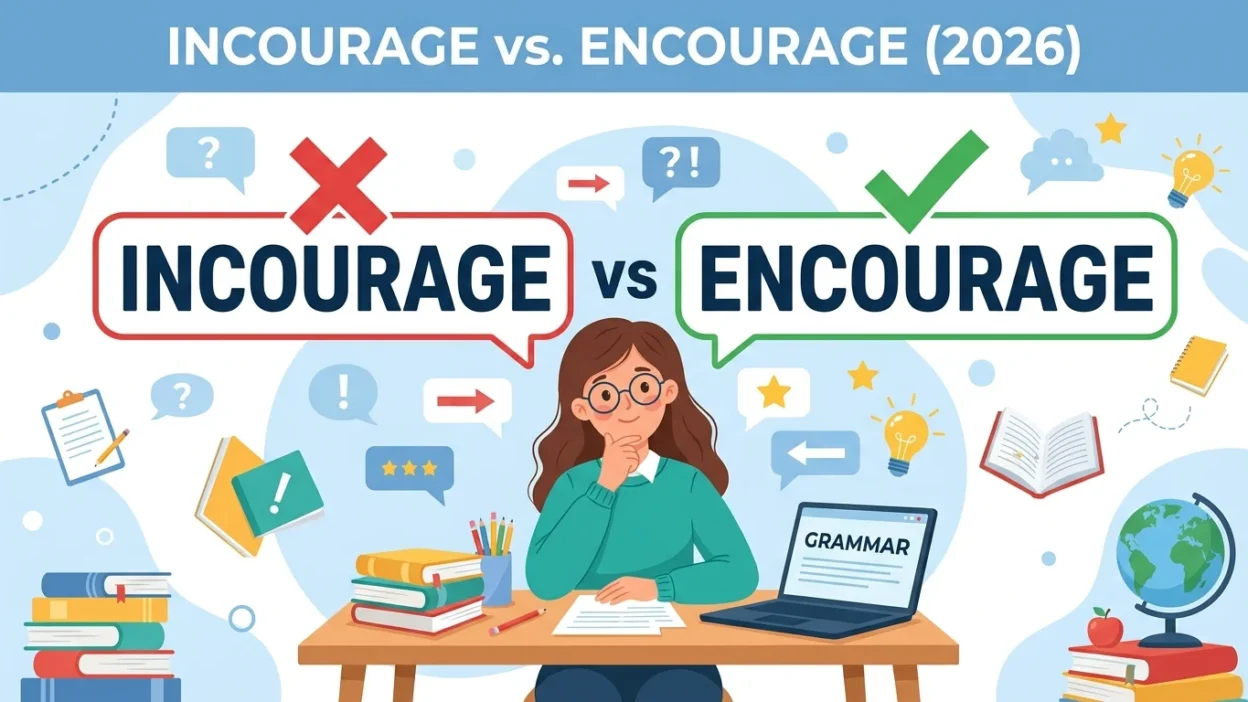
Many people get confused between incourage and encourage because the two words look very similar. When typing fast, speaking quickly, or learning English as a second language, it is easy to think both words are correct.
But here is the important thing:
One word is correct English, and the other is usually a spelling mistake.
This article explains the difference in very simple English. By the end, you will clearly understand which word to use, when to use it, and how to avoid common mistakes.
Quick Answer
- Encourage is the correct English word.
- Incourage is not a standard English word.
- People usually write incourage by mistake when they mean encourage.
- Use encourage when talking about giving support, confidence, hope, or motivation.
Correct Example
- My teacher encouraged me to study harder.
Incorrect Example
- My teacher incouraged me to study harder.
Simple Origin or Background Explanation
The word encourage comes from old French and Latin roots connected to the word courage.
The meaning slowly became:
- to give courage
- to support someone
- to help someone feel confident
That is why encourage is connected to positive support and motivation.
The spelling starts with en-, not in-.
People often accidentally write incourage because:
- many English words start with “in”
- the pronunciation sounds similar in fast speech
- typing errors are common
Still, dictionaries and grammar guides accept only encourage as the correct standard spelling.
Clear Explanation of the Difference
What Does “Encourage” Mean?
- to support someone
- to motivate someone
- to make someone feel confident
- to help someone continue doing something
Examples
- Parents encourage children to learn.
- Good friends encourage each other.
- The coach encouraged the team before the game.
In all these examples, someone is giving support or confidence.
What Does “Incourage” Mean?
The word incourage is usually considered:
- a spelling mistake
- a typing error
- an incorrect form of “encourage”
It is not commonly accepted in standard English writing.
Incorrect Example
- She incouraged me to apply for the job.
Correct Version
- She encouraged me to apply for the job.
Why Do People Mix Them Up?
There are several reasons:
Similar Sound
When people speak quickly, “encourage” may sound like “incourage.”
Similar English Patterns
Many English words begin with:
- in-
- im-
- en-
This can confuse learners.
Typing Mistakes
Fast typing often causes spelling errors.
ESL Learning Challenges
English learners sometimes spell words based on pronunciation instead of standard spelling rules.
Comparison
Incourage vs Encourage
| Feature | Incourage | Encourage |
| Correct English word? | No | Yes |
| Standard dictionary word? | No | Yes |
| Meaning | Usually none | To support or motivate |
| Common use | Spelling mistake | Everyday English |
| Used in schools and writing? | No | Yes |
| Professional writing | Incorrect | Correct |
| Example | “I incourage you” ❌ | “I encourage you” ✅ |
Which One to Use and When
Use “Encourage” in These Situations
You should use encourage whenever you talk about:
- support
- motivation
- confidence
- positive advice
- helping someone continue
Examples
At School
- Teachers encourage students to ask questions.
At Work
- Managers encourage teamwork.
At Home
- Parents encourage healthy habits.
In Sports
- Fans encourage players during games.
Online or Social Media
- Positive comments encourage creators to keep posting.
Different Forms of “Encourage”
Learning the different forms can help you remember the correct spelling.
| Form | Example |
| Encourage | I encourage my friends. |
| Encourages | She encourages her team. |
| Encouraged | They encouraged me yesterday. |
| Encouraging | He is encouraging new ideas. |
| Encouragement | Thank you for your encouragement. |
Notice that all forms keep the spelling:
- en + courage
Not:
- in + courage
Common Mistakes People Make
Mistake 1: Writing “Incourage”
Incorrect
- I incourage you to try again.
Correct
- I encourage you to try again.
Mistake 2: Mixing Pronunciation With Spelling
Some learners spell words exactly how they hear them.
But English spelling does not always match pronunciation perfectly.
That is why listening alone can sometimes create spelling mistakes.
Mistake 3: Using Auto Correct Without Checking
Sometimes phones or apps fail to fix spelling errors correctly.
Always reread your sentence before sending messages, emails, or homework.
Mistake 4: Confusing “Courage” and “Encourage”
These words are connected but different.
Courage
Means bravery.
Example
- It takes courage to speak in public.
Encourage
Means giving support or confidence.
Example
- Friends encourage each other during difficult times.
Everyday Real Life Examples
In Emails
Correct
- I encourage you to contact us with questions.
Incorrect
- I incourage you to contact us with questions.
In School Writing
Correct
- Teachers encourage reading habits.
Incorrect
- Teachers incourage reading habits.
On Social Media
Correct
- Positive comments encourage creators.
Incorrect
- Positive comments incourage creators.
In News Articles
Correct
- The campaign encourages people to recycle.
Incorrect
- The campaign incourages people to recycle.
In Daily Conversations
Correct
- My family encouraged me to continue learning English.
Incorrect
- My family incouraged me to continue learning English.
Short Learning Section for Students and Beginners
Easy Trick to Remember
Think of this:
Encourage = “give courage”
The word already contains:
- courage
And the correct beginning is:
- en-
So remember:
- encourage = en + courage
Simple Memory Tip
“EN” in encourage can remind you of:
- energy
- enable
- enjoy
These are positive words, just like encourage.
Practice Sentences
Fill in the blanks with the correct word.
- Good teachers ______ students.
- My parents always ______ me to work hard.
- Friends should ______ each other.
Answers
- encourage
- encourage
- encourage
Mini Quiz
Choose the correct sentence.
A
- She incouraged me to study.
B
- She encouraged me to study.
Correct Answer
B is correct.
FAQ
Is “incourage” a real English word?
No. It is usually considered a spelling mistake of “encourage.”
Why do people write “incourage”?
People often confuse the spelling because the words sound similar when spoken quickly.
Which spelling is correct: incourage or encourage?
The correct spelling is encourage.
Can I use “incourage” in formal writing?
No. You should avoid it in:
- school assignments
- emails
- job applications
- professional writing
What does “encourage” mean?
It means:
- to support
- to motivate
- to give confidence
Is “encouragement” correct too?
Yes. “Encouragement” is the noun form of “encourage.”
Example
- Thank you for your encouragement.
How can I remember the correct spelling?
Remember:
- encourage = give courage
The correct beginning is always en-.
Do native English speakers also make this mistake?
Yes. Even native speakers sometimes type “incourage” by accident, especially when typing quickly.
Conclusion
The difference between incourage and encourage is very simple:
- Encourage is the correct English word.
- Incourage is usually a spelling mistake.
Use encourage when talking about:
- support
- motivation
- confidence
- helping someone feel stronger or more positive
If you remember the connection between encourage and courage, the correct spelling becomes much easier to remember.
With practice, reading, and careful writing, you will stop confusing these two words completely.

Marak Robort is a content writer and researcher with a strong interest in language, meanings, and digital information. His work focuses on presenting clear, easy-to-understand explanations that help readers quickly grasp complex ideas.