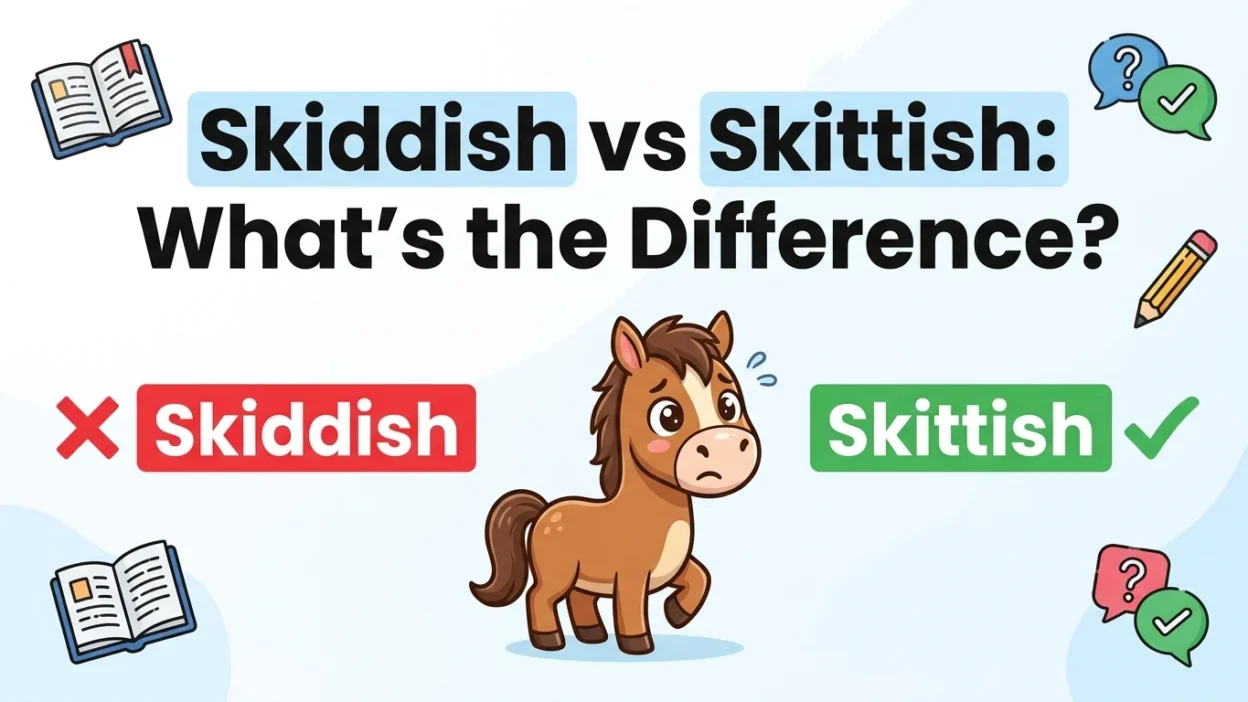
Many English learners and native speakers get confused by skiddish and skittish because they sound very similar when spoken.
The confusion becomes even bigger because many people use skiddish in casual conversation. When someone hears the word, they may assume it is correct and start using it too.
However, there is an important difference:
- One word is recognized as standard English.
- The other is usually considered a spelling mistake or a nonstandard form.
Understanding this difference is easy once you know how each word is used.
In this guide, you will learn exactly what skiddish and skittish mean, which one is correct, and how to avoid common mistakes.
Quick Answer
- Skittish is the correct and standard English word.
- Skittish means nervous, easily frightened, or easily scared.
- Skiddish is generally considered a misspelling or nonstandard version of skittish.
- In formal writing, school work, emails, and professional communication, use skittish.
- If you are unsure, choose skittish every time.
Simple Example
✅ The horse was skittish during the storm.
❌ The horse was skiddish during the storm.
The first sentence is standard English.
Simple Origin or Background Explanation
The word skittish has been part of English for a long time.
It was originally used to describe horses that were nervous, restless, or easily startled. Over time, people began using it for humans as well.
Today, skittish can describe:
- Animals that get scared easily
- People who seem nervous
- People who hesitate because they feel uncertain
The form skiddish likely developed because many people hear the word spoken and guess the spelling incorrectly.
Since skittish and skiddish sound somewhat alike, the mistake is understandable. However, dictionaries and grammar guides recognize skittish as the standard spelling.
Clear Explanation of the Difference
The biggest difference is simple:
Skittish
Skittish is the accepted English word.
Meaning:
- Easily frightened
- Nervous
- Jumpy
- Easily startled
- Hesitant because of fear or uncertainty
Examples:
- The dog became skittish around strangers.
- Investors were skittish after the bad news.
- She felt skittish before giving her speech.
Skiddish
Skiddish is generally not accepted as standard English.
Many people use it when they actually mean skittish.
Examples:
- The cat seemed skiddish. ❌
- He became skiddish after the accident. ❌
In standard writing, these should be:
- The cat seemed skittish. ✅
- He became skittish after the accident. ✅
Easy Rule to Remember
If you are writing English for school, work, exams, articles, or emails, use skittish.
Avoid skiddish unless you are intentionally showing informal speech.
Comparison Table
| Feature | Skittish | Skiddish |
| Standard English word | Yes | No |
| Found in dictionaries | Yes | Usually no |
| Correct for formal writing | Yes | No |
| Means nervous or easily scared | Yes | Often used with this meaning |
| Common spelling mistake | No | Yes |
| Safe choice for students | Yes | No |
| Used in professional writing | Yes | No |
Which One to Use and When
Use “Skittish” When Writing
Use skittish in:
- School assignments
- Essays
- Emails
- News articles
- Books
- Business communication
- Social media posts
- Everyday conversations
Examples:
- The horse became skittish during the parade.
- The market remained skittish after the announcement.
- She was skittish about meeting new people.
Avoid “Skiddish”
Most teachers, editors, and grammar checkers will consider skiddish incorrect.
Instead of writing:
❌ He seemed skiddish.
Write:
✅ He seemed skittish.
This simple change makes your writing more accurate.
Common Mistakes People Make
Many learners make the same mistakes when using these words.
Mistake 1: Thinking Both Words Are Correct
Some people believe skiddish and skittish are interchangeable.
This is not true in standard English.
Correct:
✅ The rabbit is skittish.
Incorrect:
❌ The rabbit is skiddish.
Mistake 2: Spelling by Sound
English words are not always spelled exactly as they sound.
People hear “skittish” and write “skiddish.”
Always remember that the correct spelling contains:
s-k-i-t-t-i-s-h
Mistake 3: Using Skiddish in Formal Writing
Using skiddish in an essay, report, or professional email may look like a spelling error.
Use skittish instead.
Mistake 4: Assuming Spell Check Is Wrong
Sometimes writers think the spell checker is making a mistake when it suggests skittish.
In most cases, the correction is accurate.
Everyday Real Life Examples
Emails
Correct:
The client seemed skittish about signing the agreement.
Correct:
Some customers are skittish about sharing personal information online.
Incorrect:
The client seemed skiddish about signing the agreement.
News
Journalists often use skittish to describe uncertainty.
Examples:
- Consumers remain skittish about rising prices.
- Investors are skittish ahead of the report.
- Travelers are skittish after recent delays.
Social Media
People often write:
My rescue dog is still skittish around loud noises.
I’m a little skittish about trying that ride.
You may occasionally see skiddish online, but that does not make it the standard spelling.
Daily Conversations
Examples:
- The cat gets skittish when guests arrive.
- He became skittish after hearing the strange noise.
- The horse looked skittish before the race.
- She felt skittish about moving to a new city.
Short Learning Section for Students and Beginners
Here is a quick learning trick.
Remember This Sentence
“A skittish animal scares easily.”
Notice the spelling:
Skittish = Correct
Memory Tip
Think about the two letter T’s in skittish.
When you write the word, remember:
S-K-I-T-T-I-S-H
Practice Exercise
Choose the correct word.
- The horse was _____ during the thunderstorm.
- The puppy became _____ around strangers.
- She felt _____ before her first interview.
Answers:
- Skittish
- Skittish
- Skittish
Quick Test
Which word is standard English?
- Skittish ✅
- Skiddish ❌
If you chose skittish, you got it right.
FAQ
Is skiddish a real word?
Some people use it in conversation, but it is generally not considered standard English. The accepted form is skittish.
Is skittish the correct spelling?
Yes. Skittish is the correct and standard spelling.
What does skittish mean?
It means nervous, easily frightened, jumpy, or easily startled.
Can skittish describe people?
Yes. It can describe people who feel nervous, cautious, or uncertain.
Example:
She was skittish about making a big decision.
Can skittish describe animals?
Yes. It is very commonly used for animals.
Example:
The horse became skittish when it heard thunder.
Why do people write skiddish?
Many people spell the word the way they think it sounds. This creates the nonstandard spelling skiddish.
Should I use skiddish in school assignments?
No. Use skittish in all school and academic writing.
Which word should ESL learners remember?
ESL learners should remember skittish because it is the accepted English word used in dictionaries and formal writing.
Conclusion
The difference between skiddish and skittish is actually very simple. Skittish is the correct and standard English word, while skiddish is usually considered a misspelling or nonstandard form. If you want clear, accurate English, always choose skittish.
Remember that skittish means nervous, easily frightened, jumpy, or hesitant. It can describe animals, people, and even situations where uncertainty exists.
When in doubt, use skittish. It is the spelling that teachers, editors, dictionaries, and professional writers expect to see.

David William is a language enthusiast, researcher, and content creator at Lingoveb. With a deep passion for words, meanings, and global communication, he focuses on making language simple, clear, and accessible for readers around the world.