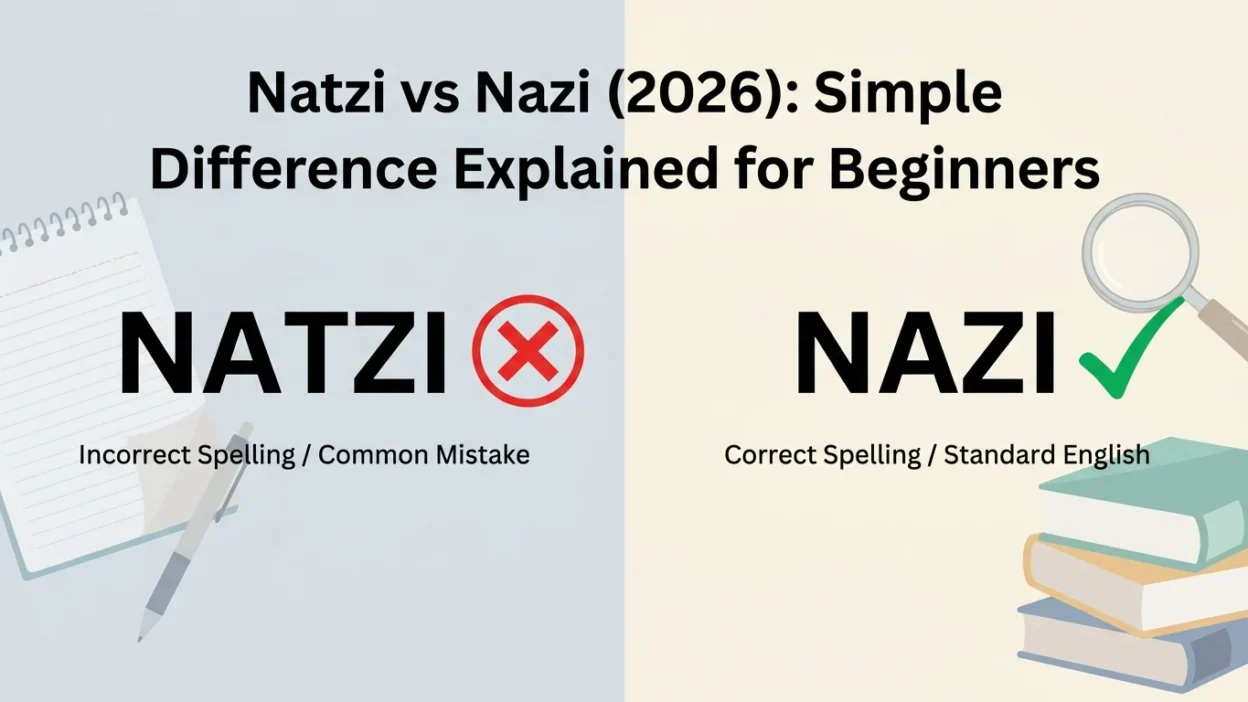
Many people get confused between “Natzi” and “Nazi” because the two words look and sound very similar. When typing quickly, people often make spelling mistakes. Some learners also see both words online and wonder if they have different meanings.
The truth is simple:
- Nazi is the correct word.
- Natzi is usually a spelling mistake.
This article explains the difference in very easy English so students, ESL learners, and beginners can understand it clearly.
Quick Answer
Here is the simple answer:
- Nazi = the correct historical and political term
- Natzi = usually a misspelling of “Nazi”
- “Nazi” refers to members of a political group in Germany during the time of World War II.
- “Natzi” is not the standard English spelling.
- In school writing, news articles, books, and formal English, you should use “Nazi.”
Very Short Example
✅ Correct: “The Nazi party was active in Germany.”
❌ Incorrect: “The Natzi party was active in Germany.”
Simple Origin or Background Explanation
The word “Nazi” comes from Germany. It is connected to the political group led by Adolf Hitler in the 1930s and 1940s.
The full German name was:
National Socialist German Workers’ Party
People shortened the name to “Nazi.”
Over time, the word became widely known around the world because of:
- World War II
- German history
- Political discussions
- Human rights history
The spelling “Natzi” does not come from history or official language rules. It usually appears because:
- someone typed too fast
- someone heard the word but never saw it written
- autocorrect changed the spelling
- a learner confused the letters
So the main point is:
“Nazi” has a real historical meaning.
“Natzi” is usually just an incorrect spelling.
Clear Explanation of the Difference
The difference is mainly about correct spelling.
“Nazi”
- Real English word
- Correct spelling
- Used in history books, schools, and news
- Refers to a historical political group
“Natzi”
- Not the accepted spelling
- Usually a typo or spelling mistake
- Rarely used in correct English writing
- May confuse readers
Why One Letter Matters
English spelling can completely change how writing looks. Even one extra letter can make a word incorrect.
For example:
- “friend” is correct
- “freind” is wrong
In the same way:
- “Nazi” is correct
- “Natzi” is wrong
This is why careful spelling is important, especially in school essays, reports, and online discussions.
Comparison
| Feature | Nazi | Natzi |
| Correct spelling? | Yes | No |
| Real English word? | Yes | Usually no |
| Used in history books? | Yes | No |
| Common mistake? | No | Yes |
| Accepted in formal writing? | Yes | No |
| Meaning | Historical political term | Misspelling of “Nazi” |
| Safe to use in school writing? | Yes, when historically relevant | No |
Which One to Use and When
You should use “Nazi” whenever you are talking about:
- World War II
- German history
- Historical events
- Political discussions related to that period
Examples
✅ “The Nazi government controlled Germany during World War II.”
✅ “Students studied Nazi history in class.”
✅ “The museum has information about the Nazi period.”
You should not use “Natzi” in formal English.
When “Natzi” Appears
You may still see “Natzi”:
- in social media comments
- in typing mistakes
- in online gaming chats
- from language learners
- in rushed messages
But it is not considered the correct form.
Common Mistakes People Make
Confusing Sound With Spelling
Some people hear the word and think there should be a “t” sound in the middle. This leads to “Natzi.”
But English spelling does not always match pronunciation perfectly.
Copying Incorrect Online Text
Sometimes users copy words from comments or social media posts without checking spelling.
If one person writes “Natzi,” others may repeat it.
Typing Too Fast
Fast typing often creates extra letters.
Example:
- “Nazi” → “Natzi”
Autocorrect Problems
Phones and keyboards sometimes change words unexpectedly.
Always double check spelling before sending messages or school work.
Thinking Both Words Are Different Terms
Some learners think:
- “Nazi” means one thing
- “Natzi” means another thing
In normal English, this is not true.
“Natzi” is generally just a spelling error.
Everyday Real Life Examples
Emails
A student writing a history assignment email should use the correct spelling.
✅ “My report is about Nazi Germany.”
❌ “My report is about Natzi Germany.”
News
News articles use the correct historical spelling.
✅ “The documentary explained Nazi history.”
You will almost never see respected news writing use “Natzi.”
Social Media
Social media contains many typing mistakes.
You may see:
- “Natzi”
- “Nazzi”
- “Naazi”
But these are usually errors, not correct forms.
Daily Use
If you discuss history in conversation, essays, or class, always use the correct spelling:
✅ Nazi
Short Learning Section for Students and Beginners
Here are some easy ways to remember the correct spelling.
Memory Tip
Think of:
Na + zi = Nazi
Only four letters.
No extra “t.”
Quick Practice
Choose the correct word:
- The _____ party ruled Germany during World War II.
- Nazi ✅
- Natzi ❌
- My teacher explained _____ history.
- Nazi ✅
- Natzi ❌
- The book discussed the rise of the _____ government.
- Nazi ✅
- Natzi ❌
Beginner Advice
When learning English:
- check spelling carefully
- use dictionaries
- compare words in trusted books
- avoid copying random internet comments
This helps you learn correct English faster.
FAQ
Is “Natzi” a real English word?
Usually no. It is mostly considered a spelling mistake of “Nazi.”
Which spelling is correct?
“Nazi” is the correct spelling.
Why do people write “Natzi”?
People may:
- type too quickly
- misunderstand pronunciation
- make keyboard mistakes
- copy incorrect spelling online
Can I use “Natzi” in school writing?
No. You should use “Nazi.”
Is “Nazi” a historical term?
Yes. It is connected to Germany and World War II history.
Do dictionaries include “Natzi”?
Most standard dictionaries do not recognize it as the correct spelling.
Is “Natzi” used in formal English?
No. Formal English uses “Nazi.”
How can I remember the correct spelling?
Remember:
- “Nazi” has only four letters
- there is no “t” in the middle
Conclusion
The difference between “Natzi” and “Nazi” is very simple.
- Nazi is the correct historical word.
- Natzi is usually just a spelling mistake.
Many people get confused because the words sound similar, but only “Nazi” is accepted in correct English writing.
If you are a student, ESL learner, or beginner, the safest choice is easy:
✅ Use “Nazi”
❌ Avoid “Natzi”
Learning small spelling differences like this can improve your English writing and help you communicate more clearly.

Marak Robort is a content writer and researcher with a strong interest in language, meanings, and digital information. His work focuses on presenting clear, easy-to-understand explanations that help readers quickly grasp complex ideas.