Many English learners get confused between seak and seek because the two words look and sound similar. When typing quickly, people often write seak by mistake instead of seek.
Another reason for the confusion is that English spelling can be tricky. Some words use “ea” while others use “ee,” and beginners may not know which spelling is correct.
The simple truth is this:
- Seek is the correct English word.
- Seak is not a standard English word.
Once you understand this basic idea, the confusion becomes much easier to avoid.
Quick Answer
Here is the short and simple answer:
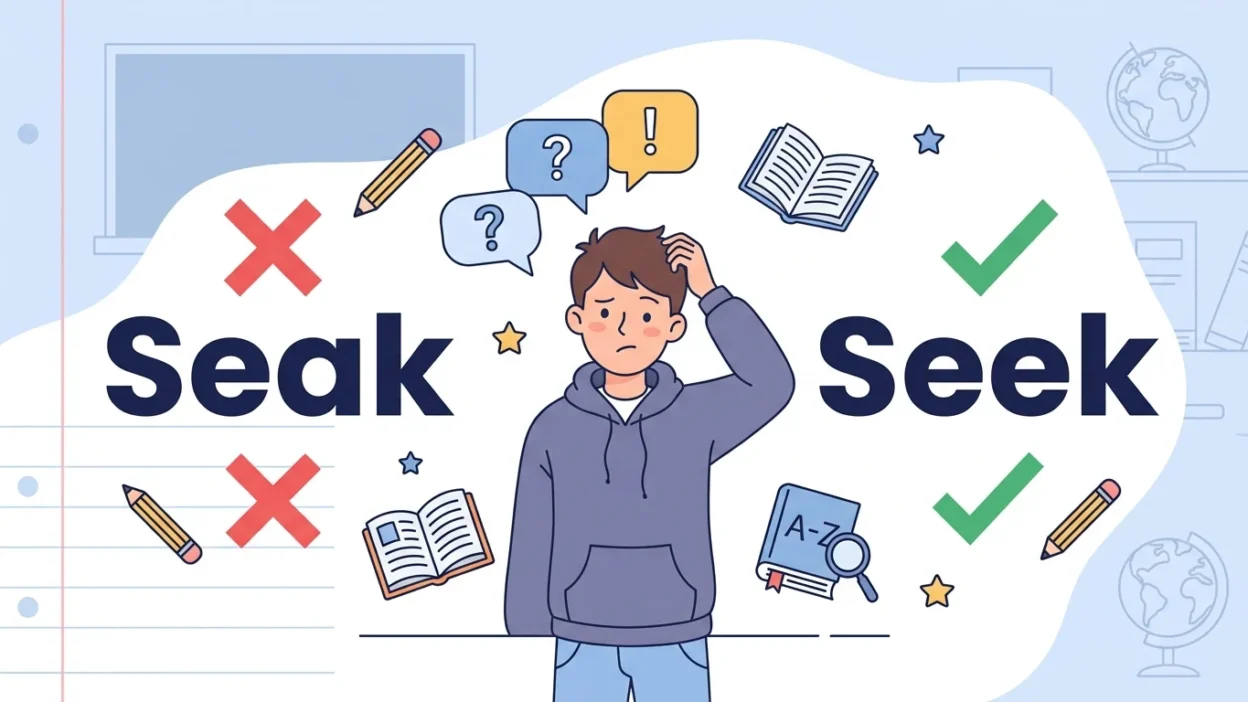
- ✅ Seek = correct spelling
- ❌ Seak = incorrect spelling or typo
Meaning of “seek”
The word seek means:
- to look for something
- to try to find something
- to ask for help, advice, or information
Examples
- I want to seek help.
- She seeks the truth.
- They are seeking a new job.
Important Tip
If you are writing in English, always use seek, not seak.
Simple Origin or Background Explanation
The word seek is a very old English word. It has been used in English for hundreds of years.
It comes from old forms of English and has always carried the idea of:
- searching
- looking for
- trying to get something
Over time, the spelling became fixed as seek.
The spelling seak did not become part of standard English. Most of the time, it appears because of:
- typing mistakes
- spelling confusion
- pronunciation guesses
That is why dictionaries include seek but not seak.
Clear Explanation of the Difference
The difference is actually very simple.
“Seek” Is Correct
“Seek” is a real English verb.
It is used when someone:
- searches for something
- tries to get something
- asks for something
Examples
- We should seek medical advice.
- He wants to seek success.
- Students often seek guidance from teachers.
“Seak” Is Incorrect
“Seak” is not accepted as a standard English word.
People usually write it accidentally when they mean “seek.”
Wrong Example
- ❌ I will seak help.
Correct Example
- ✅ I will seek help.
So whenever you want to talk about searching, looking, or asking, the correct spelling is always seek.
Comparison Table
Seak vs Seek Comparison
| Word | Correct or Incorrect? | Meaning | Used in English? |
| Seek | ✅ Correct | To look for or try to get something | Yes |
| Seak | ❌ Incorrect | No accepted meaning | No |
Pronunciation
| Word | Pronunciation |
| Seek | “seek” (sounds like “week”) |
| Seak | Usually a misspelling |
Example Sentences
| Incorrect | Correct |
| I seak knowledge. | I seek knowledge. |
| They seak help online. | They seek help online. |
| She is seaking answers. | She is seeking answers. |
Which One to Use and When
You should use seek in all situations where you mean:
- search for something
- ask for help
- try to achieve something
Use “Seek” in Formal Writing
“Seek” is common in:
- school writing
- business emails
- news articles
- official documents
Examples
- Please seek permission first.
- The company is seeking new employees.
- Many people seek peace and happiness.
Use “Seek” in Daily Conversation
People also use it in everyday English.
Examples
- I need to seek advice.
- She is seeking a better opportunity.
- They seek answers online.
Never Use “Seak”
Even in casual writing or social media, “seak” is still considered incorrect.
Common Mistakes People Make
Many learners make similar mistakes with this word. Here are the most common ones.
Writing “Seak” Instead of “Seek”
This is the biggest mistake.
- ❌ seak
- ✅ seek
Using the Wrong Verb Form
Correct forms of “seek” include:
| Form | Example |
| Seek | I seek answers. |
| Seeks | She seeks help. |
| Seeking | They are seeking jobs. |
| Sought | He sought advice. |
Confusing Pronunciation and Spelling
Some learners think the word should use “ea” because many English words do.
For example:
- speak
- break
- dream
But English spelling rules are not always consistent. The correct spelling here is still seek.
Forgetting the Past Tense
The past tense of “seek” is not “seeked.”
Correct form:
- ✅ sought
Wrong form:
- ❌ seeked
Example
- ✅ She sought help from her teacher.
- ❌ She seeked help from her teacher.
Everyday Real Life Examples
Emails
- Please seek approval before sending the file.
- I am seeking more information about the meeting.
- We seek your feedback on this project.
News
- The police seek witnesses after the accident.
- Leaders seek peaceful solutions.
- Scientists seek answers about climate change.
Social Media
- Many users seek advice online.
- People seek motivation from creators.
- Students often seek study tips on social platforms.
Daily Conversations
- I need to seek medical help.
- She seeks happiness in life.
- We are seeking a new apartment.
School and Learning
- Students seek knowledge.
- Teachers seek better ways to explain lessons.
- Parents seek good schools for their children.
Short Learning Section for Students and Beginners
Here is a very easy way to remember the correct word.
Memory Trick
Think of this sentence:
“I seek what I need.”
The word seek has double “e,” just like:
- need
- feel
- keep
This can help you remember the spelling.
Easy Practice Sentences
Fill in the blanks with the correct word.
- I _____ help from my teacher.
- They are _____ new opportunities.
- We _____ the truth.
Answers
- seek
- seeking
- seek
Beginner Tip
If your spell checker underlines “seak,” it is because the word is incorrect.
Always change it to seek.
FAQ
Is “seak” a real English word?
No. “Seak” is not a standard English word.
What does “seek” mean?
“Seek” means to look for, search for, or try to get something.
Why do people write “seak”?
People usually write “seak” because of spelling mistakes or typing errors.
Which spelling is correct: seek or seak?
The correct spelling is seek.
Can I use “seak” in formal writing?
No. You should never use “seak” in formal writing.
What is the past tense of “seek”?
The past tense of “seek” is sought.
Example
- She sought help yesterday.
Is “seek” a formal word?
Yes, but it is also used in everyday English.
How can I remember the correct spelling?
Remember that seek has double “e.”
Think of similar words like:
- keep
- feel
- need
Conclusion
The difference between seak and seek is very simple once you understand it clearly.
- Seek is the correct English word.
- Seak is an incorrect spelling.
Use seek whenever you want to talk about:
- searching for something
- asking for help
- trying to find answers
- looking for opportunities
This word is common in everyday English, school writing, business communication, and news reports.
If you remember one thing from this article, remember this:
✅ Always write “seek”
❌ Never write “seak”

Ely Joseph is a language researcher, writer, and contributor who specializes in words, meanings, and multilingual communication. With a strong interest in how language shapes understanding across cultures, Ely focuses on creating clear, accurate, and reader-friendly content for a global audience.