Many people get confused between “adict” and “addict” because the two words look very similar. When speaking quickly, some people may also pronounce them almost the same way. This confusion is very common among students, ESL learners, and beginner English writers.
Another reason is typing mistakes. Since English spelling can sometimes feel tricky, people may accidentally remove one “d” and write “adict” instead of “addict.”
The good news is simple:
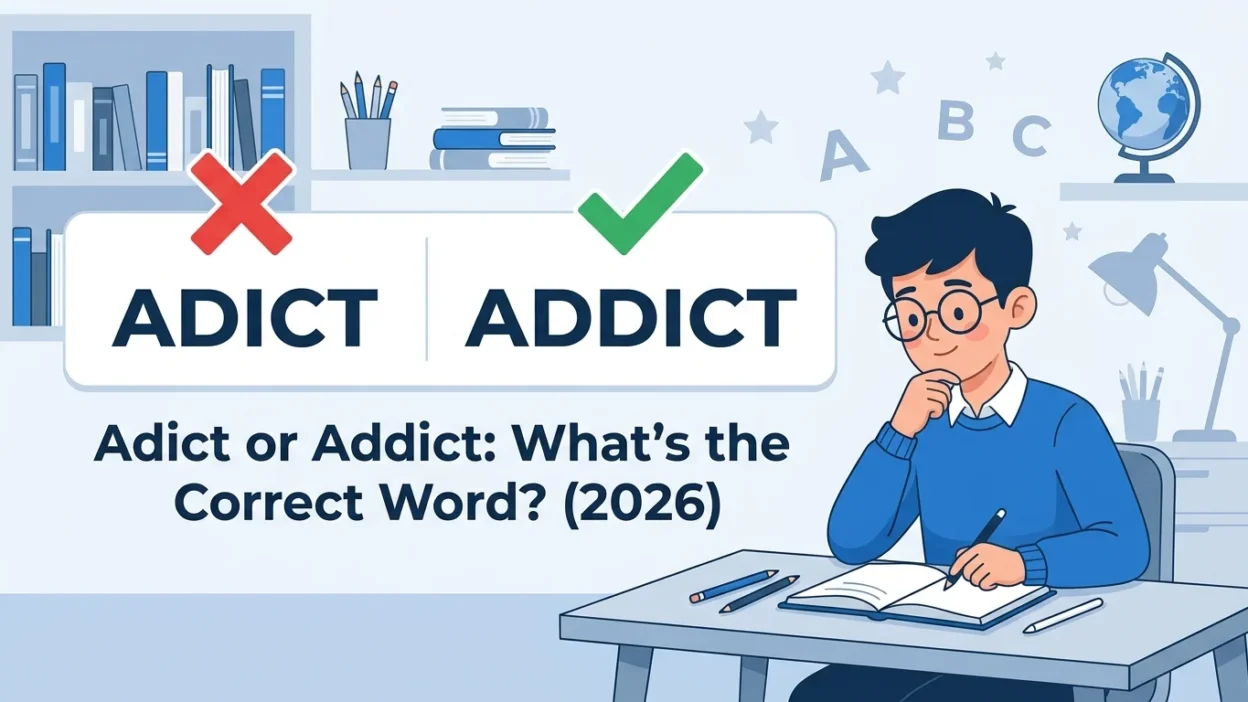
- “Addict” is the correct English word
- “Adict” is not a correct standard English word
Once you understand this basic rule, the confusion becomes much easier to avoid.
Quick Answer
- ✅ Addict = correct English word
- ❌ Adict = incorrect spelling in English
- “Addict” can be:
- a noun
- a verb
- Use “addict” when talking about strong dependence or habit
- Never use “adict” in formal English writing
Examples
- ✅ He is an addict.
- ✅ Some games can addict people.
- ❌ He is an adict.
Simple Origin or Background Explanation
The word “addict” comes from old Latin language roots. Over time, it entered English and became a normal English word.
Originally, the word meant giving yourself completely to something. Today, people mostly use it when talking about:
- drugs
- smoking
- alcohol
- gaming
- phones
- social media
- habits
For example:
- She is addicted to coffee.
- He became a gaming addict.
The spelling has always included two “d” letters:
a + d + d + i + c + t
That is why “adict” is considered a spelling mistake.
Clear Explanation of the Difference
The difference is actually very simple.
“Addict” = Correct Word
“Addict” is a real English word. It is accepted in dictionaries and used in daily English.
It can describe:
- a person with a strong habit
- someone dependent on something
- the action of causing dependence
Examples
As a noun
- He is a phone addict.
- The movie shows the life of a drug addict.
As a verb
- Some apps addict users very quickly.
“Adict” = Incorrect Spelling
“Adict” is not standard English.
People usually write it by mistake because:
- they forget one “d”
- they type too fast
- they are still learning English spelling
Wrong Examples
- ❌ She is an adict.
- ❌ Many teenagers become adicts.
These sentences should use “addict.”
Comparison
| Feature | Addict | Adict |
| Correct English word | Yes | No |
| Found in dictionaries | Yes | No |
| Standard spelling | Yes | No |
| Used in schools and writing | Yes | No |
| Common typing mistake | No | Yes |
| Example | “He is an addict.” | Incorrect |
Which One to Use and When
You should always use “addict” in English writing and speaking.
Use “addict” when talking about:
A person with strong dependence
- alcohol addict
- gaming addict
- social media addict
A very strong habit
- She is addicted to shopping.
- He is addicted to music.
Someone who cannot stop something easily
- The character became a drug addict.
Never Use “Adict”
Avoid using “adict” in:
- school writing
- exams
- emails
- social media captions
- job applications
- articles
Even in casual writing, native English speakers usually see “adict” as a spelling mistake.
Common Mistakes People Make
Many learners make small mistakes with this word. Here are the most common ones.
Forgetting One “D”
This is the biggest mistake.
Wrong
- adict
Correct
- addict
Mixing “Addict” and “Addicted”
These words are related but different.
| Word | Meaning |
| Addict | A person or verb |
| Addicted | Describes dependence |
Examples
- He is an addict.
- He is addicted to gaming.
Using It Too Casually
Sometimes people jokingly say:
- “I’m a chocolate addict.”
- “I’m addicted to TV dramas.”
This is common in casual English, but remember that the word can also describe serious problems.
Wrong Pronunciation
Some learners pronounce it like:
- “ah-dikt”
A clearer pronunciation is closer to:
- “uh-dikt”
Listening to native pronunciation can help.
Everyday Real Life Examples
Emails
- I think my brother is becoming a phone addict.
- She said she was addicted to online shopping.
News
- The report discussed drug addicts in the city.
- Experts warned that social media can addict young users.
Social Media
- I’m addicted to this new song!
- My friend is a coffee addict.
Daily Conversations
- He spends all day gaming. He’s a real gaming addict.
- She became addicted to sugar drinks.
School and Classroom Use
- The teacher explained the difference between “addict” and “addicted.”
- Students often misspell “addict” as “adict.”
Short Learning Section for Students and Beginners
Here are easy ways to remember the correct spelling.
Memory Trick
Think of the word this way:
“Addict” has an extra “d.”
You can remember it like this:
Bad habits “add” problems.
The word “add” already has two “d” letters.
That can help you remember the spelling of “addict.”
Simple Practice Sentences
Fill in the blank with the correct word.
- He is a gaming _______.
- She became _______ to coffee.
- “Adict” is a spelling _______.
Answers
- addict
- addicted
- mistake
Easy Spelling Tip
Break the word into parts:
ad + dict
But remember that the spelling keeps double d:
addict
Practice writing it several times:
- addict
- addict
- addict
This helps your brain remember the correct form.
FAQ
Is “adict” a real English word?
No. “Adict” is not considered correct standard English spelling.
Is “addict” correct?
Yes. “Addict” is the correct English word.
Why do people write “adict”?
Usually because of typing mistakes or spelling confusion.
Can “addict” be both a noun and a verb?
Yes.
Noun example
- He is a gaming addict.
Verb example
- Some apps addict users.
What is the difference between “addict” and “addicted”?
- Addict = a person or verb
- Addicted = describes dependence
Example:
- She is an addict.
- She is addicted to coffee.
Is “addict” always about drugs?
No. It can also describe habits like:
- gaming
- phones
- shopping
- coffee
- social media
Is it okay to say “I’m addicted to music”?
Yes. People often use it casually to show strong interest.
How can I remember the correct spelling?
Remember this:
“Addict” has double “d.”
Practice writing the word correctly several times.
Conclusion
The confusion between “adict” and “addict” is very common, especially for students and English learners. However, the rule is simple once you learn it clearly.
- ✅ Addict is the correct English word
- ❌ Adict is an incorrect spelling
Use “addict” when talking about strong habits, dependence, or someone who cannot easily stop doing something.
If you remember the double “d” spelling, you will avoid this mistake easily in school, writing, conversations, and daily English use.

Ely Joseph is a language researcher, writer, and contributor who specializes in words, meanings, and multilingual communication. With a strong interest in how language shapes understanding across cultures, Ely focuses on creating clear, accurate, and reader-friendly content for a global audience.