
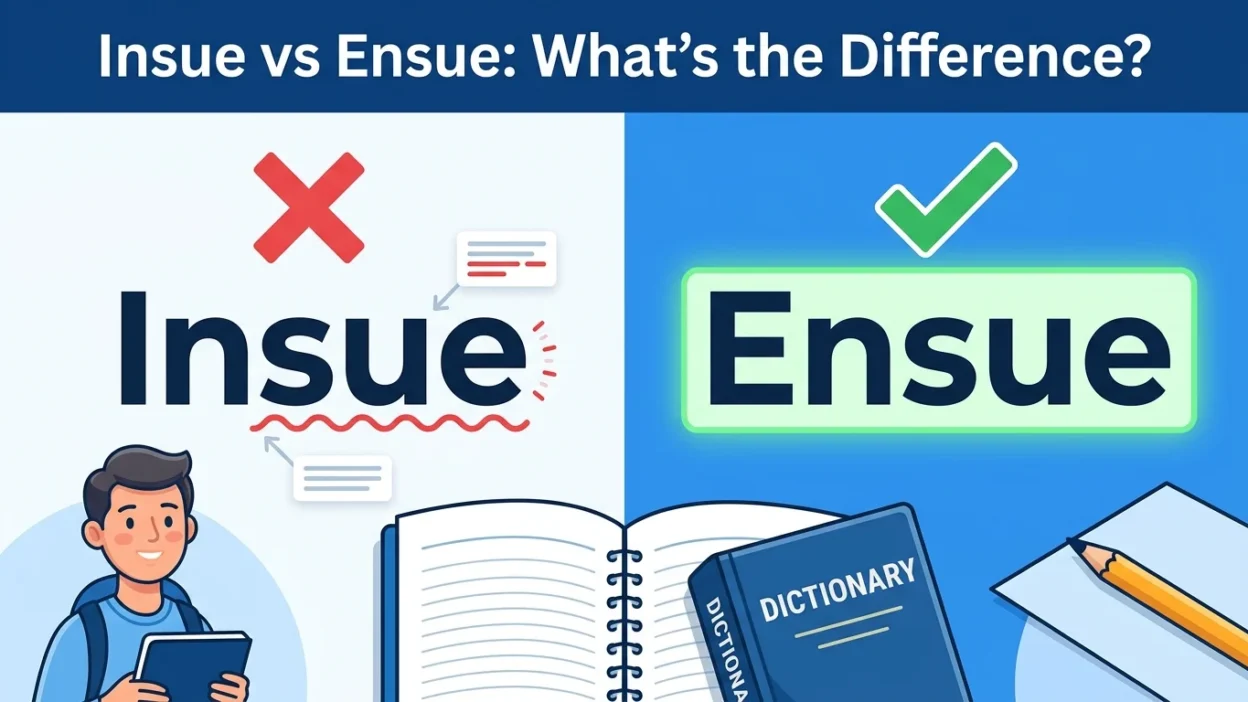
In my experience working with ESL learners and beginners, the confusion between insue and ensue often comes from pronunciation similarity and simple spelling confusion. Many students assume both are English word forms, but only ensue is the correct spelling and a real word, while insue is an incorrect spelling and a clear misspelling that creates a common writing error in standard English. The word ensue is a verb that means something happens afterward, a direct result, or a consequence that follow event in natural flow. This is why we often see examples like “silence ensued,” “chaos ensued,” or “debate ensued,” showing real life cause and effect in formal writing, academic writing, and even everyday communication like emails, news, and workplace communication.
The origin and background of ensue goes back to Latin insequi, through Old French ensuivre, showing clear French origin and long historical development in the English language. Over time, its meaning evolution stayed close to “to follow,” shaped by prefix en-, while confusion grew due to en vs in, pronunciation change, and spelling similarity with other confusion words like ensure, insure, and pursue.
Many ESL students face learners mistake, especially when doing proofreading or writing error checks in essays, reports, or storytelling, where insue misspelling appears due to lack of familiarity and weak vocabulary exposure. In proper English spelling rules, only ensue is dictionary recognized, and it is widely accepted in American and British English with no regional variation. A simple memory tip is to remember that events “comes next” and a chain reaction always ensue, so you should always replace insue with ensue to maintain clarity guide, writing confidence, and communication accuracy in both professional English and academic use.
Quick Answer
- Ensue is a real English word.
- Insue is not a standard English word.
- Use ensue when you mean “to happen afterward” or “to follow as a result.”
- Avoid using insue in writing, schoolwork, emails, or professional communication.
- If you see insue, it is usually a misspelling of ensue.
Example
✅ The argument started, and chaos ensued.
❌ The argument started, and chaos insued.
Simple Origin or Background Explanation
The word ensue has been part of the English language for many centuries.
It comes from older forms of language that carried the idea of following after something.
Over time, English speakers began using ensue to describe events that happen as a result of something else.
For example:
- Heavy rain fell all night.
- Flooding ensued.
This means the flooding happened after the rain and because of the rain.
The spelling insue did not become an accepted English word. Today, dictionaries recognize ensue, not insue.
Clear Explanation of the Difference
The difference is actually very simple.
What Does Ensue Mean?
Ensue means:
- To happen afterward
- To follow as a result
- To occur because something else happened first
It often describes a consequence or result.
Examples
- The power went out, and confusion ensued.
- The team scored a goal, and celebrations ensued.
- The warning was ignored, and problems ensued.
In all of these examples, something happened first, and another event followed.
What Does Insue Mean?
In modern English, insue is not considered a correct word.
Most of the time, it appears because:
- Someone misspelled ensue
- Someone heard the word but never saw its correct spelling
- A typing error occurred
Example
Incorrect:
- Several problems insued after the mistake.
Correct:
- Several problems ensued after the mistake.
Comparison Table
| Feature | Ensue | Insue |
| Is it a real English word? | Yes | No |
| Accepted in dictionaries? | Yes | No |
| Correct for formal writing? | Yes | No |
| Meaning | To happen afterward or as a result | Usually a misspelling |
| Commonly used? | Yes | No |
| Safe to use in school or work? | Yes | No |
Which One to Use and When
You should use ensue whenever you want to describe something that happens after another event.
Use Ensue When
- A result follows an action.
- One event causes another event.
- You are describing consequences.
Examples
- The alarm sounded, and panic ensued.
- The company announced layoffs, and protests ensued.
- The teacher entered the classroom, and silence ensued.
Do Not Use Insue
Avoid using insue because readers may think it is a mistake.
Easy Rule to Remember
If you are choosing between insue and ensue, always choose ensue.
Common Mistakes People Make
Many learners make similar mistakes with this word.
Mistake 1: Using Insue Instead of Ensue
❌ Trouble insued after the decision.
✅ Trouble ensued after the decision.
Mistake 2: Thinking Both Words Are Correct
Some people assume both spellings exist.
The truth is:
- Ensue = Correct
- Insue = Incorrect
Mistake 3: Using Ensue Without a Cause
The word usually works best when something happens first.
Less natural:
- Chaos ensued suddenly.
More natural:
- The doors were left open, and chaos ensued.
Mistake 4: Spelling Ensued Incorrectly
People often write:
- Insued
- Ensuedd
- Ensueded
- Ensued
Everyday Real Life Examples
Emails
Correct:
- The system crashed, and several delays ensued.
Correct:
- A misunderstanding occurred, and confusion ensued.
News
- A strong storm hit the region, and flooding ensued.
- The accident blocked the highway, and traffic delays ensued.
- The announcement was released, and public debate ensued.
Social Media
- I posted my opinion, and a long discussion ensued.
- The video went viral, and thousands of comments ensued.
- One funny joke started a conversation that ensued for hours.
Daily Conversations
- The kids started arguing, and chaos ensued.
- The lights went out, and everyone became nervous. Panic ensued.
- The dog escaped the yard, and a neighborhood search ensued.
Short Learning Section for Students and Beginners
A Simple Memory Trick
Think of ensue as:
Event 1 → Event 2 follows
Example:
- It started snowing.
- Traffic problems ensued.
The traffic problems followed the snow.
Practice Sentences
Choose the correct word.
- The fire alarm rang, and confusion _____.
- The game ended, and celebrations _____.
- The warning was ignored, and problems _____.
Answers:
- ensued
- ensued
- ensued
Mini Exercise
Correct the sentence:
- Heavy rain fell all day, and flooding insued.
Correct answer:
- Heavy rain fell all day, and flooding ensued.
FAQ
Is insue a real word?
No. In modern English, insue is generally considered a misspelling of ensue.
What does ensue mean?
It means to happen afterward or to follow as a result of something else.
Why do people write insue?
Many people hear the word before they see it written. Because of this, they guess the spelling and sometimes write insue by mistake.
Can I use insue in formal writing?
No. Use ensue instead.
Is ensue a common English word?
Yes. It appears in books, articles, news reports, and everyday writing.
What is the past tense of ensue?
The past tense is ensued.
Example:
- An argument broke out, and chaos ensued.
Can ensue describe positive events?
Yes.
Examples:
- The team won the championship, and celebrations ensued.
- The good news was announced, and happiness ensued.
How can I remember the correct spelling?
Simply remember:
- Ensue = correct
- Insue = incorrect
Whenever you are unsure, choose ensue.
Conclusion
The confusion between insue and ensue is easier to solve than many people think. In modern English, ensue is the correct word, and it means something happens afterward as a result of another event. The spelling insue is generally just a mistake and should be avoided.
Whenever you write about a consequence, result, or event that follows another event, use ensue. Remember the simple rule: ensue is correct, insue is not. Once you know this, you can use the word confidently in school assignments, emails, articles, and everyday communication.

Marak Robort is a content writer and researcher with a strong interest in language, meanings, and digital information. His work focuses on presenting clear, easy-to-understand explanations that help readers quickly grasp complex ideas.