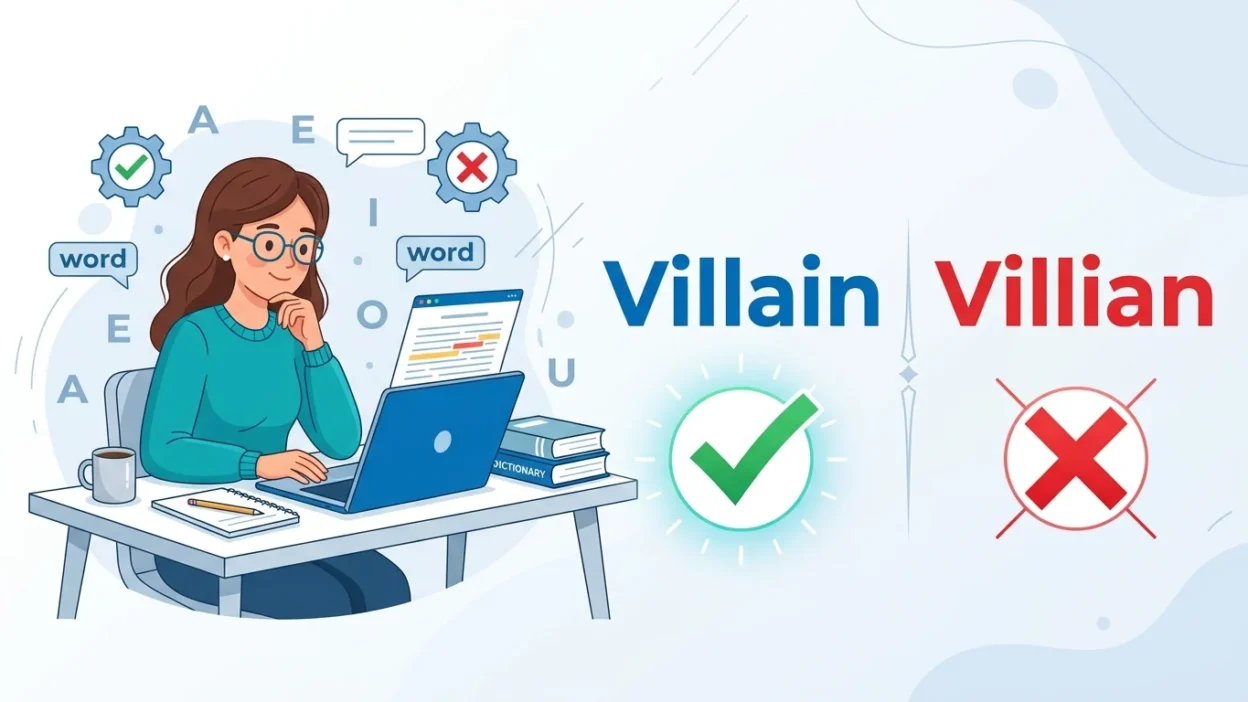
Villain vs villian is a common spelling confusion where only villain is the correct spelling and villian is an incorrect spelling and clear misspelling in modern English writing. The word villain is a real word and valid English word, used for an evil character, bad character, wicked person, or primary antagonist who creates conflict against a hero or protagonist in stories, movies, films, books, and everyday speech.
I have often seen students in school, education, and even workplace writing mix the correct order of letters due to typing errors, fast typing, or simple letter order confusion between ai and ia, which affects clarity, confidence, and accuracy in formal writing and informal writing.
The word comes from Old French, Latin, villanus, vilain, originally meaning farm worker, villager, living on an estate or land, but through medieval stories, its evolution and language development changed its evolved meaning into a wicked character, dishonest, scoundrel-like behavior, and evil person in literature and storytelling traditions. In modern usage, the noun and adjective forms like villainous and villainy describe harmful actions, flawed morals, and morally bad behavior, often seen in movies, films, television, video games, and popular culture like Darth Vader, Joker, Lord Voldemort, and Scar as iconic villains.
Even in social media, news, debate, essay writing, and academic writing, using correct spelling improves credibility, precision, communication, and language control, supported by dictionary recognition, grammar tools, spellcheck, style guides, and software that ensure standard English, universally correct usage across British English, American English, London, New York, and Karachi.
Quick Answer
- Villain = Correct spelling
- Villian = Incorrect spelling (spelling mistake)
- Use villain when talking about a bad character or an evil person in a story.
- Avoid using villian because it is not accepted as a standard English word.
Example:
✅ The villain tried to take over the city.
❌ The villian tried to take over the city.
Origin and Background
The word villain has been part of English for many centuries.
Long ago, the word referred to a person who lived and worked in a village. Over time, its meaning changed. Eventually, it became associated with people who behaved badly or acted in dishonest ways.
Today, the word is mostly used to describe:
- A bad character in stories
- An evil person in movies
- Someone who causes problems or harm
The spelling villain developed through the history of the English language and became the accepted standard spelling.
The spelling villian did not become an accepted English word. It is simply a common spelling error.
The Difference Between Villain and Villian
The difference is very easy to understand.
Villain
Villain is the correct English word.
It refers to:
- A bad character in a story
- An evil person in a movie
- Someone who causes trouble or harm
Examples:
- The villain kidnapped the prince.
- Every superhero has a villain.
- The villain’s plan failed in the end.
Villian
Villian is not a standard English word.
People usually write it by accident because the letters are placed in the wrong order.
Examples:
❌ The villian escaped from prison.
❌ The movie’s villian was very clever.
The correct version is:
✅ The villain escaped from prison.
✅ The movie’s villain was very clever.
Easy Way to Remember
Think of the word ending as:
vill + ain = villain
The correct spelling has “ai” near the end.
If you see “ia”, it is probably a spelling mistake.
Comparison Table
| Feature | Villain | Villian |
| Correct English spelling | Yes | No |
| Found in dictionaries | Yes | No |
| Used in books and articles | Yes | No |
| Accepted in school writing | Yes | No |
| Meaning | Bad person or character | Misspelling of villain |
| Recommended to use | Yes | No |
Which One to Use and When
You should always use villain.
There is no situation in normal English writing where villian is preferred.
Use “Villain” When Talking About Stories
Examples:
- The villain wanted to destroy the kingdom.
- The villain was defeated by the hero.
- The villain escaped at the end of the movie.
Use “Villain” When Describing Bad Behavior
Sometimes people use the word outside stories.
Examples:
- The newspaper described him as the villain of the scandal.
- Fans blamed the coach and treated him like the villain.
Avoid “Villian” Everywhere
Whether you are writing:
- Essays
- Emails
- Social media posts
- School assignments
- News articles
- Stories
Always choose villain.
Common Mistakes People Make
Many learners make the same errors when writing this word.
Mixing Up the Letters
The most common mistake is writing:
❌ Villian
Instead of:
✅ Villain
The letters a and i are reversed.
Typing Too Quickly
Fast typing often causes spelling mistakes.
Example:
❌ The villian won.
✅ The villain won.
Not Checking Spellings
Some writers rely only on memory and do not double check difficult words.
A quick spelling check can help avoid mistakes.
Copying Incorrect Spellings
Sometimes people see the wrong spelling online and assume it is correct.
Always remember that villain is the accepted spelling.
Everyday Real Life Examples
Emails
Correct:
- The villain in your story is very interesting.
- Your main villain needs a stronger motivation.
Incorrect:
- The villian in your story is very interesting.
News
Correct:
- The actor played the villain in the new film.
- Critics praised the movie’s villain.
Incorrect:
- Critics praised the movie’s villian.
Social Media
Correct:
- This villain is one of my favorite characters.
- Who is the greatest villain in movie history?
Incorrect:
- This villian is one of my favorite characters.
Daily Conversations
- The villain was scary.
- The villain had a clever plan.
- The villain lost in the end.
These are all correct uses of the word.
Learning Section for Students and Beginners
If you are learning English, here are a few simple tips.
Tip 1: Remember the “AI”
The correct spelling contains:
v-i-l-l-a-i-n
Notice the “ai” near the end.
Tip 2: Read It Slowly
Break the word into parts:
vil-lain
This makes it easier to remember.
Tip 3: Practice Writing It
Write the word several times:
- villain
- villain
- villain
- villain
Repetition helps memory.
Tip 4: Create a Sentence
Make your own sentence.
Examples:
- The villain stole the treasure.
- The villain laughed loudly.
- The villain was defeated by the hero.
Tip 5: Watch for Autocorrect Warnings
Many spelling tools will highlight villian as incorrect.
Pay attention to those warnings.
FAQ
Is villain or villian correct?
Villain is correct. Villian is a spelling mistake.
What does villain mean?
A villain is a bad person or an evil character, especially in a story, movie, or book.
Is villian a real word?
No. It is generally considered a misspelling of villain.
Why do people write villian?
People often switch the letters a and i by accident because the word can be tricky to spell.
Can I use villian in school writing?
No. You should use villain because it is the correct spelling.
How can I remember the correct spelling?
Remember that the word contains “ai” near the end:
villain
Is villain used only in stories?
No. It can also describe a real person who is seen as responsible for something bad.
Are there other words related to villain?
Yes. Some related words include:
- Evil
- Bad guy
- Criminal
- Enemy
- Opponent
These words may have different meanings, but they are often connected to the idea of a villain.
Conclusion
The difference between villain and villian is simple. Villain is the correct spelling and is the word you should always use in English. It refers to a bad person, an evil character, or someone who causes trouble. Villian is not a standard English word and is usually just a spelling mistake.
If you remember one thing from this article, remember this: the correct spelling is villain, with “ai” near the end. Once you learn that pattern, you can avoid the mistake and use the word confidently in school, work, social media, and everyday writing.

David William is a language enthusiast, researcher, and content creator at Lingoveb. With a deep passion for words, meanings, and global communication, he focuses on making language simple, clear, and accessible for readers around the world.