The words cancel and cancell often create spelling confusion, especially for English learners, students, and even native speakers. In real use, we mostly see cancel, canceled, cancelled, canceling, and cancelling, which appear in writing, emails, documents, and publication writing across American English, British English, and Commonwealth English. I have often noticed in editing work that people mix single letter, double letters, one l, and two l forms, which leads to inconsistent spelling and weak consistency in professional texts.
The correct spelling, preferred spelling, and standard spelling depends on regional differences and dialects across the United States, United Kingdom, Australia, and Canada. In US English, the simplified form like canceled and canceling is common, while UK English and British English prefer cancelled and cancelling with a double l.
This reflects orthographic variation, language variation, and spelling rules influenced by Noah Webster, dictionary usage, and historical spelling reform. Even style guides like AP Style, MLA, and Chicago support different usage rules, but both forms remain universally accepted with the same meaning and pronunciation.
In everyday writing, we see these forms in news articles, newspapers, social media, emails, and document writing, where events are called off, stopped, or ended before completion. A cancelled event or canceled event can include a flight cancellation, concert, meeting, class, train, or even school canceled or school cancelled due to weather, rain, or tornado weather. This shows how language rules, grammar, and spelling conventions shape communication for different audience, intended audience, and international audiences.
Quick Answer
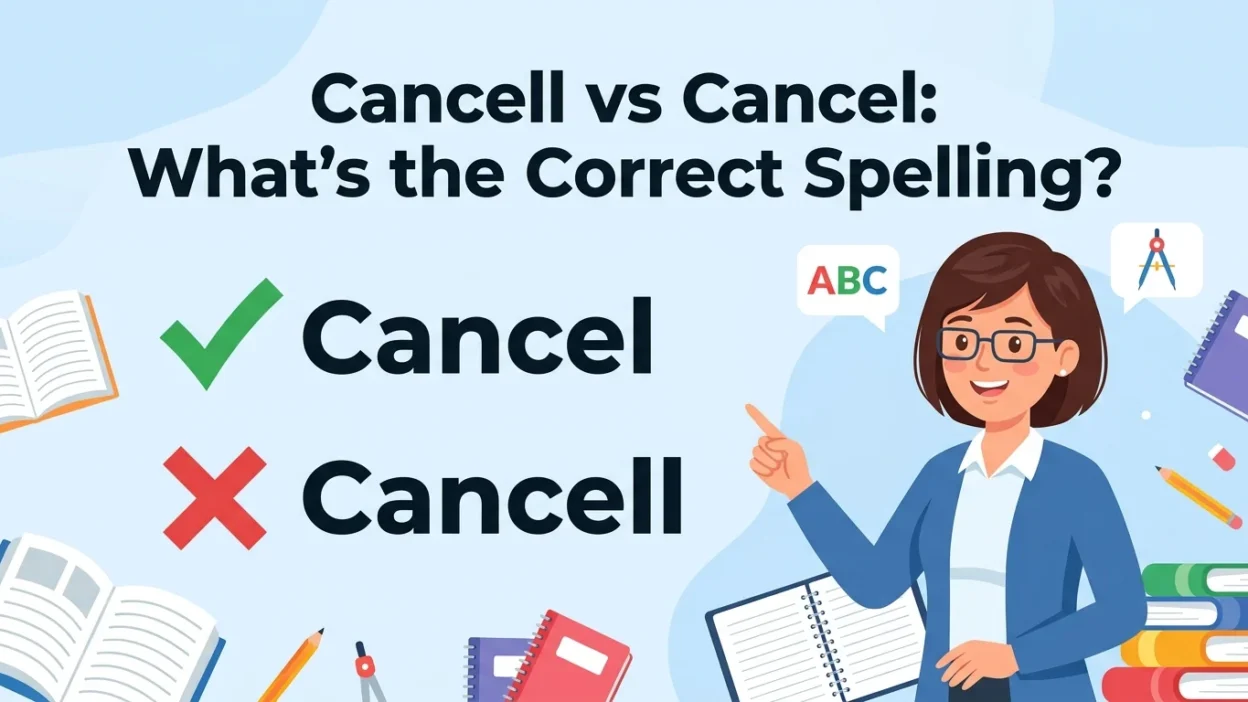
- ✅ Cancel is the correct spelling.
- ❌ Cancell is not a standard English word.
- Use cancel when you want to stop, end, or call off something.
- The extra “l” in cancell is a spelling mistake.
- Examples:
- ✅ I need to cancel my appointment.
- ❌ I need to cancell my appointment.
If you remember only one thing from this article, remember this:
“Cancel” is correct. “Cancell” is incorrect.
Origin and Background of the Word
The word cancel has been used in English for hundreds of years. It came into English through older languages and gradually developed into the word we use today.
The meaning has remained mostly the same:
- To stop something
- To end a plan
- To call something off
- To make something no longer valid
Today, people use cancel in many situations:
- Cancel a meeting
- Cancel a flight
- Cancel a subscription
- Cancel an order
- Cancel an event
The spelling has always been cancel, not cancell.
The confusion mainly comes from related forms such as:
- Cancelled
- Cancelling
- Cancellation
Because these forms contain double l, some writers mistakenly add an extra l to the base word.
Clear Explanation of the Difference
The difference is actually very simple.
Cancel
Cancel is the correct English word.
It can be used as a verb.
Examples:
- Please cancel my order.
- We decided to cancel the trip.
- She had to cancel her appointment.
Cancell
Cancell is not a correct spelling in standard English.
It is usually a typing error or spelling mistake.
Examples:
- ❌ I want to cancell the booking.
- ❌ They will cancell the event.
Correct versions:
- ✅ I want to cancel the booking.
- ✅ They will cancel the event.
Easy Rule
If you are writing the basic word, use:
Cancel
Never use:
Cancell
Comparison Table
| Feature | Cancel | Cancell |
| Correct English spelling | Yes | No |
| Found in dictionaries | Yes | No |
| Used in everyday writing | Yes | No |
| Accepted in school writing | Yes | No |
| Accepted in business writing | Yes | No |
| Considered a spelling mistake | No | Yes |
This table shows that cancel is the only correct choice.
Which One to Use and When
You should use cancel whenever you want to express the idea of stopping, ending, or calling off something.
Use “cancel” for appointments
Examples:
- I need to cancel my doctor’s appointment.
- She canceled her meeting.
Use “cancel” for travel plans
Examples:
- The airline canceled the flight.
- We had to cancel our vacation.
Use “cancel” for subscriptions
Examples:
- I want to cancel my membership.
- He canceled the service.
Use “cancel” for events
Examples:
- The school canceled the sports day.
- The concert was canceled.
No matter the situation, the base word remains cancel.
Common Mistakes People Make
Many learners make the same mistakes when using this word.
Mistake 1: Adding an Extra “L”
Incorrect:
- ❌ Cancell the order.
Correct:
- ✅ Cancel the order.
Mistake 2: Copying the Double “L” from Other Forms
People often see words like:
- Cancelled
- Cancelling
Then they assume the base word should be:
- ❌ Cancell
But the base word is still:
- ✅ Cancel
Mistake 3: Typing Too Fast
Sometimes writers simply press the l key twice by accident.
Example:
- ❌ Please cancell my reservation.
Correct:
- ✅ Please cancel my reservation.
Mistake 4: Not Checking Spelling
A quick spelling check can prevent this error.
Always look carefully before sending:
- Emails
- School assignments
- Social media posts
- Work documents
Everyday Real Life Examples
Emails
Correct examples:
- Please cancel my appointment for tomorrow.
- I would like to cancel my subscription.
- Can you cancel my order?
Incorrect examples:
- ❌ Please cancell my appointment.
- ❌ I want to cancell my order.
News
Correct examples:
- The city canceled the event due to weather.
- The company decided to cancel the project.
Social Media
Correct examples:
- We had to cancel our weekend plans.
- They canceled the show at the last minute.
Daily Use
Correct examples:
- I need to cancel dinner tonight.
- She canceled the reservation.
- We canceled the meeting.
These examples show how commonly the word cancel is used in everyday life.
Short Learning Section for Students and Beginners
Here is a simple trick to remember the correct spelling.
Memory Trick
Think of this sentence:
“I will cancel the plan.”
Notice that cancel ends with only one l.
Remember This Pattern
Base word:
- Cancel
Related forms:
- Canceling or Cancelling
- Canceled or Cancelled
- Cancellation
The extra l may appear in some related forms depending on the style of English being used, but the basic word remains:
Cancel
Practice Sentences
Fill in the blank:
- I need to _____ my appointment.
- They decided to _____ the event.
- Please _____ my order.
Answers:
- Cancel
- Cancel
- Cancel
If you wrote cancel for all three, you are correct.
Frequently Asked Questions (FAQ)
Is “cancell” a real English word?
No. Cancell is not a standard English word. It is considered a spelling mistake.
Which spelling is correct: cancel or cancell?
Cancel is the correct spelling.
Why do people write “cancell”?
People often get confused because related words such as cancelled and cancelling contain double l.
Can I use “cancell” in formal writing?
No. You should always use cancel in formal and informal writing.
Is “cancel” a verb?
Yes. Cancel is a verb that means to stop, end, or call off something.
How do I remember the correct spelling?
Remember that the basic word has only one l:
Cancel
Is “cancel” used in American and British English?
Yes. Both American and British English use cancel as the base form.
What is an example sentence with “cancel”?
Example:
We decided to cancel the meeting because of the weather.
Conclusion
The difference between cancell and cancel is very straightforward. Cancel is the correct English spelling, while cancell is a spelling mistake. The confusion usually happens because some related forms, such as cancelled and cancelling, may contain double l.
Whenever you want to talk about stopping, ending, or calling off something, always use cancel. Whether you are writing an email, school assignment, social media post, or business message, cancel is the spelling you can trust.
A simple rule to remember is:
One “l” = correct (cancel)
Two “l’s” = incorrect (cancell)
Keep this rule in mind, and you will never confuse these two spellings again.

David William is a language enthusiast, researcher, and content creator at Lingoveb. With a deep passion for words, meanings, and global communication, he focuses on making language simple, clear, and accessible for readers around the world.