Many English learners and even native speakers sometimes get confused between proceed and procede because the two words look almost the same.
When writing quickly, people may accidentally leave out a letter or assume both spellings are correct. Since English contains many words with unusual spelling patterns, it is easy to wonder whether procede is another accepted version of proceed.
The good news is that the difference is very simple.
One spelling is correct in modern English, and the other is not.
This guide will explain everything clearly so you never confuse these words again.
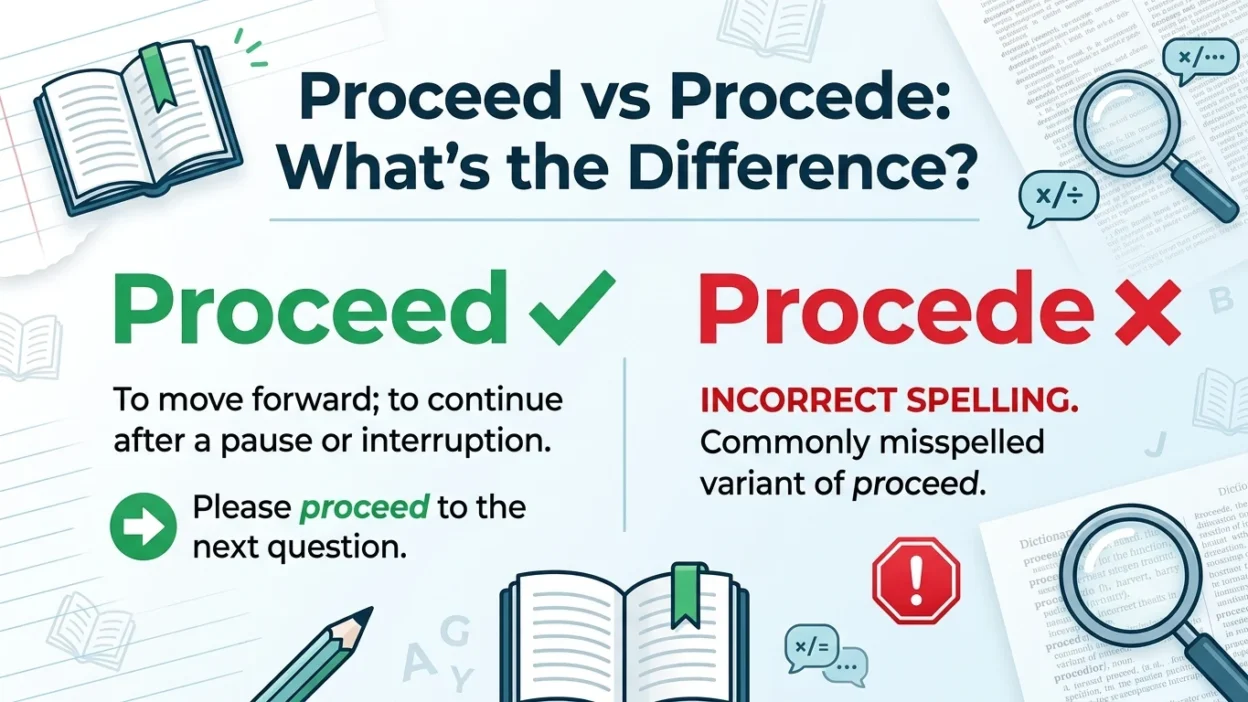
Quick Answer
- ✅ Proceed is the correct English word.
- ❌ Procede is considered a misspelling in modern English.
- Use proceed when you mean:
- Continue
- Move forward
- Go on with something
- Take the next step
- Avoid using procede in writing, emails, school work, or professional documents.
Example:
✅ Please proceed to the next page.
❌ Please procede to the next page.
Origin and Background
The word proceed comes from an older Latin word that meant “to move forward” or “go forth.”
Over time, the word entered English and kept the spelling proceed.
The double “e” at the end may look unusual, but it has been part of the standard spelling for a very long time.
The spelling procede sometimes appears because people write the word the way it sounds. Since many English words end with “-cede,” some writers mistakenly think procede should follow the same pattern.
However, modern English dictionaries recognize proceed as the correct spelling.
The Difference Between Proceed and Procede
The difference is actually very easy.
Proceed
Proceed is a real English word.
It means:
- To continue
- To move forward
- To carry on
- To take the next action
Examples:
- You may proceed with your presentation.
- After lunch, we will proceed with the meeting.
- The driver proceeded carefully down the road.
- Please proceed to the checkout counter.
Procede
Procede is generally not accepted as a standard English word.
In most situations, it is simply a spelling mistake of proceed.
Examples:
❌ We can procede with the project.
❌ Please procede to the next step.
These sentences should use proceed instead.
The Simple Rule
If you want to say continue or move forward, always use proceed.
Proceed vs Procede Comparison Table
| Feature | Proceed | Procede |
| Correct English spelling | ✅ Yes | ❌ No |
| Found in standard dictionaries | ✅ Yes | ❌ No |
| Means continue or move forward | ✅ Yes | ❌ No |
| Appropriate for school writing | ✅ Yes | ❌ No |
| Appropriate for business writing | ✅ Yes | ❌ No |
| Common spelling mistake | ❌ No | ✅ Yes |
| Recommended to use | ✅ Always | ❌ Never |
Which One Should You Use and When?
The answer is simple:
Use “Proceed” Every Time
Whenever you want to express the idea of continuing or moving forward, use proceed.
Common Situations
In School
- Proceed to question five.
- Students may proceed with the experiment.
At Work
- We will proceed with the plan.
- Management decided to proceed with the project.
In Travel
- Passengers may proceed to Gate 12.
- Please proceed through security.
In Daily Conversations
- Let’s proceed carefully.
- We can proceed after dinner.
Do Not Use “Procede”
Even if it looks correct, it is not the accepted spelling.
Common Mistakes People Make
Many learners make similar errors when using this word.
Mistake 1: Dropping One “E”
❌ Procede
✅ Proceed
People often forget that the correct spelling contains two “e” letters near the end.
Mistake 2: Writing the Word Based on Sound
English spelling is not always the same as pronunciation.
Some people hear the word and write:
❌ Procede
Instead of:
✅ Proceed
Mistake 3: Confusing It With Other Words
Words such as:
- concede
- precede
- recede
end with -cede.
Because of this pattern, writers sometimes assume proceed should also end with -cede.
But English does not always follow one simple rule.
Mistake 4: Not Using Spell Check
Many spelling errors happen because people type quickly and do not review their work before sending it.
Everyday Real Life Examples
Emails
Correct:
- Please proceed with the order.
- You may proceed once approval is received.
- We can proceed with the payment tomorrow.
Incorrect:
- Please procede with the order.
- We can procede tomorrow.
News
Correct:
- The company will proceed with construction.
- Officials decided to proceed with the investigation.
Incorrect:
- The company will procede with construction.
Social Media
Correct:
- Let’s proceed and see what happens.
- Ready to proceed with the challenge?
Incorrect:
- Let’s procede and see what happens.
Daily Use
Correct:
- You can proceed now.
- Shall we proceed?
- Please proceed carefully.
- We proceeded to the next room.
Incorrect:
- You can procede now.
- Shall we procede?
Learning Tips for Students and Beginners
Remembering the correct spelling can be easy if you use a few simple tricks.
Tip 1: Remember the Double “E”
Think of the ending:
proceed
Notice the two “e” letters.
This can help you remember the correct form.
Tip 2: Connect It With “Continue”
Whenever you think of the word continue, think of proceed.
Both words express the idea of moving forward.
Tip 3: Read It Often
The more you see the correct spelling, the easier it becomes to remember.
Tip 4: Practice Writing Sentences
Try writing:
- I will proceed with my homework.
- We can proceed after lunch.
- Please proceed to the next chapter.
Practice helps the spelling stay in your memory.
Tip 5: Check Before Sending
Before sending emails, assignments, or messages, quickly check whether you wrote proceed correctly.
Frequently Asked Questions (FAQ)
Is “procede” a real English word?
No. In modern English, procede is generally considered a misspelling of proceed.
Which spelling is correct: proceed or procede?
Proceed is the correct spelling.
What does proceed mean?
It means to continue, move forward, or take the next step.
Can I use procede in formal writing?
No. You should use proceed in all formal and informal writing.
Why do people write procede?
Many people write it by mistake because it sounds similar and resembles words ending in -cede.
Is proceed used in business English?
Yes. It is very common in workplaces, meetings, reports, and professional communication.
Example:
“We will proceed with the proposal.”
How can I remember the correct spelling?
Remember that proceed contains two “e” letters near the end:
proc-ee-d
Is proceed a verb?
Yes. Proceed is a verb because it describes an action such as continuing or moving forward.
Conclusion
The difference between proceed and procede is simple. Proceed is the correct English word and should be used whenever you want to express the idea of continuing, moving forward, or taking the next step. Procede is generally a spelling mistake and should be avoided in school assignments, emails, business documents, and everyday writing.
A good rule to remember is: if you mean continue, always write proceed. Once you remember the double “e” spelling, the confusion usually disappears.

David William is a language enthusiast, researcher, and content creator at Lingoveb. With a deep passion for words, meanings, and global communication, he focuses on making language simple, clear, and accessible for readers around the world.